
The elections for the representatives of the 17th Lok Sabha or the lower house of the Indian Parliament is underway. The Indian parliament election is one of unprecedented scale as over 900 million people are eligible to vote. It is a load test to any electoral process. As with most elections, emotions are running high, polarisation is immense and everyone is projecting a doomsday result if the other party gets elected. As a person who truly hates both the parties, I find it extremely laughable. There will be no significant difference in outcome irrespective of which party comes to power. I will explain the reasons during the course of this blog.
The two coalitions
There are two major coalitions which are fighting the elections. One is the incumbent National Democratic Alliance (NDA) led by Bharathiya Janatha Party (BJP) and the other one is the United Progressive Alliance (UPA) led by Indian National Congress (INC). I want to table a brief introduction about both these coalitions.
| Name | National Democratic Alliance (NDA) | United Progressive Alliance (UPA) |
| Main Party | Bharathiya Janatha Party (BJP) | Indian National Congress (INC). |
| Leader | Narendra Modi | Rahul Gandhi |
| Last election performance (272 needed for a majority) | 282 seats | 44 seats |
| How followers see the leader |
|
|
| How opponents see the leader |
|
|
| My view of their leader |
|
|
As far as the corruption and number of criminal cases go, both these parties are exactly the same. So, there isn’t much difference there.
Key performance
I want to look at some key performance indicators. I want to look at this in terms of the party in power and the resultant impact. I do not want to assess the validity of the parameters or the absolute performance of the country. I want to measure the performance relative to the party in power. The data for these have come from the World Bank, OECD and Indian government sites.
| From | To | Coalition(Party) |
| 19-Mar-98 | 22-May-04 | NDA (BJP) |
| 22-May-04 | 26-May-14 | UPA (INC) |
| 26-May-14 | till date | NDA (BJP) |
Financial Indicators
The GDP of India has been constantly rising since 1998. The growth rate though has been up and down. In a mixed economy dependent on both exports and huge internal consumption, a balance of inflation and geopolitical reasons will impact short term growth rate. What is also significant is that the debt/GDP ratio has been coming down since 2002. The Ten years of UPA and 6 years of BJP have had no impact on these financial indicators.

Economic indicators
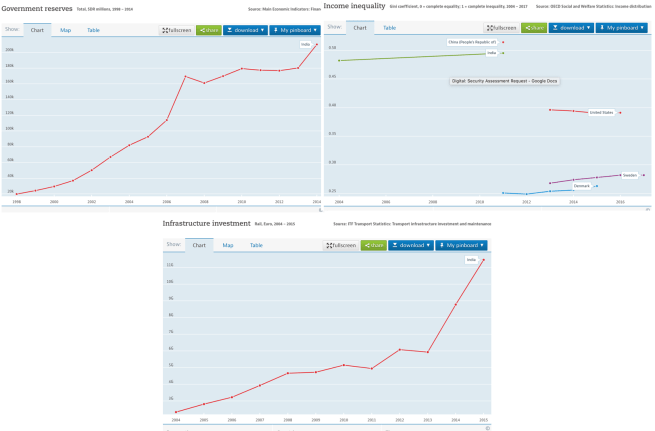
I have got three main indicators of the economic health of a country. They are savings, distribution and investment. Here is the reason I have these indicators.
- Savings: Does this country have enough assets to handle emergency situations?
- Distribution: Has the economic model resulted in the growth of the whole population?
- Investment: What is the focus on future generation?
Based on these, there is again very little difference between the parties with a reserve and income inequality. There is however a big difference as far as investment in infrastructure is concerned. The NDA government led by Modi has made a lot of investment in their tenure.
Social & Environment indicators
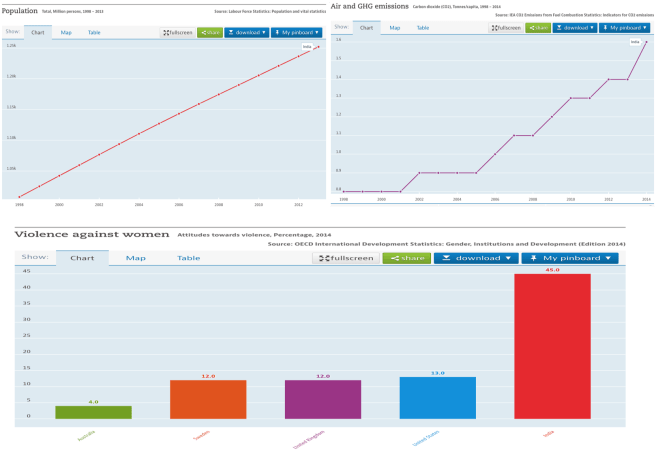
The next set of indicators are to do with social and environmental performance. The population is important as there is no point if the population grows faster than the GDP.
The population of India has been rising constantly for decades now. Through the number has been steadily increasing, the rate has been falling. The next one if the emissions caused. The CO2 emissions number in India has also increased over the period although the per capita emission has almost been constant.
The last one I want to highlight is violence against women. I do not have a trend chart for this but a comparison against most other nations show where India stands in this regard.
Domestic Considerations
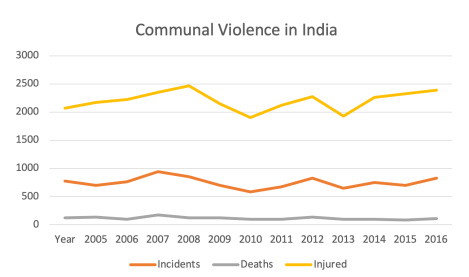
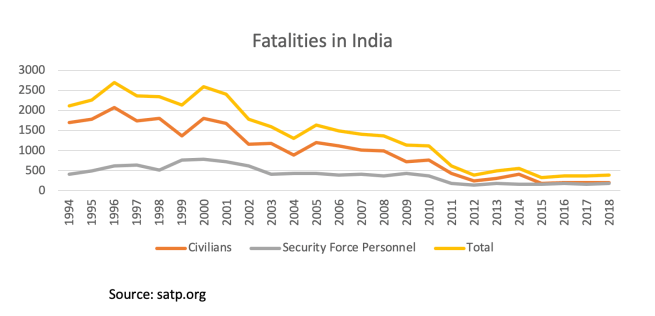
The NDA under BJP is claimed to be against minorities, stifling them of their freedom and instigating riots. The UPA under INC is accused of being soft on terror and crime. The statistics give a completely different picture. The number of incidents, deaths and injuries due to communal violence has almost been constant over the last 13 years. The fatalities to civilians have also seen a downward trend since 1998.
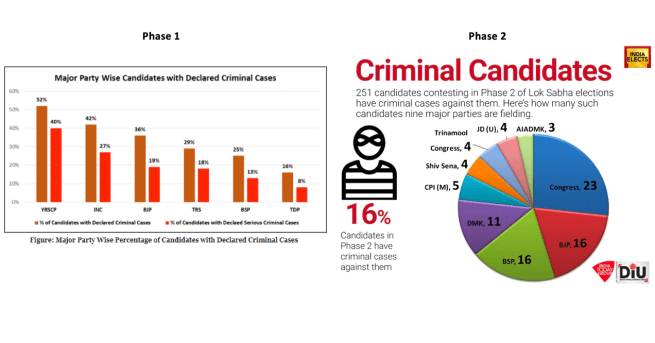
The number of people with criminal cases is almost the same in both parties. India Today magazine published the statistics on candidates who have criminal cases against them.
Other developmental policies
There are definitely some policies enacted by each government which focuses on development. Those policies would have benefitted a community or a region. Again each party has its set of feathers in their cap. The net effect of these is still the same.
Foreign Policy Considerations
The next item to consider is the difference in foreign policy. I want to split the foreign policy into zones.
The United States of America: No significant change. India continues to toe the line which the United States wants them. From Manmohan Singh to Narendra Modi, no one wants to disturb the peaceful settlement of abject surrender.
China: No significant change. India continues the tensed relationship with China. Apart from the odd Doklam issue and rejection to join the OROB bandwagon, India has hardly been able to have any influence on China.
Rest of BRICS: No change.
Pakistan: Both Narendra Modi and Manmohan Singh have tried to better relationship with Pakistan and both have ended not taking the relationship forward. The issue with the relationship continues to be volatile.
Middle East: One good aspect which has happened in the last 5 years is the improving relationship with Isreal. Other than the relationship has been one which ignores all the human rights violations for the sake of oil.
Iran: I can only find India’s relationship with Iran humorous. India has always had a good relationship with Iran. However, India hasn’t been able to capitalise it by setting up the oil and gas pipeline which they always wanted. Primarily, India doesn’t want to annoy the USA by publicly using its proximity to Iran.
South East Asia: No change
Europe: No change
Social Considerations
Secularism
India has no truly secular party. They have castist parties and religious parties. The only difference is which religion do they support. It is evident when you see the candidate from each party in a locality. It is always based on caste and religion.
Free Speech and Tolerance
There is no party in India which is tolerant and advocates free speech. From INC, BJP to the Communist parties, all of them have an extremist wing. They attack civilians and journalists who oppose them.
Journalistic freedom
While there have been claims of journalists being attacked during the BJP tenure, it is not unique to only one party. All parties have done that. The biggest attack on individual and journalistic freedom was the emergency period carried out by the INC government under Indira Gandhi. There were TV stations ransacked by the so-called secular, tolerant parties in different parts of the country. Journalists who have exposed corruption have always been attacked.
Conclusion
To conclude, in spite of the polarisation, there will be no significant difference between a Rahul Gandhi led UPA government and a Narendra Modi led NDA government. Both parties will do what benefits them and pander to their base. They have already created a system when nothing can significantly change. So, Indians can relax. It is not doomsday yet.
References
- OECD Data https://data.oecd.org
- India Today Magazine https://www.indiatoday.in
- World Bank Data https://data.worldbank.org

 Demystifying a skeptic's world