The evening with nothing at stake

“When you do dance, I wish you a wave o’ the sea, that you might ever do nothing but that.” Florizel to Perdita, The Winter’s Tale, Act IV Scene IV

My family was at a dance show. A very close friend of ours was performing. That was the reason we went. There was no other reason, and it took me not long to work out that the absence of a reason was the point.

Look at the last few months in our house and you will find nothing that was not work. The jobs. The move. My daughter’s tennis. Every hour was allocated to something with a result attached to it. Our happiness came from work. Our pressure came from work. When the source of your joy and the source of your strain are the same object, you have built something efficient and you have built something brittle. We did not notice. People in that state never do.

So we went to watch dancing. No score. No ranking. Nothing to be measured afterwards.

I want to set out five things in this post.

  1. What the evening actually was, and the distinction I think it turns on.
  2. What I saw on my daughter’s face, and why it took me by surprise.
  3. What a treatise worked out about audiences two thousand years before anyone was put in a scanner.
  4. What the research does and does not establish about dancing and about watching.
  5. Where I fall short of the standard I am about to set out.

Acknowledgements

Before the argument, the concessions.

I cannot dance. Not modestly, not badly. Not at all. Whatever I am about to say about the pleasure of watching is said by someone with no access to the pleasure of doing.

I have no expertise in neuroscience, and the studies I cite below are small, mostly conducted on Western undergraduates, and in several cases contradict each other. I will say where.

The performance I watched was amateur. Children and mothers, not a company. That matters, and I will come back to it, because almost nothing in the literature is about people like them.

And I am an anti theist writing approvingly about a text embedded in a devotional tradition. I am taking the aesthetics. I am leaving the temple, the priest and the caste order that carried the manuscript. The Natyashastra is a piece of thinking. It is not a reason to respect the apparatus that preserved it.

Expression against achievement

The pair at the centre of this is performance against achievement, and almost everyone blurs them.

My daughter performs on a tennis court. Every stroke is evidence, submitted for judgment, resolved into a number by the end of the afternoon. A woman on a stage in a suburban hall is also performing. Nothing she does resolves into a number. Nobody leaves knowing who won.

Both are called performance. They are opposite activities. One converts effort into a verdict. The other converts effort into expression and stops there. We have taken a word that once meant “to carry through” and let the corporate and sporting sense of it, performance as measured output, colonise the artistic sense entirely. When a parent says their child performs well, nobody thinks of a stage.

The evening had no outcome of significance. That is precisely why it did something to us that months of successful, outcome laden work had not.

What my daughter’s face gave away

My daughter smiled. That is the entire event.

Not a polite smile. Not the smile at the end of a match, which is a smile about a result and evaporates when the result is examined too closely. This was a face with nothing behind it. No friction. No calculation of what the smile would cost her if the next point went badly.

I looked at it and felt something closer to indictment than to joy. Because I could not remember when I had last seen it.

I hold that free will is an illusion, and this is one of the places where that view does real work rather than sitting decoratively in an argument. She did not decide to be free that evening. Nothing in her chose it. We had removed the conditions that were producing the friction, and the friction stopped. That is all. Which means the friction the rest of the time is not her character and not her attitude. It is our engineering. We built the environment that produces the guarded face, and we can dismantle it, and until that evening it had not occurred to me that it was ours to dismantle.

Blaming a child for a tight jaw is like blaming water for the shape of the glass.

Bhava and rasa, two thousand years early

The Natyashastra separates two things that English collapses into “emotion”.

Bhava is the state the performer enacts. Rasa is what arises in the person watching. They are not the same substance and the second is not a copy of the first. The theory is explicit that the spectator is not a receiver: the rasa experience is co created between performer and an audience capable of receptivity, and the word for that audience member, sahrdaya, means one who has heart. The stated purpose of performance is catalytic. It provokes an emotion already present in the person watching.

Catalytic. That is the word I was missing.

I had wanted to say that the fun in the room was not conserved, that it multiplied instead of being divided. That is a nice line and it is bad physics, and someone would have told me so in the comments. Fun is not a conserved quantity because it is not a quantity. The honest description is catalysis. The dancer does not transfer joy to me. She lowers the activation energy for something that was already sitting in me, unreacted, since the last time I let it move.

The mothers on that stage were not giving me anything. They were making it cheap for me to feel what I had been too busy to feel.

What the evidence shows

Here is the part where I have to be careful, because this material is quoted badly everywhere.

The strongest finding is not about watching at all. It is about moving in synchrony with other people. Tarr, Launay, Cohen and Dunbar separated exertion from synchrony in a single design and found that each independently raised pain threshold, used as a proxy for endorphin release, and each independently raised reported bonding. The replication sharpened it: people who danced in synchrony showed elevated pain thresholds, while partial synchrony and asynchrony produced no analgesic effect at all.

Then they tested the mechanism by breaking it. Strangers danced in synchrony after receiving either a placebo or naltrexone, which blocks opioid receptors, with neither the participants nor the researchers knowing which. The naltrexone group showed significantly increased pain sensitivity. Block the opioid system and the effect disappears. That is as close to a demonstrated mechanism as this field offers.

For watching rather than doing, there is one good experiment. Dunbar and colleagues found that people who watched an emotionally arousing film had higher pain thresholds and a greater sense of group bonding than people who watched a neutral one.

ClaimWhat it rests on
Dancing in synchrony triggers endorphin releaseReplicated, and confirmed by blocking the receptors
Dancing in synchrony makes people feel closerEstablished, but self reported
Dancing in synchrony makes people behave betterTested in an economic game and not found
Dance improves balance and motor symptoms in Parkinson’sSixteen randomised trials, 636 participants, moderate quality
Dance therapy reduces depression and anxietySmall and consistent in the tighter subset, d = 0.30
Watching arousing performance raises pain thresholdOne good experiment, on film rather than live dance
Mirror neurons explain why audiences feel itContested, and weaker than the popular accounts admit
Dancing cuts dementia risk by 76 percentNot supported at anything like that strength

Two of those rows deserve their own paragraph, because they are the rows where people I am otherwise aligned with are cheating.

The 76 percent figure appears in newspapers as recently as this January. It comes from a cohort study of 469 people over 75, followed for a median of 5.1 years, in which the hazard ratio for physical activity was exactly 1.00. The 76 percent is not in the paper. It comes from a dance instructor’s summary of a frequency table, and it survives because everybody wants it to be true. It also has an obvious problem that nobody quoting it mentions: people in the early years of dementia stop going out dancing. The arrow may well point the other way.

The mirror neuron story is the second. Hickok’s critique is that there is no monkey data directly testing the action understanding theory, and that the missing evidence is any demonstration that damaging the system causes deficits in understanding. He does not deny the cells exist. He denies the leap. The sentence “mirror neurons make us feel the dance” is not a finding. It is a press release with a paper stapled to it.

What the evidence does not show

My central question was why people who cannot dance feel released watching people who can. The literature has failed, so far, to answer it, and has failed in an interesting direction.

Calvo-Merino and colleagues scanned ballet dancers, capoeira dancers and non dancers. Expert dancers showed greater activation in premotor cortex and related regions when watching movements they were trained to perform than movements they were not. On that finding, I should get less from watching, not more.

Cross and colleagues found close to the opposite. People with no dance training showed stronger parietal engagement for movements they rated as both highly enjoyable to watch and extremely difficult to reproduce. Other studies find liking tracks how well people believe they could reproduce a movement.

So the field has good evidence that we like what we can do and good evidence that we like what we cannot. Nobody has resolved it. I find this more useful than a clean answer would have been, because the clean answer would have been imported from somewhere and would have been wrong.

There is a larger absence. Almost every study here uses professionals, undergraduates in laboratories, or clinical populations. What I actually watched was mothers and children of mixed ability performing in front of an audience that knows them personally. The mothers dancing are not in the data. The single most common form of live performance on earth, the amateur recital in a local hall, is close to unstudied.

And group dance appears in every human culture that has been looked at. The endogenous opioid system it runs on is shared with other primates and predates our species by a long way. Whatever happened in that hall was old before there was anyone to write it down, and the research literature on it is forty years deep and mostly conducted on people who signed up for course credit.

What I did with it

Here is where I fail my own standard, and it is worse than usual.

I went to an evening chosen specifically because it had no outcome. I sat there and watched people do something with no result attached. And within about seventy two hours I had turned it into a research project, a reading list, an argument about a misquoted statistic, and this post. I converted the one thing in months that was not work into work. That is not a charming irony. That is the exact pathology the evening was supposed to interrupt, reasserting itself immediately and using the evening as raw material.

I do not think I know how to stop doing that. I am not going to end on a line about learning to be present, because I have not learnt it and I would be lying to you in the last paragraph of an essay about being honest.

What I can say is smaller. Somebody else’s daughter, mother, wife, sister had practised for months for an evening that produced what we saw, and my daughter’s face changed because of it. The people who make that possible are not compensated in anything I can measure, which is the whole point and also the reason the rest of us keep failing to value it properly. I am grateful to them. I am aware that gratitude expressed in an essay is the cheapest form available, and that the more useful response would have been to show a form of patronage. Hopefully, that day will come too.

References

Ajatashatru, son of Bimbisara

“What will happen to you if I don’t spend time with you?”, I asked my daughter a few weeks back.

The narcissist in me was thinking of how much time and effort I was spending with my daughter, taking her to classes, teacher her, training with her. I wanted her to acknowledge the effort. I wanted her to be grateful. In a moment of reflection, I realised how very unbecoming was my wish. It was not for my daughter to learn but for me to feel acknowledged. I was reminded of the story of Ajatashatru that I read as a child. The story has always been with me for two reasons. I want to share both here.

Ajatashatru was the king of Magadha who is believed to have lived in 450 BC, right at the same time as Gautama Buddha. As a teenager he imprisoned his father, King Bimbisara and forcefully took over him kingdom. He has massive expansionist ambitions. In a few months, he ordered for the execution of his father. Months later, his uncle Presenajit, the king of Kosala waged a war on him to avenge the death of his friend and the husband of his sister, Bimbisara. During the war, Ajatashatru confessed told him the story.

“The day I ordered execution of my father, I had a child of my own. I lifted the baby and realise the love a father has for his children. I realised the sacrifices a father is ready to make for his children. I didn’t want my father executed anymore. I rushed but by then my orders were already carried out. I am unable to live in peace from then on. I couldn’t go back to the same palace. I moved the capital from Rajgriha to Champa to stay away from the memories. I am haunted by these memories.

I have never felt at peace ever since. I keep waging wars as it distracts me from those memories. “

Firstly, the story stuck with me for how sons never realise the sacrifices of their father till they become one. Then they expect their children to be grateful without ever showing the same to their father. The second one was how mistakes haunt people and the coping mechanisms one takes. I want to talk more about the former in this post.

Coming back to my present, as I started reflecting on the story. I started thinking of the sacrifices my father has made for us. He could have very comfortable life, if he didn’t sacrifice as much. As I just pondered over my childhood, I was filled with gratitude.

  1. As a computer science and mathematics graduate, he could have easily got a job in many parts of the world, which meant he won’t be able to take care of his parents. He sacrificed his career for them.
  2. To ensure, we have a place, he invested everything he can to buy a house. For the next 15 years, he didn’t buy anything for himself from clothes to shoes.
  3. He was a diabetic but he worked three and sometimes 4 jobs to ensure our family can afford everything. Today, we talk about working on weekends like some sort of sacrifice. From my memory, he worked a single day job, 2 separate evening jobs, a weekend job and used to run private tuitions. Being tired was a luxury he couldn’t afford. He didn’t have anyone to complain about his situation.
  4. He travelled a lot on a scooter, which in those poor roads had the same impact on one’s hand like drilling concrete. His schedule on an average day was
    • Wake up at 4 – 4:30
    • Help getting things ready for all of us
    • Drop me and my sister to school at 7:30
    • Go to work
    • Come back from work at 3:00, pick us up from school
    • Go to his next job
    • Come back at 8:00 pm
    • Have dinner and continue the next day
  5. Even after doing all this for the first 1.5 decades of my life, I never saw him do anything for himself.

I was comparing my situation. I drive air conditioned cars. I can afford to buy more than what I need. I have more than what I deserve. I can take off anytime I want. My father topped the state in HSC but couldn’t afford to get application form for engineering. He had to top the university every year, so that he can study the next. He lived in a home because my grandparents couldn’t afford food while he studied school. I was an average student, who was sent to UK to do an MBA. The luxuries in my life today are purely a function of the sacrificed made by my parents.

Well, if I want my daughter needs to be grateful, then what should I do? Actually, I want her to be grateful not to me but to her grandfather. As a first step, I decided to stop talking about myself but instead about the sacrifices her grand father. I want her to be grateful for the life we do today. That was my Ajatashatru – Bimbisara moment.

To be needed, respected or liked: How we got the priorities wrong?

We are what we aspire. People like us when they find us agreeable, enjoyable and satisfactory. People respect us when they feel deep admiration for our abilities, qualities or achievements. People need us if they require us because it is essential or every important. If I were to prioritise them, I would always want to be needed. To be needed, it requires one to be both talented and critical. However, in the corporate world today, not being liked hurts people the most, while being in a position of needed but not liked is considered the worst. I do agree that not being needed or liked can be the worst. I want to break this reflection of mine to a set of topics, starting with the importance of this idea.

Why is this discussion important?

The professional world has moved from infancy to insanity with no stops in between. For people like me who watched the horrors of professional exploitation of individuals from both the owners and unions, it is hard to make sense of the trigger. I remember in early 1990s and 2000s, there were two different kinds of industries. The first one was where, business owners would treat professionals poorly as long as possible. They will need your talent and the best way to retain your talent is by entrapment. The second type was one where unions held professionals to ransom. They ensure that one’s ability was never rewarded on par with their contribution. Any one trying to challenge this was a traitor.

If I look at the professional world now, individuals are forced to be acceptable and likeable. There is a high chance that people will be reprimanded for having opinions, saying uncomfortable truth or on set of arbitary guidelines set to constraint oneself. Unions are few and far these days. We have moved from being entrapped for exploitation to entrapped on social norms, professionalism and conformism. It has killed originality to such an extent that we look at people like Elon Musk as some form eccentric.

What is the impact?

People with power always find ways to retain it for their lineage. Historically, they have found ways to achieve this through religion, slavery, controlling knowledge, fear of law and if nothing works then violence. These rules eventually meant that there is a group that orders and there is a much larger group that executes. It also prevented the group that executes from ever switch sides to group that orders. In the modern corporate world, these rules have been eliminated. People are free to learn, legal system has evolved and threat of violence isn’t much of an option. How do we therefore ensure distribution? People have done it changing the dymanic of the game itself.

  1. A person who is knowledgeable and needed cannot be let go
  2. A person who is knowledgeable and needed will not care of medicrisy
  3. A person who is knowledgeable and needed will not worry about telling the truth

Businesses have started to distribute knowledge to ensure dispensability. The rules have been formed to force people to believe that being likeable is more important that being needed. I have not seen a HR rulebook or ethics code where it clearly says, one can tell uncomfortable truth or one cannot be fired if their truth hurt or being right is more important that being fair. However, I have read enough books which force me to never hurt sentiments, apologise even if I am right and above all be respectful for feelings. Entropy on of the most crucial phenomenon in Thermodynamics and equilibrium is rooted in disorder. Employees are forced and have subsequently been brainwashed to execute. This starts from an associate and goes all the way to the CEO. As a result of this dynamic, we have created a world where dispensability thrives.

My prediction

While I may not consider myself a socialist anymore, the concept of materialistic conception of history continue to hold true even after centuries. While the tools of oppression might have been different across societies, the existence of oppression has been constant till date. There are three classes globally, oppressor, oppressed and free. While the free may look enlightened in general, it is only a subset of people who are knowledgeable, have broken the shackles and have found no need to oppress anyone. I am still in the camp that free will is an illusion. People who want to break the shackles will always break it. They will prioritise wisdom over adulation and respect. They won’t toe the social lines or bother about the impact of it. They know that society needs them. The rest will keep oppressing and getting oppressed.

Breaking shackles

The key to breaking free from the chains of subjugation is to release oneself from the pleasure of adulation. When we fall for praise, we tend to enjoy being liked. When we enjoy being liked, it is hard to state truth. The second step in this is to focus on gaining knowledge through critical thinking. Finally, obedience and loyalty are good for masters and not for people who want to be independent. We are 1/2 a chromosome away from a chimpanzee. To expect more from humans is just as ridiculous like asking a chimpanzee why it can’t add two numbers. We have one life. It is paramount to live it free.

My tryst with anxiety – V: The remnants

“You will suffer from PTSD for years to come,” my doctor said two years back.

PTSD is one of those phenomena which is commonly used, expressed in terms of symptoms but the truth is always concealed. Like the famous comedy routine of George Carlin, the pain is covered in the jargon. When you go through it doesn’t feel like the trauma is post. It feels present. It has been over two years, and I am out of medication but the remnants of the period still remain. I have laughed off all the physical impact but once in a while, I relive the pain. Otherwise back to my physical and mental strength, I want to share one (hopefully) final post on the experience.

For the lucky people who have never experienced this, I have an analogy to explain. Imagine you are forty years old and living in 2024. Your eyes see electric cars, tall buildings, smartphones, and heavy traffic. Your brain makes you believe, you are a child in the middle of an old town in 1985. There is a massive dissonance between what you need to experience to what you do. This isn’t post-trauma. This is a different form of trauma, one where the reality is distorted by your experience. Another and something more personal to me is what a victim feels when confronted with their abuser even after years. The abuser could be a frail shadow of the past and the victim is no more a child but a more powerful person. However, the shiver down the spine that sends a signal of helplessness that you felt during those wretched times can never be explained.

The purpose of this post isn’t to garner sympathy or bask in victimhood. Having gone through this twice in my life, first as a teenager and second as an adult, I can’t stop myself from comparing and coming up with coping mechanisms. The trigger for this post was an innocus catchup I had with one of my office mates from the past. we shared a few laughs and discussed about the happenings. I came home and felt a sense of drain, doom and gloom. The calendar said 2024 and my body was reacting like Dec 2022, immersed in anxiety.

No shame in abnormality

You feel weak, your heart races, you are nervous about the situation that rest of them feel normal. You don’t want to show the weakness to anyone else as you feel ashamed of the abnormal reaction. I have continuously reinforced myself that the physiological manifestations of my emotional pain doesn’t need external gratification. I feel what I feel and I am secure about it. If I feel ashamed to exhbit what I feel is a sign of weakness then I won’t. I would rather keep my sanity with that pretence.

Safety is key

These are times where you feel the need to share. As a child, it is hard to express because you lack words. As an adult, it is hard to express because you fear judgement and ridicule. You can’t share it with closed ones as they will continue to get hurt. You can’t share it with distant ones because you fear information leakage. A therapist becomes your best anonymous companion. If you can’t then find a friend who can be your support buddy. If nothing works, then imaginary discussions to yourself isn’t bad either. Talking to oneself is one of the safest ways to express.

Sleep

A good night’s sleep does wonders. The natural circadian rhythm for cortisol ensures that it is least at midnight. Hitting the bed early and getting a wonderful sleep helps regulate the anxiety caused by PTSD. Personally, it refreshes my brain to start all over again but this time more clearly.

Stay away

Advices like “Confront your abuser” or “Face your fears” are great for normal situations. When you are having PTSD, you don’t need to confront your abuser or face the trauma again. You need time to recover. If staying away is the best way to deal with the situation, then it is perfectly acceptable to stay away from the abuser or the environment that resulted in the trauma.

“Stop being jealous”- The remark that got me thinking

I am an assured, candid, egoist who bulldozes people to get his point through. The part assured was always key for me as that was the one that enabled me to be candid. That made me stand up and accept that if I walk into a room of 100 random people, I have a zero chance of being in the top 20% of smart people. What I lack in terms of IQ, I try to compensate with my work ethic. This acknowledgment also led me to want to keep learning more and admire people who are way smarter than me. The quote I was able to relate to the most was from Will Smith when he said in an interview, “If we get on a treadmill together, you’re going to get off first, Or I’m going to die.” Why am I saying this now? Recently, I had an exchange with a friend who I trust and respect who said, “Stop being jealous. Reflect on the last time you praised someone wholeheartedly.” While my response to her was one of petulance and denial, I wasn’t able to stop thinking about it. Why did that assertion bother me? What connotation did I have for the adjective jealous? What should I learn from this about myself? I felt the best tribute I could give my friend was to be candid about my reflections. Since, this post is a product of reflection, I will use the pronoun I more than any other.

The clear dichotomy between Jealousy and Envy

In a strict collochial usage, I tend to use the words envy and jealousy quite interchangeably, while always considering the meaning of the former. While, I would have been able to define them when questioned, I never used or understood the usage of those words in the context of what they meant. Jealousy is when one feels threatened that someone will take away something one has. It leads to anxiety, fear and sometime rage. Envy is a feeling of discontent or covetousness with regard to someone’s advantages, success or possessions. When Aristotle can explain the difference, I want to use it.

Jealousy is both reasonable and belongs to reasonable men, while envy is base and belongs to the base, for the one makes himself get good things by jealousy, while the other does not allow his neighbour to have them through envy.

Aristotle

My priced possessions include the handful of decent relationships I have built in my life and my ability to think. While the former has a shelf life that depends on how quickly I drive people away, the latter will fade away with age.

So, am I jealous? Of course, I am. I am jealous when my priced possessions get taken away. The way I deal with the loss, is by allowing my ego to take over. The ego which somehow convinces me that I am much more than that relationship or ability.

Am I envious of anyone? Of couse, I am. I envy people who are at the level of smartness that I can never reach. I also respect and admire people whom I envy. I can never be them.

Assured about my insecurity

I am extremely assured and secure in my world of insecurity. I live my life in a way that I have never felt secure in what I know or behaved. Like Alan Watts famously summarises in his philosophical magnum opus ‘The Wisdom of Insecurity’, I have to admit that I am insecure about everything I know and possess. Insecurity like jealousy, can have a negative connotation and when combined can even sound dangerous. The truth however like many other aspects is in the context. It is what is the insecurity about, our acceptance of the insecurity and how we deal with it.

The more we try to live in the world of words, the more we feel isolated and alone, the more all the joy and liveliness of things is exchanged for mere certainty and security. On the other hand, the more we are forced to admit that we actually live in the real world, the more we feel ignorant, uncertain, and insecure about everything.

The Wisdom of Insecurity by Alan Watts

Am I insecure about my work? Of course, I am. I know and acknowledge that I am surrounded by people who are not just smarter than me but also have achieved more than I could ever imagine. The only way I can understand a concept is by simplfying it to the ability my brain can process. So, when I explain it to others, it almost become natural for me to down play and make the work sound simple.

My two key learning

I started this post by mentioning about reflection and learning. I will be damned if I don’t share the two points I have learned in the process of this reflection. The only way to respect the person who trusts you to give the feedback is by reflecting and acting on those.

Downgrading my one work, down grades every one who has done the work

As I mentioned, my natural tendency while trying to explain to others any topic, even if it excites me a lot is by down playing it. For example, I love financial modelling. I get excited when I do it. However, I have many times said, “this is nothing, I just did it over a day.” While in my mind, it was an expression of discomfort and insecurity, it expresses two unintended messages.

  1. Demeans the work itself: There are people who do it and do it way better than I do. By articulating the way I do, I am in many ways demeaning their work.
  2. Projects condosension: There are people who are trying to understand it just as the way I did. By expressing the way I do, I make it sound like this is nothing special for me and if it is for you then somehow you are not at my level.

Need not reserve praise for people who do better than oneself

I have never hesitated to admire and praise people who are smarter. In this process, I also miss out acknowledging one’s who are in the process of learning like I am. My ability to quickly dismiss has made me who I am as a person. I have to work on adding an additional parameter to the dismissal criteria.

Neither of the two I have mentioned above are going to easy to change. To be honest, I don’t even know how to change. In typical Froydian analysis, these are my ids. I am also too egoistic to say, I cannot change.

My tryst with anxiety – IV: The tribute

Continuing from My trust with anxiety – III: The redress

The path to recovery from any illness cannot be one of solitude. I spent many days in a pensive mood, trying to unravel the happenings. A key aspect of the entire process was the support from my loved ones. It includes family and a close bunch of friends. I will not name anyone here, as people in that group know about it. I want to share the value of the support and my tribute to all of them.

One striking change in my perception of my ability was the need for approval. I continuously felt the need for acceptance and acknowledgement akin to a child. While I can comfortably say that I am over that stage, I am incredibly grateful that I got the necessary support. For a person who thrived on hatred, I wanted appreciation and affection. It isn’t easy for people who were on the receiving end of this.

I want to present a tribute to everyone who supported me.

Arrogant was I, with a penchant for candour,
breezing through life and dreaming of valour.
Blessed was my state, rare if any in aught,
the slip from grace was rapid and fraught,
Senses went grave, meandering through the dark,
Gripped by angst, my fall was quite stark,
“What next?” I wondered, devoid of pleasure,
Bleak felt my future, having lost the treasure.
“What is left of life sans glee?” I murmured,
Alas! I felt thy hand of kinship, totally undeserved,
sharing my agony, bearing through kind and sober,
ebbing and flowing with me, never asking a favour,
what pleasure do I owe, for all thy grace,
so profound was the love I felt in thy embrace,
I beseech thee to ne’er keep me at bay,
for I owe you more than words ever convey.

A sincere thanks to my family, friends and doctors.

My tryst with anxiety – III: The redress

Continuing from My tryst with anxiety – II : The fall

Elisabeth Kübler-Ross came up with the five stage model for grief: denial, anger, bargaining, depression and acceptance. If I had to adapt that model for my state, I had already crossed the first four. The issue was the final hurdle from depression to acceptance. As Sam Harris says, Free Will is an illusion. Once we form a habit, it is going to be hard to unlearn. Our brain takes over and triggers action way before we can ascertain the implications of the action. I couldn’t imagine a world I won’t be able to bulldoze the issues at work. I could feel the cortisol imbalance in my system. I walked into the therapy, hoping my problem was physiological and not psychological. My bigger want was a mean reversal back to my previous state.

My first session with the psychologist was a revelation. Once I sat down in front of the psychologist, I kept my bias aside. I wanted to give therapy a chance. I spoke for close to two hours. I shared my issues honestly. I opened up about my insecurities. I relived every incident from the previous six months. It left me in a battered state, completely drained and devoid of any energy. 

The fortnight following the first session was comfortably the hardest. It coincided with the Christmas break, leaving me with very little official work to do. I felt exhausted and started sleeping at odd times. Interactions with people were still hard. As expected from a person of my ego, I managed to hide it from everyone except a select few. 

Fast forward a couple of weeks, I was already at work. I had overestimated my recovery. In less than a week, I realised that I had no energy left to continue and needed a longer break from work. For starters, I took four weeks of leave. Little did I know that I wasn’t going back to work in the same place again. 

In line with Freud’s psychoanalytic theory, my id was to take a battle head-on. The super-ego which had to instruct me about self-preservation doesn’t exist at all. What followed were cycles of ebb and flow on the path to recovery. I never really got my head out of the issues at work. As I mentioned in my first blog of this series, I have an addictive personality. My two addictions were:

  1. My close circle of people I care
  2. My work

My inability to get myself detached from the latter was affecting my relationship with the former. After every ebb, the fall was drastic and painful. Very soon, the situation hit an abyss. 

Something had to give in as my situation started to deteriorate rapidly, and the discussions at work started to get more apathetic and tense. After almost eight weeks of leave, I realised returning to the same setup wasn’t an option. I decided to quit and move on. The anxiety also hit its peak as I was prescribed medication to deal with the situation. 

Three weeks in, the medication started to take effect. I also began to disassociate myself from the job. The path to recovery had just started. My therapist told me that I am suffering from Post Traumatic Stress Disorder. Unfortunately, the damage has already been done. The road to recovery will take time and plenty of care. 

One year after this entire episode began, I am feeling close to my normal state. I am still on medication, but I haven’t had an episode of anxiety in close to 3 months. This traumatic experience has taught me how fragile my mind was, irrespective of what I thought. This recovery was possible mainly due to the support I received from my loved ones. 

My tryst with anxiety – II : The fall

Continuing from My tryst with anxiety – I : The background

The business world judges a person on their ability to handle pressure. I took pride in wanting the most painful engagements. I had a war complex, a desperate need to overcome adversity and deliver results. This pride eventually resulted in my fall. As a consultant, I expected poor behaviour and pressure, but the customer always loves excellent outcomes. The situation is the opposite if you are a business leader. One is bound to attract all the ugly elements of corporate culture as they show positive outcomes. We must deal with insecurities, political backstabbing, nepotism and dishonesty in our organisation. I failed to recognise it.

As pressure mounted at work, sleep started to elude me slowly. Leaving my wife and daughter in one bedroom, I confined myself to another. Social interactions began to consume more energy than usual. It left me drained and battered at the end of the day. I asked my wife to not speak to me and instead text me if she needed anything. I spent 20 hours a day in a single room without interacting with my family. Isolation from face-to-face interactions and immersion in work were my drug as I felt increasingly petulant each day.

Anxiety is the worry of losing something which one considers precious. I started developing palpitations a few times a day. At first, I attributed a cause to each of these incidents. Being locked in a room was a good excuse for me to hide this state from my family. As the country was in lockdown, there was no need for me to step out. The duration and frequency of these started to increase slowly. I am still unsure if the anxiety caused the palpitations or vice versa. However, every time I felt a deep sense of loss. The insecurities in my life slowly started to come to the forefront. Questions like “why will my wife continue with me?”, “why will my daughter like me?”, “why will my friend continue to talk to me?” and “what value am I adding to work?” started to haunt me.

Confidence is the most underrated virtue. We don’t realise the value of it till we lose it. I was a person with immense confidence in my abilities and total disregard for my shortcomings. In short, prior to this episode, I was highly assured. I failed to identify the attacks happening at work. The deviousness of the character assassination and lack of atonement made it worse. I didn’t recognise that the support I sought was part of the problem. The senior leaders whom I trusted turned out to be callous. This inability to foresee affected my perception of myself and dented my confidence. I slowly lost the sense of who I was and what I could do.

Self can’t be an illusion when one is depressed. Lack of sleep, anxiety attacks and loss of confidence left me in a state I hadn’t experienced. I had to admit the vulnerability of my mental health. I became a victim of my expectations. I couldn’t concede I was affected. I was too strong to end my life. I lay down every night, hoping I wouldn’t have to wake up. Every sunrise was a disappointment.

The worst happened sometime in December. Stress levels at work reached a new high. As a team, we celebrated our Christmas by having a Go Karting race. The rush of adrenaline during the race compounded the palpitations caused by my anxiety. I lost my ability to think sanely. I woke up every 10 seconds that night with a fear of loss. The next couple of days were horrendous. I was acting my fears out. The unpleasant feeling hit rock bottom when my wife saw me struggle to watch a movie with her.

Unable to stand my state, my wife confronted me and forced me to open up. I was also a person with biases against anything I perceived as irrational. One of my biases is the need for therapy. I always felt it was for the weak. While I appreciated psychology as a study, especially evolutionary psychology, I found the concept of seeking psychological help beneath me and never perceived myself in that state. Perception isn’t reality. Something had to change to arrest this downward spiral.

My tryst with anxiety – I : The background

Life is as fragile as it comes. The quarks in our body have survived 13.6 billion years to evolve into a conscious species which can think, feel, plan and act. Above all, it forms relationships with people and attachments. In July of 2021, if someone had asked me about my life, I would have categorically said it is as perfect as possible. Fast forward six months, I suffered from anxiety and depression at levels I had never encountered. The fall from perfection was rapid, especially for a person with no expectations from his life. If you compare my state with people in the war-torn areas, it does feel like a first world problem. As a person with a high ego who never thought I could ever need external support for my mental health, the last few months have been a big revelation. Randomness and entropy drive this universe and life. My solitary insignificant consciousness cannot be an exception to that rule. At the risk of sounding cliched, my life has come a full circle.

Every being is a summation of our evolutionary past and learnings from the time of birth. We are deterministic and like to seek answers to all questions. I am no different. I was born agnostic like every other child. I was fearful of consequences, anxious about unknowns and insecure about my value. The loneliness of these traits, coupled with some horrendous childhood trauma, made me the person I am known by people around me today. I am obnoxious, cynical, confident, brutally honest and an ergomaniac.

“On a treadmill, I either win, or I die”, Will Smith once said in an interview.

“A cynic is just a dead idealist”, said the famous comedian George Carlin.

These two quotes summarise my attitude roughly. The anxieties and insecurities were buried deep as I forgot to care about anything but the truth. Over the years, I also realised the two key pillars of my personality, addiction and ego. I get addicted to people and behaviours. My ego pulls me out when I realise the loss of control. This combination has kept me in check overall. It also meant I was keeping an eye on my attachments.

As the saying goes, the only way from the top is down. In July of 2021, my life was at its best. I was happy and content as lockdown hit Sydney. I immersed myself in my new role at work. I loved the job and found it quite gratifying. Unfortunately, life isn’t gambling. One can’t quit when they are high. The situation at work started to take a turn for the worse. Lockdown helped me as I lost track of time. As the work environment got toxic, I spent more time trying to compensate. In less than a month, my mind started to crumble without my knowledge. In a few months, I was suffering from a stress induced anxiety disorder.

The sexual abuse continues: My opinion

In the previous part, I shared the details of the grooming gangs in Pollachi. This racket has been running with the patronage and participation of people across political parties. However, in the aftermath of all these allegations, there are two unfortunately predictable social reactions.

  1. The girls are being blamed for not being modest enough. So, parents have taken control into their own hands by ordering curfew for their daughters.
  2. The marriage market has blacklisted girls from the Pollachi region.

When a society equates culture to more protection, reduction of liberties for just one gender then there is nothing that is going to significantly change. I look at this in a very simple fashion.

Any two individuals have the right to engage in a consensual sexual relationship.  When they do that it is a covenant between the two. There is no need for society to be involved unless they are impacted (eg. Extra marital relationships which the spouses don’t agree). Also, when one of the two breaks it by exposing the act without the permission of the other or threatens to do that then it should be a non-bailable offence.

The reality is people are going to have sexual relationships as it is innate to human desires. It is a function of hormones & opportunity. The issue of the force and lack of consent which makes the action reprehensible. This is where the law should come into the picture.

Two Key points to consider

The Rape Culture is pervasive

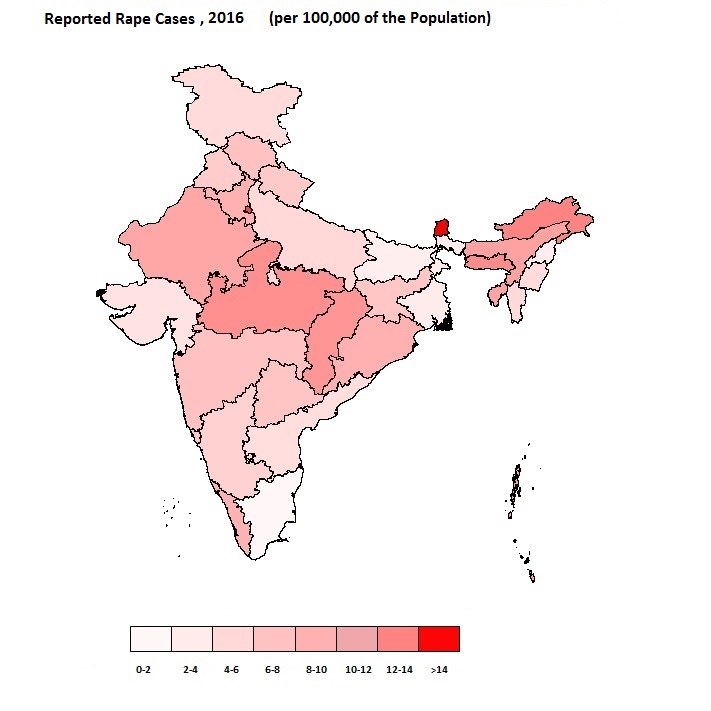
If one wants to look at the culture of rape, the NCRB data which only shows reported cases is a good indication.  Surprisingly when I started digging into the government records, there is no statistics after 2016. So, I have to analyse with 2016 data. The average for reporting cases seems to be around 10 for a population of 100,000. Though one rape is one too many, it can easily be dismissed as statistically insignificant. Let us break this down.

  • Population set size: 100,000
  • Approximate Number of Women @47% which is the India average): 47,000
  • Number of people within the age group of (15-55) 59% approx: 27,730
  • The probability of a person getting raped (assuming one person is not raped more than once) during that period: 1.5%

Now with a probability of 1.5% of a woman getting raped during her life and reporting the same, one has to acknowledge the culture of rape. Again, I have to stress this is only reported cases. Most of them go unreported as people are scared of social repercussions.

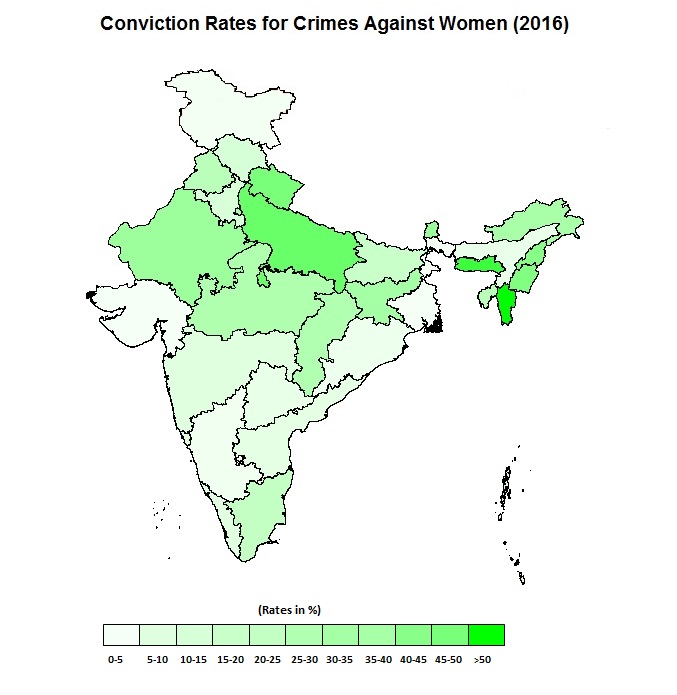
NCRB-Rape ReportedConviction

NCRB-Reported Cases Trend

What is worse in this is the conviction rate for rapes are extremely low. This is not to say the rape didn’t happen but mostly that people who have been convicted were able to get away as there is no evidence.

Kailash Satyarthi, the child rights activist and Nobel peace prize winner has been working in this area for a few years now. According to his organisation, one in five girl child between the ages 5 and 9 have been sexually abused at least one. Most of them by people whom they know like family members, friends and school staff. If this doesn’t show the abuse of women is cultural then I am not sure what does. What is worse even when there is an abuse, the victims are almost always discriminated. She is the symbol of shame to the society. If the society is ashamed of what happened inside her birth canal, I suggest they chop off the organ which they think will go in. The extinction of such people is not such a bad option.

There are two cultures which claim to be pro-women from its origin, one is Islam and the other one his Hinduism. There is a reason they have to keep mentioning this everywhere. It is a coverup for their guilt. Muslim apologists always mention their prophet has given rights to women. Who is he to give rights? Hindu apologists point out the goddesses in their religion as a testimony to the rights of women. It is not mentioned that even the female gods are subservient to their husbands in their stories. This is probably like how Brahmin women were considered superior in the hierarchy to the men from other lower castes.

Power buys justice

It doesn’t matter whether there is a law criminalising dangerous actions, power will definitely buy justice. There are three forms of power in India or for that matter globally.

  1. Political
  2. Financial
  3. Religious

I want to give some examples of this.

  • Akash Ambani: The spoilt son of the wealthiest Indian Mukesh Ambani rammed his Aston Martin into an Audi which then went on to hit a Hyundai. The women driving the Audi reported that the Aston Martin was driven by Akash Ambani. The day after the accident a long term Reliance employee surrendered to the police taking responsibility.
  • Salman Khan: Another spoilt brat who continues to get away with serious crimes. He has been arrested for the below reasons.
    • Illegal possession of arms
    • Killing endangered species
    • Ramming his car into a platform and killing a person and injuring a few more
  • Manu Sharma: Again the spoilt son of a politician. His father was a member of the Parliament. Manu Sharma shot Jessica Lal a bartender for refusing to serve him liquor after the business hours. He was originally acquitted but was later sentenced after a huge public uproar.
  • SPS Rathore: SPS Rathore was an Inspector General of Police. He molested a teenage girl who was playing Tennis. He later harassed her continuously from going public with her allegations.
  • Jayendra Saraswathi: Jayendra Saraswathi was a pontiff and head of the Kanchi Matt. He has accusations of money laundering, murder and sexual assault. In spite of all this, he was acquitted without any charge.
  • Aseemanand: Aseemanand is an Indian monk. He was charged in the bombings of Ajmer dargah, Mecca Masjid, and the Samjhauta Express. He originally confessed to doing this and also called out RSS involvement in extremism. After all this, he retracted his statements and has since been acquitted.

A plausible solution

Regulation against recording & distribution of videos and photos

Any person who commits the below acts should be punished with a minimum of 7 years rigorous imprisonment with the option to extend it by another 7 years. In the case of the victim being minors, the punishment should be a minimum of 14 years with at least 5 years in solitary confinement.

  1. Revenge porn: Releasing recording of a sexual act without the permission of all the people involved
  2. Recording: Recording of a sexual or intimate act without the consent of the individuals
  3. Distribution: Circulation of videos or photos of a sexual or intimate act of private individuals without their consent unless it is done for legal or reporting purposes. The exception is a recording of any public event or artworks including photo shoots, theatre and movies.

Special squad to handle gang crimes against women

India doesn’t need anti-Romeo squads which go after couples or the people showing their affection in public. What India needs is squads which are vigilant about atrocities against women and children in both the real world and digital. The squads shouldn’t go after sex workers and consensual sex. They should go after human trafficking, forced prostitution and abuses. These squads should be tasked to come up with an operating model to percolate the benefits to every society or community.

Elimination of right to choose your lawyer for rape cases

Many accused get away because of the lawyers they are able to engage. There is a marked difference in quality between the public prosecutors and notorious high profile lawyers hired to defend the accused rapists. I advocate abolishing the right to choose a lawyer in case of cases of sexual abuse or homicide. Notorious lawyers like Ram Jethmalani have made a living defending criminals successfully. The accused have to be randomly picked a lawyer from the group of advocates to defend them.

I also advocate limiting the fees of lawyers in criminal cases. One can get any lawyer for civil cases but criminal cases should be controlled by the government. Justice should not be available for purchase.

A public register of Sex Offenders

The Government has to create a public list of sexual offenders. This should include accused, convicted and acquitted. The list of sexual offenders along with their photo and present location should be made public. Most sex offenders are repeat and it is important to highlight the same. The public has the right to protect themselves.

Victims need to feel love and empowerment

One of the key drivers for the fears around sexual assault is the fear of finding a partner. It is extremely common for Indian men to think of a girl abused as inferior. This despicable behaviour has to change. Men have to show love and care to the victims. They are not in any way responsible for the pain they have undergone. So, these women have to be empowered to make their life choices. They have to feel the love in their life again. That doesn’t mean that they need a partner in life but they should not be denied the option of having one if they so wish.

While I do feel that these are all plausible solutions, I don’t think anything is going to change. One might find rare cases of decency but the majority are happy with the status quo. The outpour of anger is strictly a manifestation of the need to project an image of decency. Every individual who wants to punish the victim also finds the need to escape punishment as small as it may be when they do commit it.