
Socrates considered Democracy as a system which is only better than anarchy. If I have to quote a more recent one, our fictional friend from Yes Minister, Sir Humphrey Appleby explains the purpose of the government as “Stability. Keeping things going. Preventing anarchy. It is only about order or chaos”. As Australia votes to elect its federal government, it is a good opportunity to reflect on the policies of the two key parties to see if Socrates and Sir Humphrey Appleby were indeed right. Is any party going to look at intergenerational investments and future proofing Australia instead of going through the motions? I want to do this analysis in four sections.
- How is Australia doing?
- The key risks & issues
- Policies of the two key parties
- My opinion
While I will try my best to state facts without cherry picking them to suit my narrative, I have to admit I am not an unbiased player in this space. I will never vote for authoritarians who erode civil liberties and I will never vote for conservatives.
There is also a popular misconception that the Labour Party is pro-workers and not tough on crime while the Liberal party is pro-business and socially conservative. While one can choose an example for these, it is definitely a stereotype. It is worth debunking this but I don’t think I will be able to do it in this blog. I find it more prudent to look at policies and implementation rather than opinions and feelings.
How is Australia doing?
In order to identify the key risks and issues facing Australia, I want to look at parameters which are under the influence of the government. I specifically didn’t focus on parameters which are not critical or have been consistently good (like Poverty rate, infant mortality). in the country.
Government
In order to form a judgement on voting, it is important to see which party has rules Australia in the last 2 decades. The Coalition led by Liberal has been the party in power for most of the time. The Labour party ruled from 2008 – 2013 during the Global Financial Crisis and its aftermath.

Demographics
The population of Australia has grown at a fast rate since 2006. Allowing skilled immigration has been the key contributor to this. As an immigrant myself, it can sound hypocritical but Australia has to control the inflow for a variety of reasons. The most important of this is the economy, especially the social safety. There is a strain on the economy now with the end of the mining boom and the falling of the housing sector. Adding more people at this time could have more dire consequences in the recovery. Further, raping growth will make integration extremely hard. Countries in Europe have already experienced this.

Economic
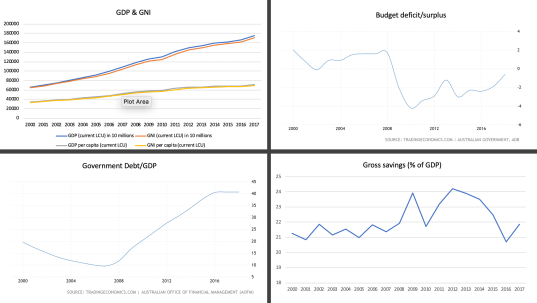
If we look at the economic parameters there are some interesting points to note.
- The total GDP and GNI and per capita GDP and GNI have consistently trended up over the years. However, the rate hasn’t been the same. The per capita GDP and GNI have increased at a far lesser rate.
- The budget is heading towards a surplus but the government debt/GDP is at an all-time high.
- The gross savings against the GDP has come down significantly over the years.
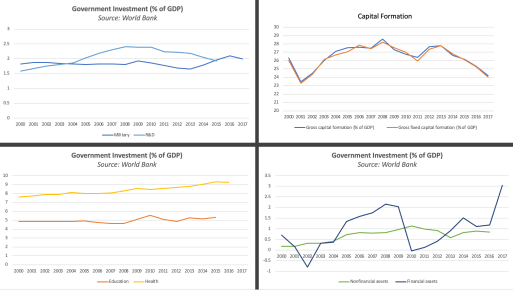
Government Investment
One of the key roles of a government is to make inter-generational investments. I have looked at some key areas which the government has been investing. The trend to note is that the previous two coalition government haven’t been making much investment in capital formation.
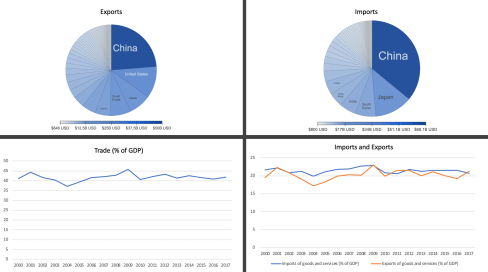
Trade
On the trade front, Australia is significantly dependent on China on both the imports and exports. Also, exports as a percentage of GDP are increasing over imports after a long time.
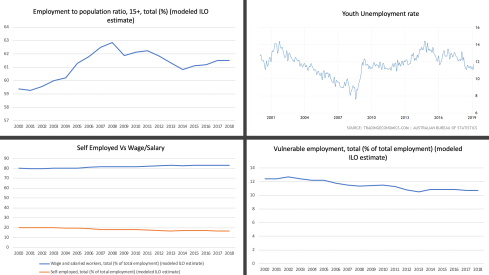
Labour
On the labour market parameters front, Australia is looking quite healthy. The employment to population ratio is fairly high. Thought the youth unemployment rate is high, it is still way below the global average. There is a good mix of people between self-employed and wages. The population who is into vulnerable employment is also low and steady.
Domestic Finance
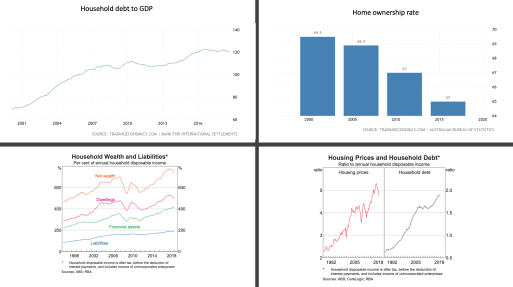
This is one of the biggest areas of concern for Australia. I want to interpret some of the numbers here.
- The household debt is at 120% of the GDP
- The homeownership rate is on the decline
- The dwellings are the biggest portion of a family’s wealth
- The housing prices are falling overall
- The household debt to disposable income is at its all-time high
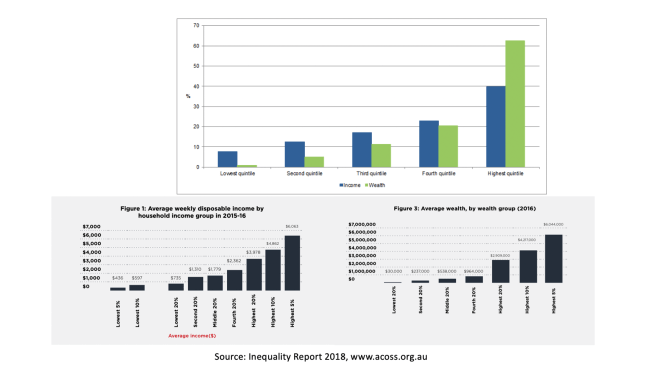
- The discrepancy in wealth is way higher than the discrepancy in income. The income distribution is good when compared to other OECD nations but the wealth gap is extremely concerning.
Energy
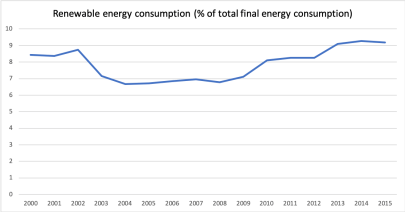
Last but not least, the percentage of energy consumed from renewable sources has stabilised since 2013. This shows a lack of movement towards alternate sources of energy.
Key risks and issues
Automation and long term risks to jobs
One of the huge risks of the present generation is the potential loss of jobs to automation. These jobs are not just ones to do with manual labour but even skilled ones like legal advice, radiology, administration and teaching. Australia is not going to be an exception to this. Some countries like the US are seeing the effect of this already.
Household debt
The household debt has reached record levels. A median income Australian family has debt which is close to three times its annual disposable income. This debt value is going to look bigger if the economy slows down. Most of this debt is mortgage and the house is the biggest asset followed by super for most Australians.
The gap between income and wealth
While income inequalities are understandable, Australia is seeing record accumulation of wealth without income levels supporting the same. This wealth disparity is going to trigger a change in social behaviours over generations. It will result in slowing down of the government revenue, increased consumption without contributing income, stagnation in production and above all social unrest.
Trade
Australia is heavily dependent on China was its trade. 36% of Australian exports and 24% of imports are with China. This is a huge risk for two main reasons.
- The Chinese government is increasingly flexing its muscles and bullying nations which doesn’t agree with its terms. With Australians not keen on selling its natural resources and infrastructure to Chinese state-run companies, China will not take it lightly for long.
- Australia has now inadvertently linked its progress to that of China. This is a very high-risk strategy. It is only made worse by Chinese business and government practices not as transparent as ones in the developed world.
Foreign policy
Australia’s foreign policy has always been toeing the line of the big guns. This in the past was to follow NATO guidelines. This meant Australia doesn’t have either the passive non-aligned policy of the Nordic countries or Switzerland or the aggressive drive of the United States. This is not going to work for long as very soon the US and China are going to be in different camps. With the imminent trade war between the US and China, one has to review the follower mode. Australia will be left without a policy-making parent country. The answer is not to go find a new one but to start behaving like an adult.
Clean Affordable Energy
In spite of having over 33% of the world’s Uranium deposits, Australia doesn’t have a single Nuclear Power plant. Nuclear power is one of the cleanest sources of affordable power. Solar power is good for domestic purposes but it has worse disposal problems than nuclear waste. The risks caused by nuclear power generation can definitely be mitigated lot more effectively. All said and done, the black coal still dominates the power generation in Australia.
Education & Skilling
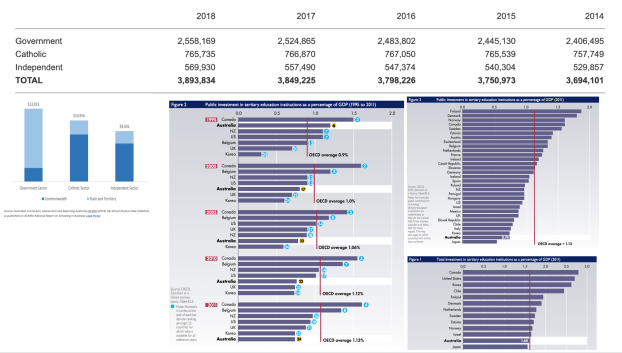
Over 70% of the students in Australia still go to Public Schools. However, Commonwealth funding is completely disproportionate. Further, skilling in Australia happens through apprenticeships and TAFE. University fees have increased tremendously over the years.
Election Policies
My Opinion
Both parties have similar sounding policies but written slightly differently. I want to first review each of their policies and then compare their performance against the key risks.
Labour Policy
The labour policy is a combination of the policies of the left-leaning parties in other countries like the UK and reverting to some of their old policies. There is hardly a single policy which I can call out for novelty. Their policies address most of the talking points in the proverbial voter checklist.
Hits
- Skilling – Investment in apprenticeship, TAFE
- Space research
- Manufacturing jobs
- Infrastructure Investment
- Naplan Review
- Review of the free trade agreements
Misses
- No standing on foreign policy apart from obeying Chinese government
- No policy to address the housing crash/correction
- The clean energy plan is extremely naive
- The plans don’t add up economically. Asking multi-national to pay fair share is alone not going to contribute to the costs
- Pandering to multi-culturalism – Chinese education, money transfer etc
- No clamping on outsourcing
Liberal Policy
The liberal policy is a self-glorification attempt. It is a combination of moderate policies which the voter wants and not talking about their policies which the voter don’t want to understand. There is again nothing new in their policies.
Hits
- Scare tactic against Labour
- Border protection
- Plans for regional areas
- First home buyer support
- Crime protection
Misses
- No substantial policy except incrementing the current one
- Free trade advocacy
- Lack of strong policies for leadership in the Pacific region
- Free ride for corporations
- No clamping on outsourcing
Performance
The next step is to review if the policy handles the risks outlined.
| Risk/Issue | Labour | Liberal | Choice |
| Automation and long term risks to jobs | They have policies for reskilling, especially in the energy sector. There is no acknowledgement of the job losses due to automation or creation of newer sectors. | They haven’t even thought of the issue. | Labour |
| Household debt | Hasn’t even bothered. If they want the bubble to burst, then they need to have policies which address the impact | Their new homeowner policy might sound attractive but is going to increase the gravity of this issue. | Neither |
| The gap between income and wealth | None | None | Neither |
| Trade | There is a slight focus on the renegotiation of trade agreements but no mention of how they are going to get it through. | Continued focus on free trade is going to backfire on Australia. | Slightly Labour |
| Foreign Policy | There is a mention of diversification but the rest of the policies fall flat in this regard. | There is a mention of derisking by improving the relationship with India but that is still not substantial. | Slightly Liberal |
| Clean Affordable Energy | Their renewable policy is definitely well written but I am still sceptical on this being affordable. The lack of discussion on nuclear is still appalling. | None. | Labour |
| Education & Skilling | Their policy to fund schools better, review Naplan and support for the public schools is definitely good.
Their policy to improve TAFE, and create university fund is a good path forward. |
There is no quality plan in this regard. The liberal policy is to continue the current policy. | Labour |
To conclude, the labour party is proposing a plan which doesn’t tie up economically and the liberal party is proposing a plan which doesn’t change anything. Both of them are engaging in a fearmongering tactic. Between a plan which is depressingly status-quo from the liberals and another one which is thoughtlessly naive from the labour the choice for the Australians is hard. The economy is growing globally so no government can take credit for this. Even after factoring in my biases, I will still advocate voting for labour to ensure there is an investment into key sectors which will result in intergenerational progress. I am definitely sceptical if they can turn their policies into action but there aren’t any more data points at the moment. A voter has to vote on policy.
References
- https://www.rba.gov.au/chart-pack/pdf/chart-pack.pdf?v=2019-05-15-11-52-15
- World Bank Data
- OECD Data
- http://www.Tradingeconomics.com
- Australian Bureau of Statistics http://www.abs.gov.au

 Demystifying a skeptic's world