Today marks the seventy-first birthday of a great man whose words and actions liberated a lot of young minds across the globe, a man whose language skills inspired a generation of writers and whose drinking ability brought charm to alcoholics. The man is none other than the great orator, author, polemicist, journalist Christopher Eric Hitchens or as his friends call Hitch. I couldn’t find a more apt day to come out of my hiatus and write again. This is my tribute to the great man, who had an unparalleled influence on me and a person I consider my mentor. Writers and scientists far superior to me have written about the great man. I can’t stop expressing my admiration to my hero just because there were people who did it more eloquently than I.
The most impressive part about Christopher is the axioms on which he operated. He also had a unique ability to refine them. While lesser mortals prefer distilled truths, Christopher can make his own from the collective learning of our entire species. As new facts emerged, he will be more than happy to dismiss those axioms for new ones. Further, his premises to those axioms were fairly simple. They were to achieve liberty, fellowship and wisdom. Every action and view of the great man were an extension of these. While many people say this very few people have ever stayed true to it in the face of adversity or contradicting facts but not Christopher. He will fight you even as his friend if you have to be corrected.
Very few people in history have defied loyalty to their group identity and always stayed true to their identity. Christopher Hitchens was a darling of the American radical left. His views were always in line with what we refer as traditional leftist views. He walked in lockstep with the famous linguist, dissident and author Noam Chomsky. He then parted ways with his comrades over the issue of Islamic terrorism. They wanted to blame the United States for it and Christopher wasn’t ready. This led to a year of trading insults in the public. Christopher wasn’t the one to flinch in the face of adversity. He fought back in a way only he can.
Oliver Goldsmith lived over 2 centuries before the birth of Christopher Hitchens but I imagine he had a view of Christopher’s ability when he wrote the Village Schoolmaster. The words can only do justice to Christopher.
Full well they laugh’d with counterfeited glee,
At all his jokes, for many a joke had he:
Full well the busy whisper, circling round,
Convey’d the dismal tidings when he frown’d:
Yet he was kind; or if severe in aught,
The love he bore to learning was in fault.
The village all declar’d how much he knew;
‘Twas certain he could write, and cipher too:
Lands he could measure, terms and tides presage,
And e’en the story ran that he could gauge.
In arguing too, the parson own’d his skill,
For e’en though vanquish’d he could argue still;
– excerpt from the Poem The village Schoolmaster by Oliver Goldsmith found in his collection “Deserted Village”
Christopher Hitchens was a ticking bomb in the hands of the people who want to use him for their vested interests. When Christopher parted ways with the American left on his war on terrorism, many people in the right started using him as a useful idiot or a tool in their hands. Little did they realise, that he was a ball of fire on their dirty hands. He burnt them alive with his scathing attack on religion with his book ‘god is not Great – How Religion Poisons Everything’. The book remains a masterpiece amongst the books written by the Four horsemen of Atheism. Christopher went on a book tour debating religious leaders across faiths and politicians across parties. The debates can only be described as the annihilation of the forces of darkness. His speech on the book at Google is still one of the best talks I have listened in Google.
Christopher Hitchens was a friend any honest individual would love to have and every dishonest person should fear. The two tales of friendship, one Salman Rushdie and the next with Sidney Blumenthal, perfectly encapsulates the fellowship Christopher held. Salman Rushdie found the militant support and reinforcement in Christopher when there was a fatwa against him from the Islamic nations or the protest against him being awarded the Bookers prize. On the other hand, Sidney Blumenthal faced the wrath of his once friend when he decided to backstab Christopher to be a confidante of the corrupt Clinton family. The man lived by and for his principles, right till his very end.
One of the famous quotes of Christopher was his response to a question on feeling safe in the night in an unknown city with religious people. Christopher responded to that question with cities without leaving the letter ‘B’ where he will never be comfortable when he knows that the crowd he is encountering is coming after a prayer meeting. It was brilliant, witty and above all irrefutable. I want to wrap my tribute to the great man by describing him with adjectives without leaving the letter ‘C’.
cantankerous – He was in all his views
captivating – He was when he expressed himself
cathartic – He was to every individual fighting for liberty
caustic – He was when you hurt his respect
challenging – He was when your views are wrong
changeable – He was with facts
charged – He was when taking on his foes
charming – He was admist adversity
cherished – He was amongst all his admirers
circumspect – He was about any faith
civilised – He was when dealing with common people
clever – He was as evident from his words
coherent – He was even when drunk
combative – He was when liberty is challenged
comfortable – He was with what he was doing
comical – He was when the situation demands
commendable – He was for all his output
communicative – He was to capture even a dissenting audience
compassionate – He was for people in need
competent – He was in every field
conscientious – He was when dealing with any issue
contentious – He was when drawn to dishonest attacks
convincing – He was in any argument
cordial – He was when being treated with respect
courageous – He was when facing a crisis
courteous – He was when speaking to strangers
Creative – He was with all his works
critical – He was of anything which affects humans in a wrong way
cultured – He was even when challenged
curious – He was as he kept learning
I can’t thank the great man enough. The world misses him as do I. His thoughts will live with me for the rest of my life.
As I concluded in my previous part, privatisation of the temples is definitely a plausible option. There is a movement in India to free the Hindu Temples from the influence of the Government. I am completely in favour of this option albeit for a different reason. In this blog, I want to write about the movement, the reasons and my opinion.
The movement to free Hindu Temples from Government Control
This movement is to challenge the Hindu religious and charitable endowments (also called HR & CE). These government departments control the management of the Hindu Temples under their control. It all started with the Tamil Nadu HR & CE Act in 1959. Here are the arguments against these controls.
Hindu Temples are the only religious institutions which are under Government Control
The income from the temples goes to the government, thereby depriving the temple to get richer.
Hindu Temples pay more income tax than other religious institutions
Hindus are not allowed to manage their own religious affairs
Hindu Temples and their assets are allowed to be destroyed by HR & CE of different states
These regulations take away the constitutional rights of the Hindu groups to manage their own affairs.
There are plenty more but these are the main reasons. There are some factual errors in this but I want to highlight one of them. The constitution of India does give the state government rights to pass regulations like these as deemed appropriate. So, the acts themselves are not unconstitutional.
Why is this relevant?
This movement has been gaining momentum from the beginning of this decade. This has gained prominence with the Sabarimala case as the same people like J Sai Deepak are fighting for both. Their logic is simple. If they gain enough momentum towards this case, they can make it an election issue. If these acts are removed, then the Hindu temples will cease to be public assets. Therefore, the rules of the temple are similar to the rules of a private body.
They will not have the money power to run education institutions to push their agenda.
None of their rules can be termed discriminatory. They can prevent people from entering, from women to people of the Dalit communities.
This will drive towards their broader agenda to make India into a Hindu nation.
Why do I feel the government should not control temples?
I am a strong proponent of the separation of church(or temples) and state. If the state starts to involve itself in the management of religion, it soon has to take sides in religious wars. It also is obliged to protect the demise of these religions. Here are my reasons why I want the state out of the business of religion.
The state has a responsibility to government people according to the rule of the law and not on religion.
The civil code should be uniform and secular. For example, child marriages, dowry and polygamy should be prohibited irrespective of a religion.
All institutions (religious or otherwise) should pay their taxes. Religious institutions should not get charitable status.
The government should not give grants or aid for people to perform religious activities, from Amarnath Yatra to Hajj trips.
The government in a secular country has the responsibility to be neutral. It can’t take responsibility to build or destroy places of worship.
The government has a responsibility to keep education secular. Religious concepts can be taught in scripture classes but not science. Evolution cannot be an optional part of biology.
The constitution still has laws against discrimination which has to be deep.
In conclusion, I see this as a dangerous sign. The articles in magazines like Swarajya show how nuanced the arguments have gotten. Considering the history and breadth of beliefs and practices in Hinduism, one is bound to find contradictions in the scriptures. This has paved the way to the new fundamentalists who have come up with an approach which only be called death by a million nuanced cuts. This confusion results in people falling for their trap. The only way to expose their devious behaviour is by letting them take control and expose their vicious, cruel agenda. If you are a parent of a child, you need to be worried about these people. Here are the reasons.
Your child might be a homosexual. Imagine the plight of a homosexual in a society run by such people.
Your child might be growing in an increasingly polarised society where the caste system is controlling collaboration.
If you have a girl child, imagine her plight as she finds a partner in her life. She might be forced to live a life of mediocracy just for being a person of the female gender.
If anyone thinks, I am exaggerating I want to attach some proofs.
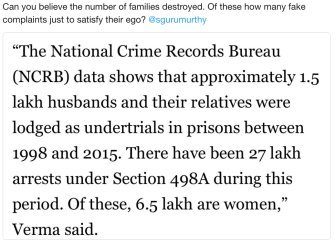
This message is extremely specific. It doesn’t say that any false complaint should be punished. If one has to be fair, they should also consider any perpetrator who has denied crime to actually get punished more. Further, the girl just complained. She didn’t provide the judgement.
This was another tweet by a Hindu Right winger on the impact caused by Section 498A which is the Dowry Act that criminalises dowry.
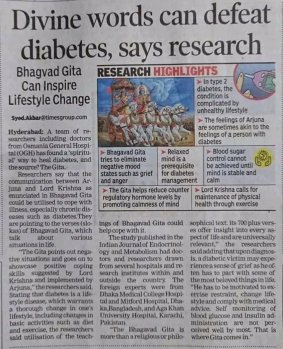
They want to spread fake medical research too.
These people are capable of defending anything under the name of religion. If you think they are good just because what they are saying now is in line with your beliefs, then think more they might be coming for you or your family next.
As mentioned in my previous blog, S Gurumurthy recently triggered a discussion on Twitter around the Sabarimala case. He was weighing in his opinion on how the legal system cannot be above faith. This is a director at Reserve Bank of India. It is intellectually boring to break down any analysis by S Gurumurthy. His opinion and bigotry can only be matched by someone like Steve Bannon from the US. However, the most acclaimed narrative has been produced by a Hindu apologist, J Sai Deepak. He is the best spokesman for the Hindu right wing and I want to take down his argument in this blog. I want to do this through the below parts.
The Sabarimala Case
Analysis of J Sai Deepak’s argument
Analysis of other arguments
Ready to wait
Blaming judgements for natural calamities
My Opinion
The Sabarimala Case
The core of this case is extremely simple. A bunch of people filed a case against women being barred from entering the Sabarimala Temple. The case was filed in 2006 and taken up by the Supreme Court of India in 2017. Towards that time a bunch of girls from Kerala started a movement called ‘Ready to wait’. This movement wanted to keep the status quo. The movement got traction and attracted some prominent religious and legal experts into the case. J Sai Deepak was one of the lawyers representing the ‘Ready to Wait’ movement. I can go on an on about de-mystifying the Sabarimala deity, Ayyappa but that is not of any significant benefit to this argument. Wikipedia provides a decent introduction on Sabarimala and Ayyappa. However, there are a few points I want to share, which adds some value to the case.
Difference between Ayyappa and Manikandan
As the legend goes, Manikanda(n) was a prince of the Pandalam dynasty. He is believed to have lived in the 12th Century BC. He is supposed to be an incarnation of the Hindu god Ayyappa. It is one short of a trinity, probably can be referred to as duality.
The belief is Ayyappa maintains celibacy
According to the belief of the people who run these temples, the deity Ayyappa wishes to be a celibate. The temple website mentions the below.
“As Sabarimala Ayyappa is ‘Nithya Brahmachari’ (celibate)women between the 10-50 age group are not allowed to enter Sabarimala. Such women who try to enter Sabarimala will be prevented by authorities. Only pilgrims who have observed Vrutham alone are allowed entry through the holly Pathinettampadi. They have to carry Irumudikettu (Pallikettu)also.”
Sabarimala is autonomous but under the Government of Kerala
The Sabarimala Temple is run by the Travancore Devaswom Board. Though the functioning of the board is autonomous, the members of the board are nominated by the state government of Kerala. The Travancore Devaswom Board website has the details. It is not a completely private institution. Further, they cannot have a constitution which contradicts the constitution of the country.
The judgement hasn’t come through on the case
There is so much noise around this subject but the judgement hasn’t been given yet. The court has reserved the judgement to a later date.
This wasn’t the first case on the subject
This case cannot be understood in full context unless we look into in the context of the judgement given by the Kerala High Court in 1991 in a case related to letting women entering the temple. After listening to the argument, the judgement was pronounced as below.
“The restriction imposed on women aged above 10 and below 50 from trekking the holy hills of Sabarimala and offering worship at Sabarimala Shrine is in accordance with the usage prevalent from time immemorial.”
“In the light of the aforesaid conclusions we direct the first respondent, the Travancore Devaswom Board, not to permit women above the age of 10 and below the age of 50 to trek the holy hills of Sabarimala in connection with the pilgrimage to the Sabarimala temple and from offering worship at Sabarimala Shrine during any period of the year. We also direct the 3rd respondent, Government of Kerala, to render all necessary assistance inclusive of police and to see that the direction which we have issued to the Devaswom Board is implemented and complied with.”
There was a similar protest to allow women to enter the Haji Ali Dargah. The women who fought for their rights won their case. The judgement was pronounced on 26 August 2016 when the Bombay High Court ruled that women could enter the Dargah. Though the Sabarimala case was filed a long time before, the Haji Ali Dargah case definitely has opened the floodgates.
J Sai Deepak’s argument can be divided into the below parts. There is so much mentioned about the veracity of this argument but I feel it only convinces people who are already convinced. I don’t think defending anything reprehensible should be praised as an act of bravery and skill. Anyway, I will deconstruct his arguments to see what makes sense.
Lord Ayyappa is a juristic person and has the liberty to do what he wants
This is a question of religious freedom
It is not a women’s issue
The court should not be imposing their views on religious practices
There are similar examples across other religions or other temples
I have given references to the argument presented by J Sai Deepak in the section below.
Lord Ayyappa is a juristic person and has the liberty to do what he wants
“Lord Ayyappa of the Sabarimala is a “juristic person” for the purposes of property ownership and taxes and hence, he equally has rights under Article 21 (protection of life and personal liberty), 25 (freedom to practice religion) and 26 (freedom to manage religious affair) of the Constitution.
The deity has the right to remain a ‘Naishtika Brahmachari’ (eternal celibate) and this was also part of the right to privacy of the deity, the will of the deity needed to be respected.”
It is true that Lord Ayyappa is considered a juristic person under the Indian Penal Code. According to law, the juristic person includes not only natural person (living) but also corporations, idols and even the dead people. However, Article 21 has an exception. When carrying out a procedure established by law, one’s personal liberty shall be deprived. So, Ayyappa has the right to remain an eternal celibate, as long as he stays lawful. The same is the case with Article 25, Ayyappa has the complete freedom to practice his religion.
However, the argument is completely mute. Sabarimala is not owned by Lord Ayyappa. The place is owned and operated by Travancore Devaswom Board for the person named Lord Ayyappa. Lord Ayyappa can walk out and sit inside his private property. At that point, he will have all the personal liberty he wants. As long as he is sitting inside a building owned and maintained by Travancore Devaswom Board it has to operate under Article 5 of the constitution. Travancore Devaswom Board is partially maintained by the State Government of Kerala and has constitution provisions.
Article 15 – 2 (b) the use of wells, tanks, bathing ghats, roads and places of public resort maintained wholly or partly out of State funds or dedicated to the use of the general public.
The proof that the board is funded by the state is in Article 290A of the Indian Constitution.
290A. A sum of forty-six lakhs and fifty thousand rupees shall be charged on, and paid out of, the Consolidated Fund of the State of Kerala every year to the Travancore Devaswom Fund; and a sum of thirteen lakhs and fifty thousand rupees shall be charged on, and paid out of, the Consolidated Fund of the State of 1 [Tamil Nadu] every year to the Devaswom Fund established in that State for the maintenance of Hindu temples and shrines in the territories transferred to that State on the 1st day of November, 1956, from the State of Travancore Cochin.
So, this argument is a non-sequitur.
This is a question of religious freedom
Now, let’s look at Article 26 of the Indian Constitution which outlines religious freedom.
26. Subject to public order, morality and health, every religious denomination or any section thereof shall have the right— (a) to establish and maintain institutions for religious and charitable purposes; (b) to manage its own affairs in matters of religion; (c) to own and acquire movable and immovable property; and (d) to administer such property in accordance with law.
This is a plain conflation of concepts. Every religious denomination has the right to manage their own affairs in matters of religion. However, matters of religion come under the law. Supreme Court is not ruling against rules of Hinduism. However, the rules of Hinduism have to come under the legal code. For example, if my religion asks me to perform a cruel operation on a newborn resulting in the death of the baby, it will still be classified as murder. Right to manage your religious matters doesn’t mean a right to discriminate. Either way, the usage of this clause is meaningless in the context of an individual called Lord Ayyappa.
Now, coming to the definition of Naishtika Brahmachari. Naishtika Brahmachari means celibacy till death. How do women entering the temple take away the celibacy of the Lord Ayyappa? According to Hindu scriptures (Smritis), a naishtika brahmachari is supposed to live under the supervision of his guru. This means he owns nothing and lives by begging. Can you think of someone begging and a male offering them food in the olden days? Also, this rules of Lord Ayyappa owning the place. Now there is another famous naishtika brahmachari in Hindu mythology, Lord Hanuman. I don’t think he avoids seeing women. The Supreme Court of India is not changing the definition of the word by any means.
It is not an issue of discrimination against women.
This is laughable. I am not sure how you can say that women who are capable of having a child cannot enter the temple and still say it is not an issue of discrimination against women.
Further, the point mentioned was “The women have been respecting the tradition for a long time now and this is not a case of temple versus women or men versus women”. Now women have also been respecting Sati for centuries. That doesn’t make the sati an acceptable practice.
The other point made is, “The issue of exclusion of women was not based on the notion of purity and rather dependent on facts like celibate nature of the deity which has been preserved for years”. This is completely false. How do I know? Prayar Gopalakrishnan, the president of the Travancore Devaswom Board has done the job. His quote says everything that needs to be said in this regard.
“These days there are machines that can scan bodies and check for weapons. There will be a day when a machine is invented to scan if it is the ‘right time’ (not menstruating) for a woman to enter the temple. When that machine is invented, we will talk about letting women inside.”
The court should not be imposing their views on religious practices
The next point by J Sai Deepak is that the court and others should not be “superimposing” their social views on the temple which has stated its position “loud and clear”. He followed that with the below point.
“Tomorrow somebody can say that he would like to offer chicken as ‘prasadam’, can such an offer be entertained and the rules of religion and the God cannot be changed.”
This is an argument from emotion than logic. Let us look at the first point here. The court should not be superimposing their social views on the temple. This is completely incorrect. The temples come under the jurisdiction of the Indian Constitution and any views that they have which are against the constitution will be challenged. A temple, for example, cannot preach discrimination or violence. It is against the law. Temple is within a jurisdiction of a legal entity. It is cyclic fallacy if you use the same law to argue that the temple is above law.
On the second point of offering chicken as ‘prasadam’, there are laws protecting such actions. For example, one cannot say that by allowing women to enter mosques, pigs can also enter the mosques next. This is a hasty generalisation fallacy. It also commits an argument from analogy.
There are similar examples across other religions or other temples
The last of his argument was that there are other such practices which continue. The example used is throwing of babies outside the Baba Umer Dargah, Solapur Maharashtra. It is worth noting that the National Commission for Protection of Child Rights has already banned the practice. It still continues to happen illegally because such people are idiots. Further, the fact that A is wrong and still happens. Therefore, B is wrong should also be allowed to happen is not a logical argument. If he is trying to trigger a divide between Hindus and Muslims in this case, then it is worth noting that there are Shiva temples in the same area which do the same ‘Throwing Baby’ act.
Overall, his complete narrative is an argument from incredulity. There is no logic to it apart from trying to strike an emotional chord with his co-fundamentalists.
Analysis of other arguments
I also want to list other arguments presented in this case.
Argument by K. Radhakrisnan
A Senior advocate K Radhhakrishnan, appearing for the Pandalam royal family, referred to the concept of morality and said that the constitutional morality cannot override the private morality in cases of religious practices. This is completely wrong. Morality is the principles concerning the distinction between right and wrong or good and bad behaviour. As seen in Wikipedia, morality is the differentiation of intentions, decisions and actions between those that are distinguished as proper and those that are improper. Constitution fundamentally does that. Most religious moralities allow you to own and trade people as slaves. The constitution gives you the right to think and speak freely. It is your right to not want to exercise it. Morality, however, is how you behave with the society in that context. Private morality is a meaningless construct in that case. It is a deliberate conflation of the definition of the word morality. I am assuming he meant liberty. Even with that, I have already shown that the argument is flawed.
Argument by Abhishek Manu Singhvi
Abhishek Manu Singhvi is a lawyer and a Member of the Parliament in India. It is outrageous to see him defend unconstitutional practices.
Defending the Sabarimala tradition in the Supreme Court, advocate Abhishek Manu Singhvi on Tuesday told the bench that there are temples in the country where even men are not allowed. He added that a court cannot be invited to give a finding that a tradition or belief is not of antiquity without the evidence being examined in a trial. Arguing for the Travancore Devasom Board which administer the sabarimala temple, Singhvi also argued that there are hundreds of traditions practised buy dozens of faiths in India and it is not possible to bring them all under definition of Constitutional morality. “Even in Mosques across the country, women are not allowed,” said Sighvi. He added that the test under articles 25 and 26 was not whether a particular practice was right or wrong but whether it was a bonafide belief practiced for centuries by a community.
His first point of men not being allowed is fundamentally allowed under the constitution of India. This is the same reason why you have women-only compartments in trains but don’t have it for me. Article 15-3 of Indian Constitution says, “Nothing in this article shall prevent the State from making any special provision for women and children.” So, women can have such special privileges. There are 8 such temples in India. His second point should comfortably be the worst of the lot. Since there are too many traditions, we should not bring them under the constitution. I wonder what is the purpose of a constitution or legal system in such a situation. I wonder if he is calling for anarchy in a court of law. And finally, I have already discussed the articles 25 and 26 above. So, I am not going back to it.
Ready to Wait argument
There is something about this campaign which invites mockery. The premise of the ‘ready to wait’ campaign is utterly stupid. While it is a cool hashtag, it is meaningless. No one is forcing these women to not wait. Even if the judgement allows women to enter the temple, it doesn’t force these women to enter. It is not a mandate. They can wait. I am surprised, people can’t see the stupidity in these arguments. It is also pretty ironic that the parent organisation is called ‘People for Dharma’. I wonder the context in which they are using the word ‘Dharma’. It could mean righteousness, rule, law or cosmic order. Do they mean, the rest of them are for ‘Adharma’? This is the callousness seen in some movements like ‘Pro-life’, like anyone who opposes it is ‘Anti-life’. You don’t need a right to wait in a democracy, just like you don’t need a right to stay hungry or right to shave your head.
I was subsequently proven right by the nature of the arguments posed by the people propping up this campaign. Here are a few.
“If you don’t wish to believe in Hindu deities and their stories/legends, then don’t. But this sudden interest in destroying millenia old traditions in the name of “rights” is becoming absurd. Would you, for instance, support my right to eat pork inside a mosque? Religious places are not public places.”
“Sati, triple talaq, child marriage are social customs. #Sabarimala temple’s tradition is based on Shastras. Not a ‘SOCIAL’ issue. Devotees coming out with #ReadyToWait declaration. Women don’t intend to allow atheism win over Bhakti.”
“I respect my traditions, therefore will never visit Sabarimala before the right time for me. Feminists should leave us alone.”
I sometimes wonder how far and deep the termite of misogyny has spread. Now women want to become their torchbearers. I want to just highlight a few points.
Destroying traditions under the name of rights is not absurd. Traditions have to be questioned in any civilised society. The Hindu Sastra (Manusmriti) highlights the role of a woman to be subservient to her male guardian.
You do not have a right to eat anywhere. It doesn’t say that in the constitution. You don’t have the right to kill a lion as well.
Shastras are social issues. Hindu Sastras call for discrimination of people based on various factors. I wish she reads a bit more before making a fool of herself in public.
Feminists are not forcing anyone, especially these people to go to the temple. No one is forcing anyone to enter. People are fighting for the right to enter a temple here.
It is not surprising to see this line of argument. In 1934 there was a report submitted to the Maharaja of Travancore on allowing lower caste Hindus to enter the Sabarimala Temple. I have given an excerpt from the report (as I read it from another source) below. This was called the ‘Temple Entry Committee Report’. I have provided more links in the references section.
“Exclusion from temples, not always the result of the excluded class being considered inferior to others. It is based on a belief that the approach of certain people is likely to derogate from the spiritual atmosphere surrounding the pratishtha, the deity installed in the temple. A large body of (high-caste folk) believe, on the basis of the (scriptures), that the entry of the (low) into (their) temples would cause defilement of the temples…and there will be no efficacy in the worship or rites performed in them.”
As it can be seen, this line of argument is not uncommon with the people running the temples and the people practising these beliefs.
Blaming judgements for natural calamities
Religious fundamentalists have always been guilt tripping judiciary when it has promoted equal rights against the will of their religions. The evangelicals in the past have blamed Hurricanes in the US, the attack on WTC, the earthquake in Haiti and even the 2011 tsunami in Japan to gay rights. Now the Hindu right in India has taken over the same approach. They are pressurising the judiciary into think there is somehow a connection between the judgement and the floods in Kerala. However, they are using a multi-pronged approach for this. There are volunteers on the ground who are helping the flood victim. This builds the goodwill. Then, there are people who drive local movements drawing the connection. They evoke the causation versus correlation conundrum in people. Finally, there are people who attack the judiciary. It is a good strategy only if everyone else is an idiot.
My Opinion
I am not a fan of religious reforms. When people talk about reforming a religion, all they do is add another flavour of the religion essentially twisting some elements of the religion to make it more palatable to the society. If the religions adapt to the social changes, then they do not perish. So, we leave the next generation to fight this evil construct. Morality has always come at the expense of religion and not because of religion. Religion has successfully collected the social morals of a time and encompassed them in their system. However, morals evolve as people learn more. If religions are allowed to move their goalpost we can never get rid of this evil.
At the same time, I am not sure about the need for any self-respecting woman to enter the temple premises after knowing how they are being discriminated against by the system. Unless they do it to annoy the establishment, I can’t think of a valid reason to enter. For that reason, I can’t think why any woman would want to be religious. No religion ever gives a woman equal right.
I want the Supreme Court of India to give the Travancore Devasom Board two options. The fundamentalists fighting for the right of the Lord Ayyappa like J Sai Deepak want the first option while the people who are contesting them want the second. I feel the court should provide both the options to the board and ask them to take a call.
Option #1: Become a completely private entity by leasing the area from the Government. This means
Lost their charity status
Pay taxes like a private institution
Lose government protection
Still under Indian Constitution and Legal system
They would run like a theme park. They set their rules. However, this requires a constitutional amendment.
Option #2: If they want to operate in its current fashion then
Allow women of all ages to enter the institution
No discrimination against any community, gender or sex
On a different note, I wish tax rebates for all religious institutions should be removed. When a cab driver or a car mechanic has to pay one’s full due of taxes why should religious institutions get a free pass?
Nothing obliterates a civil society more than its despicable treatment of women. The traditional conservative societies have moved from enslaving women to whining about their freedom to now claiming to have been an embodiment of women’s liberties. Not only have they not done anything to liberate women but also are intentionally obtuse to distract everyone from their devious intentions. The theocratic societies across the middle east and south Asia exemplify this behaviour.
The case in the Supreme Court of India to allow women to enter the Sabarimala Temple and the reactions aftermath stands a testimony to the new wave of religiosity. S Gurumurthy, the journalist and one of the directors of RBI tweeted about the possibility of the connection between the Kerala Floods and allowing women to enter the Sabarimala Temple. The sad story of the Indian culture is that this is a mainstream opinion. I want to address this in three parts.
I want to wrap this up with my opinion on how to take on the theocratic bullying we are witnessing.
The stigma and trepidation around menstruation
The deep-rooted misogyny in the Indian Culture was always covered up by traditions. I have already written about the culture of rape in the country. The discrimination against menstruating women is the ugly domestic secret of the Indian society. For a seemingly developing society with a high percentage of college graduates, it is rather ironic to see their belief in superstitions. The culture is obsessed with the women’s vagina and what comes out it. Anyone who thinks the previous statement is gross or a massive exaggeration is either an ignoramus or a charlatan. I am sure that everyone from an Indian Hindu family has seen treatment of women during their mensuration. I will call out some of the most common practices.
Menstruating girls and women are
not allowed in most religious functions and temples.
not allowed inside the kitchen
not allowed to touch anyone in the house
not allowed to go near the place of worship inside the home
not allowed to use the same dishes as the rest of the members
As a young girl child, one is made to feel scared, ashamed and even disgusted with what is happening to their body. I have personally witnessed this in well educated upper middle class families growing up in a city. The situation is worse in villages and other remote areas. While every culture across the globe had these superstitions, not all cultures have equally come out it. Education has especially done a lot to get most societies out of it. But the Indian society seems to have a unique status where a very educated family finds it acceptable to follow these prejudices. What is worse, they have upgraded to new reasons for why these practices are valid. I have heard a few Hindu religious scholars say some of the below reasons.
The radiation from the body is so intense that people should not come near menstruating women.
This sounds scientific, doesn’t it?
God cannot withstand the energy from women during those times.
I am assuming they have some weak god.
To prevent men from getting attracted to women during those times.
This assumes men have no control. If they mean religious men like themselves, then I suggest we cage men when their wives go through this. I will be more than happy if men actually took care of their wives during those times.
Women get extremely angry during those times.
I want to see the reaction in a man bleeding for three days.
The most ridiculous reason I heard was that people married their daughters at a very young age those days only to avoid these questions. As you might see, none of these actually have any moral value. There is no way a humanist or a secularist will every present such an argument. This irrational bullying is the superpower of the theocratic community. Most women who have grown up being subjugated with these practices have a trepidation at the possibility of questioning these practices.
There is also a line of argument that Hinduism or what the fundamentalists like to call Sanatana Dharma worships menstruation. The examples quoted are the Kamakhya Temple in Assam and the Bhagavathy Temple in Chengannur in Kerala. It is counterproductive for people to bring this up as neither of these temples actually allow menstruating women to enter.
As I have mentioned before in my earlier blog, the systemic misogyny in India is too deep and too well spread. The problem is that defendants of the misogynic practices now are becoming more mainstream and taking a more nuanced stand. The main case which is highlighting this is the case of allowing women to enter the Sabarimala Temple.
Yet another rape in India, this time of an eight-year-old child by eight men. While that is gruesome in isolation, the nature of the event and the religious frenzy which followed has made it extremely gut-wrenching. This has resulted in an avalanche of sexual abuse cases getting reported, mostly against minors. To me, this is India in a nutshell. For the rest of the world, India is a secular democracy with a majority Hindu population. It has seen a tremendous growth over the last few decades, thanks to information technology services and globalisation. For some Westerners, India and China are the embodiment of eastern mysticism. They somehow think there is more to these cultures than mere age. I do not share that view. For me, it is an epidemic of problems with a culture of misogyny. It is the epicentre of rape and sexual abuse in the world, stemming from a strong religious value. I do not intend to take a cheap shot at religions to gain mileage from these atrocious crimes. I want to reflect on growing up as a man in this extreme misogynic culture.
Sometime in 2013, I had an argument with one of my lady colleagues in India. I told her, I believe that sexual abuse in India is a bigger epidemic than what gets reported. In order to test my hypothesis, I told her to check with the 60+ women working in the office if they have ever been groped or sexually assaulted at least once in their lives. My test was, if more than 80% of the people say yes to it, then my hypothesis is valid. To her surprise, the result for 100% and what is worse the most of them have multiple harrowing stories. While most countries talk about discrimination at different levels, sexual abuse is definitely a red line. Misogyny is pervasive globally but some cultures protect and worship it more than others. India worships misogyny through its religious ideologies. An average male is more chauvinistic than most other cultures. Let us drill down on this further.
For the sake of accuracy, I want to start by acknowledging a couple of facts. I do this to set to rest the common and rather stupid copouts given by religious nutjobs for the behaviour of men in their communities.
Accepting the risk of approximation, it won’t be inaccurate to say a majority of males are more physically powerful than their female counterparts, assuming they belong to the same ethnicity and share the same food habits.
The need to take control of one’s life and exert some degree of power over others is quite innate in most primates.
These two points are true globally but sexual abuses are not that common in the rest of the world as it is in the religious nations. So there are some cultures which have evolved more than the others.
Influence of the religions
According to the 2011 census in India, India has close to 79.8% Hindus, 14.2% Muslims, 2.3% Christians and 1.7% Sikhs. The rest of the religions and non-affiliated population constitute around 2%. For the sake of ease, let me take the top 94% of the population for this study which comprises of Hindus and Muslims. It will definitely not require a massive leap of faith if one were to look at India through the history of these two religious faiths. Both Hindus and Muslims claim that their religion is one which respects women. The reality is any nation which has these religions as a majority doesn’t seem to be a friendly place for women. Then how do these religions claim to be so pro-women. Both Hinduism and the Abrahamic faiths find a strong reason to protect and defend their women. They do not believe they can do that themselves. They also believe left to themselves they cannot be as moral as their male counterparts. The other countries which feel subjugation is a form of protection include Saudi Arabia, Iran, Mauritania, Pakistan etc. The connection is very obvious to see. India is rather unique in this coalition of rotten chauvinists. India has a ‘Secular Democracy’ or at least a constitution which says so. By giving each religion a unique right to practice its chauvinism, India has projected an image of religious tolerance. This dissonance is hard for most people to assimilate and understand. It is easier when Saudi Arabia or Pakistan do it. But when there are multiple religions and one defends the other in this act, the process is tricky. So, we need to unpack these religions one by one.
Let me start with Hindus. It is a polytheistic religion. These are the people who worship, Rama, Krishna and Shiva as Gods. It is also true that there are just as many female Gods in Hinduism as there are male gods. However, that is the bait. If people listen to the myths, they will understand that these ‘Gods’ are not just immoral normally but extremely misogynistic. Rama’s wife Sita was kidnapped by another king who fell for her beauty. When she got freed, Rama wanted his wife to prove her chastity by walking into a pyre of fire. He didn’t trust her ‘purity’ because she was kidnapped by another guy. Years later as a king of a nation, he asked his pregnant wife to do the same when his citizens doubted her. When she refused, he sent her into exile. He later wanted her back as he wanted to do some prayers which required him to have his wife. However, he wanted her to do the purity test once more before she gets back to the kingdom. This “God” is worshipped and is considered as an ideal husband, someone every woman should hope for. Half of India is fine with waging a war to get a temple built for his person.
Let’s take the next God Krishna, who goes an extra mile with his libido. The stories of Mahabharata, various Upanishads and Gita Govinda describe his amorous life in great detail. Somewhere I feel the sick intentions of the author come out in these works. His crude and despicable sexual escapades with both married and single women in his village are romanticised through songs and dance. My intestine rolls over when I see women dance for these songs. It is an insult to human decency.
The third major God worshipped in India is Siva. As the legend goes that Siva disapproved of his wife(Sati) attending a pooja done by her father. She goes in spite of that, gets disrespected and self-immolates herself as she has disobeyed her husband’s order. She is considered a great moral example. There is no wonder, this is also the reason behind the practice of Sati, where a widow immolates herself on her husband’s pyre. It has taken centuries for people to come out of this practice and there are still some fringe forces which want to restart this.
Looking at all this it is rather bemusing when the ruling party in the Government of India wants to establish a ‘Rama Rajya’ meaning rule of Rama. When a majority of the country think it should happen, we have wonder about the state of their minds. No wonder every religious scumbag wants to molest the girl hoping to use these examples to get away.
Let us now go to the Muslims. These are worshippers of Allah through the words of their prophet. Muhammad, a conquering warlord in Arabia is said to have married 13 women. This perfect prophet married his wife Aisha when she was six and consummated the marriage when she was nine. It is worthy to note that Muhammad was 53 at that time. In many countries, it is legal for parents to get their daughter married at age nine. In India, it is allowed only for Muslims. Further men are allowed to have up to four wives at any time.
Hadiths which are interpretations of the Quran offer 72 virgins to martyrs. Husbands are legally permitted to beat their wife if they follow the Sharia laws. In 2005, an Islamic seminary told a woman who was raped by her father-in-law to start treating her husband like her son. He used the Quran to justify this. When she defied these orders she was punished instead of her rapist father-in-law. This is what Muslim leaders want, a special court for themselves where justice is based on their medieval beliefs disseminated by a horny and deluded warlord.
There are a great number of examples of the culture of rape and sexual assault in India but nothing exemplifies it more than the events which happened on the western border of India during 1947. The Hindus, Muslims and Sikhs ganged up to rape the women and sometimes minor girls in the other communities. The documentary below shows men who are proud of their act.
Now, let us look at some statistics. In this age, twenty-two girls die every day in India due to dowry-related violence. One the average there are 70 rape cases reported every single day. This means by the time you read this blog post there has been a new rape case reported somewhere in the country. Again, this is only a reported crime. Most rapes go unreported as it is considered a social stigma. Further marital rape is not considered a crime in India. Then there are sexual abuses, eve teasing and groping cases which will include every girl in every city. Almost all of these go unreported. The other major crimes against female include infanticide, forced prostitution, domestic violence, forced marriage and worst of all chemical attacks.
International Men and Gender Equality Survey conducted a survey which showed some disturbing results.
A man should have the final word about decisions in his home – 81%
A woman should tolerate violence in order to keep her family together – 68%
There are times when a woman deserves to be beaten – 65%
Perpetrating physical violence against partner – 37%
When 65% of men think that woman deserves to be beaten, you cannot brush it as a fringe group. When 24% of men have admitted to sexual violence, it is not a fringe group. The common excuse that most religious people are moderates and law-abiding citizens is not actually true. My thoughts go back to Christopher Hitchens book, ‘god is not great. How religion poisons everything?’. I want to quote the American physicist Steven Weinberg here, “Religion is an insult to human dignity. With or without it you would have good people doing good things and evil people doing evil things. But for good people to do evil things, that takes religion.”
Priests involved in rape
It is also noteworthy that there is a large number of religious priests and gurus who have been involved in sexual abuses. While this is pretty much a global phenomenon, India is special in its complete lack of respect for evidence and prolonged support for these people under the pretext of religion is something to cringeworthy. Here are some of the high profile cases from my recent memory. In each of these cases, the followers continue to believe that the alleged rapist is innocent.
Asaram Bapu, a septuagenarian godman has been accused of raping a 16-year-old girl.
Rajneesh or Osho had practices within his ashram, which earned him the nickname ‘sex guru’
Jayendra Saraswati, a Hindu seer was accused a sexually assaulting a female writer.
Gurmeet Ram Rahim a self-styled spiritual leader has been accused of rape and murder
Father Robin Vadakkumcherry has been arrested for raping a minor girl and making her pregnant
Seeing this in practice
If you want to further evidence of this archaic belief system and misogyny worship, one has to witness Indian weddings. I have witnessed quite a few wedding during my life there across the three major religions. I will call out two really ugly practices.
In Hindu weddings, the father of the bride performs a ceremony where he donates his daughter to the groom as a gift (of a virgin). The girl has to consider her husband a form of Vishnu, a Hindu god. This ugly practice is supposed to give salvation to the bride’s father as he has done the ultimate sacrifice. Some scumbags call this practice a testimony to the respect women have in Hinduism. This happens at every wedding and is a soul-crushing activity ( http://www.csuchico.edu/anth/mithila/kanyadan2.htm ).
In Muslim weddings, immediately after the ceremony is over a priest or imam explains the role of a wife. I was a distressed participant to one of these weddings when my friend’s sister got married. The priest speaks about how the wife has to be obedient to her husband, be ready to meet his needs and desires, content with what her husband provides, do household work and honour her husband. She is expected to be a sex slave who does household work for free. (http://eng.islam-today.ru/women-in-islam/what-are-the-duties-of-a-muslim-woman-toward-her-husband/)
Conclusion
I can go on and on about the pervasive misogyny and its roots in religion. One of the most touching and hard-hitting work is the documentary ‘India’s Daughter’. A 23-year-old female physiotherapy intern was brutally raped and killed in the capital of India. The religious leaders from all major religions were quick to blame the girl and society for the lack of modesty. Here is the documentary for you to watch.
In the spirit of honest disclosure, I did reflect a lot as I started synthesising the content of this blog. I am definitely a vociferous critic of any cultural elements which are sacrosanct because they have practised long. I want to trust in my quest for truth in an unbiased fashion. I promised myself that I will go back and correct my work if I learnt anything which makes it inaccurate. When rape and sexual abuse become an epidemic, the culture has to reflect and look at the root causes. For now, the only common thread across all the rapes in India is a religion promoted misogyny. There is no way to fight violence against women in India keeping religious views intact. It is an insult to morality and decency.
My previous article had the on the “resurgence of brahminim” deliberately left a few questions unanswered. I want to take those questions, and also elaborate on why brahminism cannot be eradicated without contesting brahmins.
Brahmins aren’t the only people who are obsessed with their caste? Why are you taking them on and not everyone else? Do you think they are a soft target or are you scared of taking any other caste on?
Why use the word brahminism instead of casteism?
There are plenty of rich people in the society and not just brahmins. Brahmins are a minority. Further, there are plenty of poor brahmins. How can brahmins be responsible?
I am sure there are plenty of others but they either variants of the above question or too stupid to answer.
As I mentioned in my article, I do not consider the modern brahmins as just the traditional brahmins, while they do form a part of it. Brahminism according to me is a social construct which has a community at the top dictating or at least having control over the progress of the society. There are few key social constructs which drive any heterogeneous progressive society, which eventually aims be a land of opportunity. The first one is access to quality education for all, the second construct is to remove any barriers of discrimination and the third construct is to provide health care. These three key constructs which will drive progress have been controlled and dragged by the modern brahmins.
Let me start with education. My parents like pretty much most people of their generation studied in a government school. Furthermore, they were from rural India. They ended up as professor and school teacher in government-aided institutions. Every baby boomer in India who is from an upper middle class to a lower class background would have studied in a government school. All their children went to private schools. I studied in a truly secular, affordable private school but even there the behaviours were extremely discriminatory. The government schools over the years lost their funding and the quality has been let down deliberately. The private schools where teachers are paid less than a living wage are supposed to be of better quality. When I got admission to study engineering, there was twice the number of private engineering institutions as the state-run ones. Today the percentage has quadrupled. Further, the path to get into better institutions have been curtailed a lot through co-curricular addendums which cannot be afforded by everyone. Education has been bought over by the rich.
Secondly, the emancipation of the discriminated classes in India has not gone well with the modern brahmins. There is an abject condemnation of the miserable state of the discriminated classes. One needs to understand that the slavery was abolished in the US before the caste-based discrimination got legally abolished in India. A vast majority of these people have parents who were not allowed to enter some streets in their village. I prefer the word brahminism instead of the caste system. Caste system refers to the system of having different communities. Brahminism, on the other hand, are the rules enabling the discrimination of these communities and the laws governing their social status. There are people in my own extended family circle and acquaintances who believe they are superior to the other communities.
The most common argument is that not all brahmins are rich and their biggest regret is the reservation system in India. While I do agree that the reservation system in India has its flaws and can definitely be improved, poor brahmin fetches just as much sympathy from me as a wounded terrorist. The moment a person is referring to oneself as a brahmin, then she/he doesn’t deserve the pity. The acknowledgement to belong to a class which has ordained itself the right to discriminate after knowing everything they have done in the past will only get my ire, not sympathy. I always see these brahmins complain about reservation depriving of their opportunities but never about wealthy individuals doing the same, even though the latter takes a larger share of the pie.
So, why has this problem become relevant now? If we scratch the surface the deeper cunning brahminism exists even today. The classic example is Mohandas Karamchand Gandhi. Gandhi was born to a trader community in India and was a staunch Hindu. When he realised that Dr. B.R. Ambedkar has started to mobilise all the classes of the discriminated people with him, Gandhi played one of the cheapest possible tricks. He plagiarised the word Harijan, meaning people of Vishnu. He used that to describe the discriminated classes indicating that they were the people of the Hindu God. That diluted their movement to federate and self-determinate. The situation on the ground hasn’t changed a lot since. The modern brahmins are just waiting for the right opportunity. It is not possible to eradicate brahminsm without tackling them. The key attribute of the resurgence now is a sense of pride in belonging to the community that has come to the present generation. It has been portrayed as a benign, moderate, scientific culture which is no different from any other groups. Society can only ignore it at the peril of civilisation. The roots of these people come from a dangerous book Manusmriti (Laws of Manu). It is a dangerous cult which is no different from fascism, national socialism (of which they are sympathisers), wahabism or the KKK. Brahminism is a dangerous ideology and should be eliminated and eradicated. It should be learnt in the history book as the rest of the horrific ideologies of the past but not practiced. Brahmins are the custodians of Brahminism. I finally came to the conclusion which EV Ramasamy did, “Brahminism cannot be eradicated without fighting Brahmins”.
Yesterday, I saw my little daughter do some rituals and prayer. As it filled the hearts of others with joy, it made filled me with rage, anguish, disgust, fear and above all a sense of failure. The mere thought of my daughter having been indoctrinated at a young age into this callous cycle, was too much for me to accept without a fight.
What is wrong with a child praying? Why did that bother me, when I have seen plenty of others do crazier deeds?
As a child, I have been a victim of both organised faith and sexual abuse. I found the former more tormenting than the latter. It leaves lasting impacts and a scar to the next generation. I not only consider religious faith illogical but also immoral. To see my daughter absorb it was more than what I could take.
Indoctrinating a child at is very easy as compared to an adult. This is why most parents start making their children pray and do rituals even before the child realises the impact. It is a vicious move with a sole intention to corrupt a clear mind. The child cannot unlearn it unless it makes a conscious effort to do so. The society is filled with malice and pro-religious bias that it is extremely hard to do that. A child cannot muster a defence against the argument for religious faith. We cannot explain evolution or relativity to a 3-year-old. Religion has an easy solution there.
Indoctrinating a child with religious faith future proofs the stupid gene. By definition, it suppresses your critical faculties and makes you obey holy orders with no rationale. By pushing a child through that route, the malice lives for another generation. This is another generation of sectarian wars, fight aginst science, fundamentalism, extremism, deceit and corruption.
My fight against children being corrupted by religious faith is no different from wanting to side with the defenceless, the poor, the gullible against the evil forces of power. I don’t think I will be on the side of victory in this but I will fight till I die. This fight will be a healthy one, a fight of ideas nor ideologies, a fight for peace, a fight for unity, a fight for righteousness and a fight that doesn’t involve any arms but mere words.
I always get asked why I am so vocal against religion and just leave it as is. At the outset not raising one’s voice seems to be the most logical and neutral point. However, if I dig deep, I get a totally different point. What they want me to do, is not to raise concerns on the atrocities happening. For example, women are second class citizens in most religions. Should I not vehemently oppose that? What if women have become tuned to it? Still, it doesn’t mean the covenant is right. This so-called neutral viewpoint is a very malicious way that people are using to essentially silence any opposition to their atrocities. Here are my thoughts on why it is paramount for us to oppose and obliterate organised faiths.
Discrimination as a right
People of faith feel violated anytime they are called out on discriminating others. They claim to actually be discriminated when asked to treat people equally. They feel it is against their religious freedom. The irony is, all fighting religions unite when it comes to promoting discrimination.
Let me give you examples of the same. Every religious organisation says it is discrimination if they are asked to treat people of LGBTQ community equally. I want to cast everyone’s mind to the infamous baker in the US who wanted to not sell his cakes to gay weddings. In India, the upper caste people dislike to called out on their discrimination. Most of them still believe God has given them the power to do certain activities and the rest have to merely obey. Anytime the topic of niqab or burqa comes up as a way to discriminate women, it is seen as an intrusion into the private affairs of a religion. The list can go on, but left to themselves there is no semblance of hope that people of faith will treat everyone fairly. In fact, they see it as a divine right to discriminate.
Request for special rights
Religion always wants special rights, kind of right which you don’t give any other concept. If anyone says he or she is a person of faith, there is an implicit expectation is to get respect. Further, there is a difference between tolerance and privilege. We seculars want tolerance, we do not want privilege for the religious. We do not want faith to hold rights like building temple anywhere, right to inflict it on others. You never see an atheist standing in the middle of the street holding a microphone and abusing faith. For one, most of them are inherently rational and have enough shame to not do such things. Second, it is annoying and intrusive to everyone else. However, when a religious person does that people listen. Above all, there is an expectation to not question it.
Extraordinary Claims without any evidence
Every religion makes extraordinary claims but none provides any evidence. The closest someone has come is a question, “Do you think all this just popped into existence?”. Even if let’s say we grant 80% of most religious books are true(which they aren’t), that still doesn’t prove the remaining 20% as true as well. Every scientist has proven someone else wrong but hasn’t disrespected them for that. Listen to scientific research presentations, you will see researchers caveating their work and talk only about one subject with confidence. Religion claims to answer everything while answering nothing. From creation to evolution, from civil code to military rules, religion claims to have an answer tp everything. The bigger problem is there are hundreds of religions and no two is mutually compatible. Claims of faith and truth are non-overlapping magisteria.
Creating a false equivalence with science
Religions have started putting them in the same bracket as science. I am sure many readers have seen pamphlets of “Judeo-Christian Science”, “Vedic Science”, “Islamic Science”, “Scientology” etc. There are two malicious approaches in creating this equivalence.
1. Religion is an alternate theory which holds equal weight.
2. Religion and science are not mutually exclusive but religion encompasses science.
Let me take evolution and explain the ones above. The first group consists of people who claim their Creationism is a theory which has the same authenticity as evolution. The second group of people are ones who say God helped created the laws due to which evolution happened. I personally find the first one repulsive and the second one dangerous.
Preventing knowledge development
Religion adheres to practices which prevent development. For example, they have been against immunisation, contraception, stem cell research, space research to name a few. They are against people gaining more knowledge and improving their critical thinking. These two are the pillars of development which will negate the theories presented by religions.
Adherence to Bronze age civil codes
The people who do the Triple Talaq, the genital mutilation of both boys and girls, the excommunication of LGBTQ community, the extortion by grooms under the name of dowry are not psychopaths but normal individuals. These are people who feel they are on the moral side when they do this. I would like to quote Steven Weinberg, “Religion is an insult to human dignity. With or without it, you would have good people doing good things and evil people doing evil things. But for good people to do evil things, that takes religion.”. Some of these practices are inexplicable but for the divine will.
In conclusion, religion doesn’t stay peacefully indoors. It has corrupted the society and like a virus wants a free pathway to continue doing the same. The most neutral stand is to contain its impact and ensure it doesn’t inflict any more damage on the lives of millions of innocent people.By fighting religion, I am in effect doing exactly that.
Organised Faith doesn’t have legs to stand on its own. The core principle of logic is one cannot assume the existence of ‘A’ to prove the work of ‘A’. The only way the existence of God can be proved is by assuming the existence of God. This is a fallacy, which has to be eradicated. There is no reason to believe God exists or any good can come from these beliefs. People have claimed a modicum of success by showcasing the charitable work done by religion or by raising questions which science hasn’t answered yet. When a secular person does any charitable work, he has no expectation of eternal support so does it purely out of good will. However, when a religious person does a similar deed, one cannot say the same. Religion suppresses the critical faculties of its followers, so they end up doing what it asks, irrespective of whether it is good or bad. Anyone who claims any religion as peaceful is lying. There are people who are peaceful in spite of being religious or following a religion. No religion is inherently peaceful or non-damaging.
Nothing unified India more than their rather morbid reverence of the Albanian nun, the Teresa of Calcutta. As a child growing up in India, I found this submission unhealthy and quite strange. She was hailed as a saviour by both religious and seculars alike. This credulity was widespread and it wasn’t helped by the fact that the only opposition to her were fundamental Hindus. There was no rationale opposition to a lady whose credit has been nothing more than being there in a city of poor. My neighbouring compound was a catholic nunnery. Most of them taught in a Christian school and few of them were in the medical profession. I always wondered how Teresa’s sacrifices are better than the nuns I knew. In an era of no internet and government holding a fascist control over publication, it was impossible for me to get the true picture. I found something utterly strange in the uninhibited reverence of a nun whose accomplishment to me is quite unquestionable.
Years went by and I finally got the time and the channels to do more research. To say the least, I felt my childhood doubts and questions vindicated. She was indeed a fraud. Proselytising people in misery and growing the number of papal slaves, is the least of her immoral activities. She was a timid and fragile sounding tyrant. Her looks camouflaged the deep rooted anti-science and anti-social philosophies, the pillars of the papacy.
The below documentary called Hell’s angel beautifully explain this well-crafted deception. The institution is still thriving, decades after the death of Teresa. Still, nothing noteworthy is done for the ailing except showing them a catholic path of heaven. With the death of her main detractors like Mr.Christopher Hitchens, there is not much of an opposition to her growing legacy.
Finally, she has been canonised two decades after her death. There were few people who did oppose it but they were ghastly dismissed. The most interesting article I read was the one where the author felt that she was always a saint. In my own cynical way, I rather agree. She has done to the catholic institution more than what many popes did in their lifetime. In an age where the church was exposed with many sexual scandals, she was a lone saviour. So far there are no sexual allegations against her. She just associated herself with rich dictators to get the required funding for spreading the bronze age myths of the church. She was indeed a saint for the church, a real Hell’s angel.


 Demystifying a skeptic's world