
Playbook for dealing with organisational politics

Introduction

Organisational politics is an unavoidable reality of professional life. Whether one is managing upwards to senior leadership, navigating laterally with peers, or guiding one’s team through competing priorities, success depends less upon raw technical skill and more upon one’s ability to influence without direct authority. The difference between those who thrive and those who suffer burnout often comes down to one critical insight: one cannot change difficult personalities, but one can change the incentive structures and psychological dynamics surrounding them.

This guide presents a collection of practical manoeuvring techniques: psychological ‘moves’ designed to redirect energy, defuse conflict, and advance one’s objectives without resorting to confrontation. Consider these as organisational aikido, utilising momentum, ego, and existing forces to guide outcomes in one’s favour. From the Presumptive Close that compels clarity from vague executives to the IKEA Effect that transforms resistance into ownership, each technique is founded upon a simple principle: work with human psychology, not against it.

This post synthesises established research from organisational psychology, negotiation theory, and behavioural economics with lived experience in complex, high-stakes organisations. Where concepts originate in prior research, they are acknowledged; where naming, framing, and application are novel, they reflect practitioner insight. 

Manoeuvring Techniques

While dealing with organisational politics whether it is leadership, team or your clients, the goal is not to know you have defeated them but to get to the destination without losing your sanity. 

With the leadership team the objective is ‘Organisational Aikido’. That is, utilising their momentum, ego, and weight to move the project where one wishes it to go, rather than meeting them with direct force. Since one cannot challenge them openly, one must change the environment surrounding them.

Navigating the ‘middle’ and ‘external’ layers of a company (clients, their trusted advisers, and one’s own team) requires a different kind of psychological chess. These individuals often do not possess the ‘final’ power of an executive, but they wield the power of friction.

The ‘Presumptive Close’

When dealing with senior individuals who are vague or disruptive, employ the Presumptive Close. Instead of asking ‘What should we do?’, one states, ‘I am proceeding with X unless you feel Y is a higher priority.’

This compels them to either:

  1. Agree with one’s proposal (the path of least resistance).
  2. Accept accountability for changing the plan (which requires effort they may not wish to exert).

The ‘Mirroring’ Effect

If a senior leader is being particularly difficult or aggressive, employ Mirroring. This involves repeating the last three words they uttered as a question.

  • Senior: ‘This roadmap is completely unrealistic.’
  • You: ‘Completely unrealistic?’
  • Senior: ‘Indeed, we do not have the development capacity for the API layer.’
  • You: “Just the API layer?”
  • Result: They will keep talking, eventually revealing the actual source of their stress or the specific data point they are worried about, without you ever having to “argue.”

The ‘Social Proof’ Anchor

Clients are often terrified of being the “first” to fail. If they are pushing for a detrimental feature, don’t tell them it’s bad. Tell them it’s “UnconventionalThe Phrase: ‘Most of our high-growth partners are actually moving away from this towards [Your Preferred Idea] to avoid [Common Pitfall].’void [Common Pitfall].”

  • The Psychology: One is triggering their fear of being an oThe ‘Pre-Meeting’ Whisperg” Whisper

Never go into a meeting with a peer you don’t trust without talking to them first.

  • The Move: ‘I am going to propose X. I wanted to ensure it does not tread on your toes before I say it publicly.’
  • The Result: Even if they dislike the idea intensely, they are less likely to attack one in front of others because one ‘respected’ them by approaching them first.

The ‘IKEA Effect’

If you have a team member who is resistant to your roadmap, ask them to design a small part of it.

  • The Move: ‘I am struggling with the logic for the onboarding flow. You have a better grasp of the edge cases. Could you sketch out the ideal state?’
  • The Result: Once they have expended effort ‘building’ a piece of it, they will subconsciously defend the entire project because it now contains their work.

‘The Objective Third Party’

Whenever you are in a conflict with a senior or a peer, attribute the “Bad News” to an inanimate object.Instead of: ‘I think your idea is too expensive.’.”

  • Use: ‘The data suggests the ROI on this might be lower than we require.’
  • Instead of: ‘You are slowing us down.’
  • Use: ‘The timeline is looking rather tight; how might we adjust?’

By blaming the Data, the Roadmap, or the Budget, you remove the personal ego from the equation. You aren’t fighting them; you are both fighting the “constraints.”

The ‘Negative Interest’ Frame (For Decision Makers)

If a senior leader is pushing a bad idea, frame the rejection as a temporary delay rather than a “No.”

  • The Logic: ‘If we do this now, we lose the ability to do [X] later.’
  • The Psychology: You are leveraging Loss Aversion. You aren’t saying their idea is bad; you’re saying the timing will cause them to lose something else they like.

The ‘Fogging’ Technique (For Aggressive Personalities)

When a “Senior Nitpicker” or “Aggressor” attacks your work, don’t defend it. Agree with the grain of truth in their statement to neutralize the adrenaline.

  • The Attack: “This report is a mess; the data looks completely skewed.”
  • The Fog: ‘You are right that the data in Section 3 looks different from last month. Let us examine why the source changed.’
  • Why it works: It takes the ‘wind’ out of their sails. One is not a wall they can strike; one is a fog they pass through.

The ‘Choice of Two Evils’ (For Difficult Clients)

When a client is being unreasonable, give them two options that both lead to your desired outcome, but one is clearly more painful for them.Option A: ‘We adhere to the current scope and launch on time for your board meeting.’ (One’s objective).).

  • Option B: “We add the new feature, but we have to push the launch by 3 weeks and explain the delay to the board.” (The “Painful” option).
  • The Result: They will almost always choose Option A and feel as though they made the executive decision to remain on track.

The ‘Political Cleanse’

To stay sane, remember: You cannot change their personality, you can only change the “incentive structure” around them. Feed the Ego: If they want status, give them a title or a “special project.”

  • Starve the Chaos: If they wish to micromanage, provide them with so much data and documentation that they become ‘full’ and desist.
  • Anchor the Blame: Always point back to the Roadmap, Budget, or Data as the ‘bad guy.’

Catalogue

Here is an expanded catalogue of political archetypes and the psychological ‘Aikido’ moves to neutralise them.

ScenarioPersonality TraitPsychological TechniqueSample Communication
The “Idea Thief”: A senior leader who presents your work/idea as their own in big meetings.Narcissism / Insecurity: They crave the dopamine hit of being the “innovator.”The “Inception” Technique: Frame your ideas as a logical extension of their past comments. If they feel they “co-authored” it, they will champion it.“Building on what you mentioned last month about scalability, I’ve drafted this plan to execute that vision. Since it’s your direction, how would you like to present the first milestone?”
The “Shiny Object” Executive: Drops a random, disruptive idea mid-sprint that derails the roadmap.High Impulsivity / Dopamine Seeking: They enjoy the “start” of things but hate the “grind.”The “Impact Tax”: Never say no. Instead, ask them to choose what gets sacrificed. Use Opportunity Cost framing.“That’s a fascinating angle. To give this the resources it deserves, should we pause [Project A] or [Project B]? I want to make sure we don’t dilute the impact of your new idea.”
The “Perpetual No-Man”: A senior stakeholder who blocks everything to avoid any risk of failure.Loss Aversion / High Anxiety: They are more afraid of a 1% mistake than they are excited by a 99% success.The “Pilot” Frame: Rebrand “Changes” as “Experiments.” It lowers the stakes in their mind and reduces the “threat” level.“I completely hear your concerns about the risk. To mitigate that, we aren’t doing a full launch—just a 14-day ‘learning experiment’ for 5% of users. We’ll kill it if the data looks off.”
The “Information Hoarder”: A senior gatekeeper who keeps you in the dark to maintain power.Need for Indispensability: They believe “Information = Security.”The “Expert Consultant” Loop: Make them feel like a mentor. People love being asked for their “wisdom,” which often triggers them to share the data they’re hiding.“I’m navigating some tricky data for the Q3 report and I know you’ve seen how these cycles play out better than anyone. Could I get your ‘historical perspective’ on [Hidden Data Point]?”
The “Nitpicker” Senior: A powerful person who gets lost in tiny details (colors, fonts) while the house is on fire.Micromanagement / Control Freak: They feel out of their depth with the “big picture” and retreat to small things they can control.The “Decoy Duck”: Purposefully include one minor, easily fixable “error” or controversial small detail for them to find and “fix.”“I’ve highlighted three specific areas in the UI where I’d love your aesthetic ‘final call’ before we lock the backend. Your eye for detail is exactly what we need for this polish phase.”
The “Client Whisperer”: A consultant or “trusted friend” of the client who gives bad advice.Validation Seeking: They need to prove their value to the client by “fixing” your ideas.The “Co-Author” Trap: Bring them into the draft phase early. If they help “build” it, they can’t criticize it to the client without looking like a failure.“Since you have such a close pulse on the client’s vision, I’d love to get your ‘strategic steer’ on this draft before they see it. Does this align with what you’ve been hearing?”
The “Yes-Man” Client: Agrees to everything in the meeting, then complains to your boss later.Conflict Avoidance / People Pleasing: They lack the courage to give direct feedback.The “Negative Constraint” Probe: Force them to find a flaw in a safe environment. Use Psychological Safety to “allow” them to disagree.“I’m worried this plan might be too aggressive for your team’s current capacity. If you had to pick one thing here that feels like a ‘stretch,’ what would it be?”
The “Hero” Engineer: Intentionally over-complicates tasks to appear like the only one who can solve them.Indispensability Complex: Driven by a fear of being replaceable.The “Legacy” Frame: Appeal to their desire for a “clean” reputation. Frame simplicity as a higher-level “engineering mastery” than complexity.“Anyone can build a complex system, but I’ve seen your ability to simplify. Can we make this so robust that it runs itself while you’re focused on the next big architectural shift?”
The “Over-Promising” Sales Rep: Sells a feature that doesn’t exist to close a deal.Short-Term Dopamine Hit: They are incentivized by the “win,” not the “delivery.”The “Commission at Risk” Frame: Connect their behavior to a loss of future sales. Use Loss Aversion.“If we ship this half-baked to close this one deal, the churn risk in 6 months is huge. How do we message this as a ‘Beta’ so we don’t burn your reputation with the rest of your pipeline?”
The “Gatekeeping” Peer: A peer PM or Lead who won’t share resources or data.Territoriality / Zero-Sum Thinking: They view your success as their loss.The “Reciprocity” Bridge: Give them a small “win” first. Once you do something for them, they are biologically wired to return the favor.“I noticed your team is struggling with [Problem X]. I’ve got some data that might help. By the way, once you have a second, could you look at [Resource Y] for me?”
The “Devil’s Advocate”: Stops every meeting with “just playing devil’s advocate” to stall progress.Attention Seeking / High Need for Status: They want to appear like the smartest person in the room.The “Time-Boxed Critique”: Give them a formal, limited stage. This satisfies the ego while preventing the stall.“I want to reserve the last 5 minutes for your ‘risk-assessment.’ Let’s get through the flow first, then we’ll look to you to poke holes in the logic.”
The “Martyr” Team Member: Constantly sighs about how “swamped” they are to avoid new tasks.The Need for Pity/Validation: They use “busy-ness” as a social shield against accountability.The “Priority Mirror”: Don’t offer help; offer a choice. This removes the “victim” narrative.“I see how much is on your plate. Since [New Task] is the VP’s top priority, which of your current tasks should we move to ‘backlog’ to make room for it?”
The “Ghoster”: A senior or client who ignores emails but then gets angry when a deadline is missed.Avoidance / Decision Paralysis: They are overwhelmed and fear making a “wrong” choice.The “Presumptive Deadline”: Shift the burden of action from them to you. Use the Silence = Consent rule.“I know you’re slammed. To keep us on track for Friday’s launch, I’ll proceed with Option A unless I hear otherwise by Wednesday at 4 PM.”
The “Back-Channeler”: A peer who stays quiet in meetings but complains to the boss afterward.Passive-Aggression / High Need for Safety: They fear direct confrontation but want their “truth” known.The “Spotlight” Technique: Call out the silence early in a safe way. Force the feedback into the public record.“I noticed you had some thoughts on the last project that came out later. I’d love to get those ‘gut feelings’ on the table now so we can address them together.”
The “Status Seeker”: Someone who insists on being in every meeting/CC’d on every email but adds no value.Fear of Missing Out (FOMO) / Insecurity: They equate “being in the room” with “having power.”The “Executive Summary” Out: Give them the status without the time-sink. Frame it as “protecting their time.”“I want to respect your bandwidth. How about I leave you off the daily syncs and send you a high-level Friday ‘Decision Log’ so you have the final pulse?”
The “Insecure Expert”: A long-tenured employee who blocks new tech because they fear becoming obsolete.Fear of Obsolescence / Ego Preservation: Their identity is tied to “the old way.”The “Legacy Bridge”: Frame the new tool as a way to “scale their wisdom.” Use Consistency Bias (linking the new to their past success).“This new automation isn’t replacing your process; it’s finally giving us a way to digitize the ‘secret sauce’ you’ve used for years so it’s the company standard.”
The “Scope Creeper”: A client/stakeholder who adds “just one small thing” every single day.Lack of Boundaries / Poor Impulse Control: They don’t understand the cumulative cost of “small.”The “Visual Trade-off”: Use Visual Anchoring. Show them a physical list or board. If they add one, they must move one to “Backlog.”“That’s a great add. Since our ‘Current Sprint’ bucket is full, which of these other three features should we move to ‘Phase 2’ to make room for it?”
The “Boundary Crosser”: The person who texts/Slacks you at 10 PM expecting an immediate response.Urgency Addiction: They confuse “fast” with “important” to manage their own anxiety.The “Intermittent Reinforcement Reset”: Stop rewarding the behavior. Reply only during work hours, but with high quality.(At 9 AM the next day): “I saw your note last night. To give this the focus it deserved, I waited until I was at my desk. Here is the data you need…”
The “Victim/Blamer”: A team member who always has a “reason” (external factor) why their work is late.External Locus of Control: They refuse to take agency because failure feels too personal.The “Micro-Milestone”: Break their work into tiny, daily checkpoints. It makes “external factors” harder to use as an excuse.“Let’s skip the weekly update. Can you just Slack me a ‘Done’ or ‘Blocked’ status on this one specific task by 4 PM every day? I want to clear any hurdles for you.”

​Conclusion

Navigating organisational politics is not about manipulation. It is about understanding human psychology and creating environments where productive outcomes become the path of least resistance. The techniques outlined here share a common thread: they remove ego from the equation, redirect conflict toward objective constraints, and leverage fundamental psychological principles like loss aversion, social proof, and the need for status.

The most important lesson is this: one cannot control other people, but one can control the choices one presents, the framing one employs, and the incentive structures one creates. When one ceases to meet force with force and instead redirects momentum like a skilled aikido practitioner, one transforms friction into progress. Master these techniques not to ‘win’ political battles, but to preserve one’s energy, protect one’s projects, and maintain one’s sanity in complex organisational environments. The objective is not to become a political player. It is to operate with enough psychological awareness that progress becomes easier, resistance becomes predictable, and energy is conserved for the work that actually matters. It enables one to become politically fluent enough that one can focus on the work that actually matters. Political fluency is not about winning games. It is about not being dragged into them.

References

#Concept / Technique in PlaybookPrimary Source / AuthorOriginal WorkCore Idea from Source
1Social ProofRobert CialdiniInfluence: The Psychology of Persuasion (1984)People look to others’ behaviour to decide what is “correct”
2Loss AversionDaniel Kahneman & Amos TverskyProspect Theory (1979)Losses feel psychologically stronger than equivalent gains
3Presumptive CloseNeil RackhamSPIN Selling (1988)Assumptive language increases decision commitment
4MirroringChris VossNever Split the Difference (2016)Repeating last words encourages disclosure and de-escalation
5IKEA EffectMichael Norton, Daniel Mochon, Dan ArielyThe IKEA Effect (2012)People overvalue things they helped create
6Separating People from the ProblemRoger Fisher & William UryGetting to Yes (1981)Focus on objective criteria, not personal positions
7Reciprocity PrincipleRobert CialdiniInfluence (1984)People feel compelled to return favours
8Commitment & Consistency BiasRobert CialdiniInfluence (1984)People want to act consistently with prior commitments
9Fogging TechniqueManuel J. SmithWhen I Say No, I Feel Guilty (1975)Agreeing with partial truth neutralises aggression
10Status & Power DynamicsJeffrey PfefferPower: Why Some People Have It—and Others Don’t (2010)Power comes from perception, not authority
11Face-Saving & Interaction RitualsErving GoffmanInteraction Ritual (1967)People protect social identity in interactions
12Decision ArchitectureRichard Thaler & Cass SunsteinNudge (2008)Choice framing influences outcomes
13Psychological SafetyAmy EdmondsonThe Fearless Organization (2018)Safety enables honest feedback
14Cognitive Load & Decision FatigueRoy Baumeister et al.Ego Depletion research (1998–2010)Mental fatigue reduces decision quality
15Territorial BehaviourMichael HoggSocial Identity Theory (1990s)Group identity drives in-group protection
16External Locus of ControlJulian RotterLocus of Control Theory (1966)People externalise responsibility to avoid agency
17Attention & Status SignallingAdam GalinskyPower & Status research (2000s)Visibility is often mistaken for influence
18Coalition BuildingHenry MintzbergPower In and Around Organizations (1983)Informal coalitions shape outcomes
19Opportunity Cost FramingDaniel KahnemanBehavioural EconomicsTrade-offs clarify priorities
20Habit Formation & ReinforcementB.F. SkinnerOperant ConditioningBehaviour is shaped by reinforcement

Antibacterial parenting – Creating the next generation whiners

Have you ever seen a parent who always sanitises the child’s hand every time the child touches the ground and is always behind the child to make sure it doesn’t fall? Have you ever seen a parent who complains to the school every time their child is upset about something that happened? If you are a parent or a school staff, there is a high chance you have met one. 

Have you ever felt the urge to smack a whiny, self-absorbed, perennially offended colleague? If you have met one, then there is a high chance you have felt the same. I have and it is perfectly normal to feel so or ask the colleague to grow up.  

This colleague of yours is the child from the first incident.  The parenting which results in this behaviour is antibacterial parenting. A hyper-protective parent who ensures nothing bad ever reaches or happens to their child. They want a sterile environment where no one is hurt and everyone gets a cookie. These are the parents who think everyone is special and competition makes them not feel special. The parent who thinks it is the world’s fault that the child is not feeling special. The parent who wants to control what is said in the world. The parent who thinks hatred is bad and somehow can be eliminated.

The next time a child whines for anything or complains about something others are doing which is not to their liking think of this annoying colleague. While I won’t ever advocate running a rat race, eliminating competition is against the very fabric of development. I most definitely am not going to advocate physical threat. Both these are counterproductive in the long run.

How did we reach here?

In the 1970s there was a movement in the US called the Self Esteem movement. This Self Esteem movement created helicopter parents and the children grew up self-absorbed. The kids of the helicopter parents grew up with artificially inflated self-esteem became the new bunch of anti-bacterial parents. The satellite television followed by social media has contributed to that immensely. The parents now find the need to hyper protect their kids and smother them to the extent that the kids grow up to become socially incompetent. Then if the child doesn’t turn out to be the best in everything then they feel it is the society and the system which is at fault. This has become a civilisation risk. While I have taken a US example, it is not uncommon for you to see this in most countries.  Social psychologist Roy Baumeister has done research to show that this movement contributed to lowering the school grades.

The field of child psychology has also contributed to this paranoia. After witnessing what was horrible in the world,  the psychologists I believe have devised strategies to fix these ailments. They created measures which will create a society they think they want. The only issue is they industrialised the approach without running any experiment. With no proper mechanism to undo or learn these experiments are causing massive social damage. For example, continue to tell the child that they are special. Instruct a child to never utter the word hate. This doesn’t help the child learn.

 Where should we be?

There is a popular proverb in Tamil ” களவும் கற்று மறwhich means ‘Learn to steal and then forget it. The essence of the proverb is to communicate the essence of making mistakes and more importantly learning from it. The author underlined the idea of individuals learning for themselves by doing and introspecting over being servile.

As a parent, I want to ensure my daughter has the following abilities to enable her to enjoy her life to the maximum.

  1. Ability to reason
  2. Ability to handle adversity
  3. Ability to overcome failures

These three abilities will help her be civil, maximise her potential and live a fulfilling life. Parents need to create an environment which fosters the development. This environment has to be imperfect and hard. Just like how a body develops immunity only by fighting germs, the mind develops a character only by practising. The best part of this is that the environment actually exists unless artificially altered. Parents just need to ensure they don’t ruin it.

How do we do it?

When left on their own, it is very common to see kids do the following.

  1. Pretend play
  2. Make games, create rules
  3. Fight over rules
  4. Break the rules and tell stories to coverup

This teaches the children to do the following.

  1. Making sense of a situation
  2. Figure out solutions
  3. Having conflicts
  4. Deal with conflicts
  5. Arguing
  6. How to tolerate dissidence in an argument
  7. Failing
  8. Standing up and continuing after a failure
  9. Tell lies to escape a tough situation
  10. Dealing with the consequences of telling lies
  11. Teamwork
  12. How to be friends with people who don’t agree with you always

Next time, when your child comes from the play and says that another child tells she/he has lost the game, don’t go back and tell people how to play without winners. Don’t tell the other kids to give up once. Don’t tell your kid failing is fine. Don’t tell your kid to not play. Don’t tell your kid that she/he is also a winner. Tell the kid to go back and do better next time. They have to learn to deal with issues themselves.

So, what should the parent do and don’t? Here are a few simple rules I want to follow.

Do

  1. Give kids ample time to play with other kids
  2. Explain why on every moral without asking them to obey
  3. Explain the value of honesty and truth over feelings
  4. Let kids have unstructured time to discover
  5. Give them outcome goals and let them figure out how to reach there
  6. Help them understand concepts and let them train themselves
  7. Make them feel loved
  8. Teach them the value of self-defence
  9. Teach them the value of giving up in a negotiation
  10. Help them carve a path for their career

Don’t

  1. Compare your child with others and push them for that
  2. Justify whining or glorify victimhood
  3. Ever not listen to them
  4. Ever ask them to obey you on something you can’t explain
  5. Protect them from failures
  6. Respect their feelings more than truth
  7. Instil fear of falling sick or making mistakes
  8. Tell them you will protect them always, especially financially
  9. Always interfere when kids fight
  10. Fear calling them out when they make a mistake

Conclusion

The reason to write this blog is not just for others but to also honestly admit that I have failed in doing or not doing some of the things I have given below. It is never too late. As parents, we have a duty to ensure the kids continue to live in this society and take it forward. If we can’t do it, we are doing a disservice to society and the child.

Neil deGrasse Tyson – victim of a post-truth mob culture

Dr. Neil deGrasse Tyson has recently been accused of sexual misconduct and rape. This was preceeded by the accusation on Dr. Lawrence Krauss for groping and non-consensual sexual advances. I wanted to write about the allegations of Dr. Karuss but never found time to do it. Now with Dr. Tyson I feel there is a need to discuss this matter.

Since I am going to address a rather sensitive topic here, I want to begin by acknowledging a few points.

  1. Women have been poorly treated by all communities in the past.
  2. Some communities still continue to discriminate women just for being women.

I have written plenty about the above topics. I don’t find the need to further clarify my stance.

I also want to give the women accusing any man the benefit of the doubt. Shaming victims is a trend which has got huge consequences and ignoring them is just as bad. So, I want to always listen to the victims but analyse the merit of the accusations before convicting anyone.

In this article, I want to discuss the accusation on Dr. Tyson and present my opinion on both this case and what I feel is a bigger social movement. I want to break this article into four sections.

  1. Analyse the accusations against Dr. Tyson
  2. Analyse of Dr. Tyson’s response
  3. Other articles on this subject
  4. Highlight the dangers of this trend

The accusations against Dr. Tyson

The accusations against Dr. Tyson first appeared in a blog in an online magazine called Patheos. They disclosed three incidents involving him as an evidence for his sexual misconduct. Let us go through each of those incidents in detail first.

Incident #1: Dr. Katelyn N. Allers

Dr Allers is an Associate Professor of Physics and Astronomy at Bucknell University.

Event

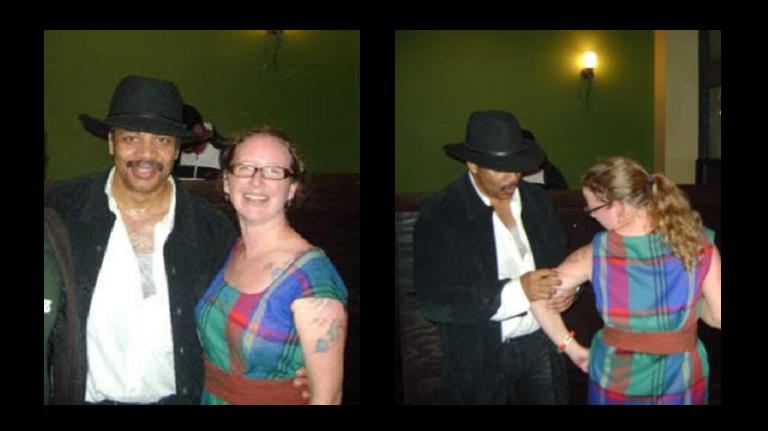
The groping incident allegedly took place at an after-party following the AAS meeting in 2009, which took place in Long Beach. This was supposed to be a lighthearted social event to show that astronomers could have fun, according to Dr. Allers.

“Tyson was there, and he was dancing and drinking and all of that at the party, so a friend and I decided to get pictures with him,” she told me.

But after the first picture was taken (above, left), Tyson decided to explore Dr. Allers’ tattoo. It features a realistic solar system that stretches from her arm to her back and collar bone area.

“After we had taken the picture, he noticed my tattoo and kind of grabbed me to look at it, and was really obsessed about whether I had Pluto on this tattoo or not… and then he looked for Pluto, and followed the tattoo into my dress.”

PictureofNDTandKatelyn-1

Accusations

Dr. Allers said her experience was public and didn’t rise to the level of assault, but that it did show Tyson was capable of some “creepy behavior.”

“My experience with him is he’s not someone who has great respect for female bodily autonomy,” she told me in a phone interview.

Dr. Allers didn’t feel like she was in danger during her encounter with Tyson, but she did describe it as “uncomfortable and creepy.” That interaction also made her think twice about allegations brought by Tchiya Amet, a musician who says Tyson raped her in his apartment when they were grad students together.

“I think that he is someone that could use his position of fame and power in a way to try and take advantage,” Dr. Allers told me.

My Opinion

As already admitted by Dr. Allers herself, Dr. Tyson was searching for the existence of the planet Pluto in her tattoo. He did that in public. Further, we have to be clear on what “into my dress” means. He was checking her shoulder. I personally wouldn’t behave this way. I definitely realise it can creep a lot of women. I am with Dr Allers when she calls the behaviour “uncomfortable and creepy”.

However, the rest of the accusations are completely made up. She herself admits that she didn’t feel like she was in danger.  This doesn’t translate into the rest of her accusations. I want to list the accusations one by one.

Accusation #1: “I think that he is someone that could use his position of fame and power in a way to try and take advantage.”

The choice of words here is very clever. One can say this about anyone. I can accuse Dr Allers as someone who sounds too creepy and could manipulate a situation to her advantage. Such a point cannot win the opponent a libel case even when the accusation has no basis. However, reading them in a sentence sends an extremely strong message. Going further, what does she mean by taking advantage? What evidence does she possess? It is an exaggeration of a creepy act beyond proportion.

Accusations #2: “My experience with him is he’s not someone who has great respect for female bodily autonomy”

I don’t see any other experience she has mentioned with Dr. Tyson other than the one at the party. She has then generalised it as someone who doesn’t respect female bodily autonomy. Is there evidence to believe that Dr. Tyson wouldn’t have done it if a guy wore a T-Shirt and showed off his solar system tattoo? What do she mean by respect for female bodily autonomy?

Irrespective of one’s gender every individual would have done something in life which could be perceived as creepy or sometimes is creepy. Doing something creepy doesn’t extend to other forms of guilt. In 60 years of his life which includes a lot public interaction and scrutiny, if people can only find a couple of creepy mistakes he made, then I consider that a very well lived life. It is also very important to note that one behavior is not a pattern. We can accuse him of that only one incident but not extend it to pronounce him guilty of mistakes we don’t have any evidence.

Incident #2: Ashley Watson

Ashley Watson was a former assistant to Tyson.

Event

Watson says she had been working directly under Tyson, who called out Trump in 2016 by saying he would grab him by the crotch when they met, and that they got along well. That all changed, however, when he invited his underling to his apartment at around 10:30 P.M. to “share a bottle of wine” and “unwind for a couple of hours.”

Watson, who said she felt pressured to impress her superstar boss, told me she agreed to come in for a glass of wine instead. Upon entering his apartment, Tyson allegedly took off his shoes and shirt, remaining in a tank top undershirt. Unfortunately, the night only got more awkward as Tyson, who is married, reportedly put on romantic music and replayed the most graphic parts.

She says Tyson soon brought out a cutting board and a knife to cut blocks of cheese that he decided they would share. But before slicing the snack, he allegedly gestured toward her with the knife and made a comment about stabbing.

Watson says Tyson started talking about how every human being needs certain “releases” in life, including physical releases. He reportedly mentioned how difficult it had been for him to be away from home for several months.

Watson says Tyson asked her if she needed any releases, and she responded with a story about sexual harassment she endured in the past. It was a smart way to diffuse a tense situation, but she says he was unfazed.

It was like talking to a wall,” Watson said.

She was getting up to leave when Neil allegedly stopped her, saying he wanted to show her a “Native American handshake” he knew. That involved holding hands tightly, making eye contact, and feeling for each other’s pulse, Watson told me.

When she broke off the awkward and incredibly intimate handshake, which he allegedly said represented a “spirit connection,” she attempted to just get up and leave.

Tyson then allegedly put his hands on her shoulders, and said he wanted to hug her, but if he did, he’d “just want more.”

Watson says she left Tyson’s apartment quickly after the inappropriate sexual comments and that, the next day, she confronted him because she felt he had betrayed her as a mentor. He reportedly told her in that meeting that she’d never rise through the ranks in her career because she was too “distracting.”

Accusations

Watson said Tyson occasionally made “misogynistic comments,” and that he kept a list of overweight actresses on his phone to prove that women aren’t inhibited by portrayals in the media when it comes to health and fitness. He allegedly said it was untrue that women feel pressured to be skinny based on societal standards.

Watson says she took the comment as a bad joke, but it’s important to note that this type of “joke” is exactly what people in power need to keep in mind when dealing with subordinates. And it set the stage for a night filled with subtle intimidation and sexual advances.

“It was definitely a very weird power move,” she said.

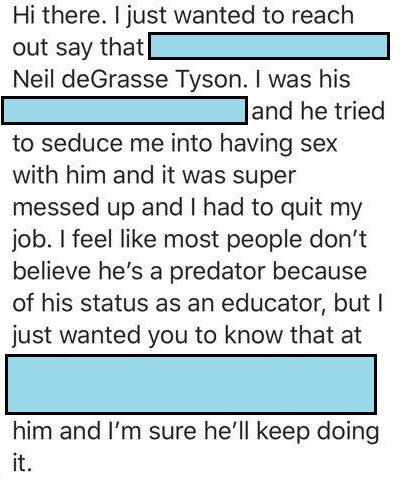
47057850_468079437049571_5175338366505320448_n

My Opinion

There are two accusations here.

Accusation #1: Misogynistic comments

How did Dr. Tyson keeping a list of overweight actresses in his phone and stating that women aren’t inhibited by portrayals in the media become a misogynistic comment? If anything he is being critical of the media portrayal of women and suggesting women are not pressured to feel skinny. He is arguing for normal women here. Misogyny is defined as the dislike of, contempt for, or ingrained prejudice against women. On a different note, this accusation seems to be a case of misandry.  It looks like a case of confirmation bias. If the starting position is ‘I believe men like Dr. Tyson are misogynists’, then it is not a big leap of faith to consider this comment he made about overweight women has to be misogynistic. Also, it is important to note that she has accused him in hindsight. This is not what she felt when she first made the comment.

In hindsight, there were red flags that she “chose to not pay attention to,” Watson told me in an interview.

Accusation #2: Sexual advance and predatory behaviour

I want to list all the ‘sexual advances’ that Dr. Tyson has been accused here.

  1. Inviting to share a “share a bottle of wine” and “unwind for a couple of hours.
  2. Took off his shoes and shirt, remaining in a tank top undershirt
  3. Put on romantic music and replayed the most graphic parts
  4. Tyson soon brought out a cutting board and a knife to cut blocks of cheese that he decided they would share
  5. Made a comment about stabbing
  6. Talking about human beings needing releases
  7. Native American handshake
  8. Saying he wanted to hug her, but if he did, he’d “just want more.”
  9. Saying she was too distracting

If I look at the evidences presented above from point number one to seven, the way I perceives the situation will depend on the below points.

  • How well do the individuals know each other?
  • Was there a demand for sex or at least physical contact?
  • Was there a threat of repercussion if you don’t submit to his will?
  • Was there contact in a way which indicated requesting for a physical relationship?

It is important to note that we are living in a free world where anyone can ask another person if they are interested in having a relationship. Anyone can reject the call for a relationship. There is an issue only if you are discriminated for not consenting to the wish or if you are forced without your consent. Even if I accept that this was a move made by Dr. Tyson to have a romantic relationship, it is still a call for consent and nothing more.  I am beginning to wonder if people now are against checking for consent or romance.

Finally, coming to the last point where Ashley Watson was apparently told that she was too distracting by Dr. Tyson. What does that ‘too distracting’ mean? Does it mean he is distracted by her? Did he say she was too distracted? Either opinion is his view of the situation. It wasn’t a sexist remark. I have been told that in the early years of my career by both men and women when I went to them with complaints. It had nothing to do with wanting to have a relationship. I didn’t agree with their response but it definitely doesn’t make them sexist or misandrist.

Now, let’s look at the definition of a sexual predator. A sexual predator is a person who ruthlessly exploits others sexually. Where is the evidence of Dr Tyson ruthless exploiting even one person let alone many people? This careless use of accusatory words without presenting a shred of evidence has become a cornerstone to such cases.

Incident #3: Tchiya Amet

Tchiya Amet is musician, healer, and teacher, who claims have studied Galactic Astronomy in the graduate program at the University of Texas in Austin when Dr. Tyson also studied there.

Event

Amet said the alleged assault started when she went to his apartment to visit, like she did almost every day.

He offered me a glass of water. I accepted a liquid in a cup made out of a coconut shell. I recall coming back to consciousness briefly, then next thing I remember is seeing him in the hallway the next day. I have lived in this nightmare for 30 years, and it stops today.

I know this will be difficult for many of you to believe, understand or to know. However, know that this is the truth. Those who know me well can attest to the fact that I lived with undiagnosed PTSD of [at] least 25 years.

She also said Tyson was the reason she didn’t further pursue her dream of reaching the stars and becoming a full-fledged astrophysicist, and accused him of telling students they could pass Astronomy 101 if they gave him a blow job.

He talks about obstacles to reaching his goal of astrophysicist. Did anyone slip him a mickey? Perhaps this was his way of eliminating the competition….what a scam YOU are Mr. Tyson…

How does it feel to know that YOU are the reason there is one less [black] female galactic astronomer on this planet? Yes, YOU. How many freshman students did you give A’s to when they were failing? Were they really failing, or was that just an easy way to get free blow jobs?

Accusations

Dr Tyson has been accused of raping Tchiya Amet here. This is a serious accusation.

My Opinion

I want to start by saying of the three accusations, this one is extremely important and requires proper analysis. Rape cases are extremely serious and cannot be judged on individual biases.

Firstly, Tchiya Amet says she went to Dr. Tyson’s apartment every day. Is there a point here which hasn’t been covered. Were they in a romantic relationship or just friends? Did they have any physical relationship prior to the incident or after that? These points are important to understand the circumstance of the alleged incident.

Tchiya Amet says she doesn’t remember anything after that. Is there evidence that he actually raped her? What made her believe it happened? Let us say she became unconscious, how did she reach the hallway. When there is no evidence of the actual rape, it is important to understand the circumstances before and after. This is where the lack of coherence in this story feels like statements have been cherry-picked to suit a narrative.

Tchiya Amet claims to have undiagnosed PTSD for 25 years now. What is ‘undiagnosed’ PTSD? How does she know she has PTSD? On face value, I want to take the point as true. That still doesn’t prove he raped her. It requires a huge leap for faith. Now, what Amet’s motivation in doing this? I don’t know and I don’t want to speculate. If she can provide any evidence on this then we can definitely change our opinion.

Against without either direct or circumstantial evidence of rape, accusing a person is a case of vilification and slander. It is important to investigate this incident but the starting position shouldn’t be guilty until proven innocent.

Dr. Tyson’s response

Dr. Tyson gave a response to these accusations in his facebook page.

There are a few lines I want to highlight here.

For Dr. Katelyn N. Allers

I only just learned (nine years after) that she thought this behavior creepy. That was never my intent and I’m deeply sorry to have made her feel that way. Had I been told of her discomfort in the moment, I would have offered this same apology eagerly, and on the spot. In my mind’s eye, I’m a friendly and accessible guy, but going forward, I can surely be more sensitive to people’s personal space, even in the midst of my planetary enthusiasm.

It is important to note that he hasn’t denied doing it and is more than happy to learn from his mistakes. In this case, it was a creepy behaviour at best which had no sexual dimension to it.

For Ashley Watson

We became so friendly that we talked about all manner of subjects, even social-personal ones, like the care of aging parents, sibling relationships, life in high school and college, hometown hobbies, race, gender, and so forth.

Practically everyone she knows on set gets a daily welcome-hug from her. I expressly rejected each hug offered frequently during the Production. But in its place I offered a handshake, and on a few occasions, clumsily declared, “If I hug you I might just want more.” My intent was to express restrained but genuine affection.

Afterwards, she came into my office and told me she was creeped out by the wine & cheese evening. She viewed the invite as an attempt to seduce her, even though she sat across the wine & cheese table from me, and all conversation had been in the same vein as all other conversations we ever had.

Further, I never touched her until I shook her hand upon departure. On that occasion, I had offered a special handshake, one I learned from a Native elder on reservation land at the edge of the Grand Canyon.

At that last meeting in my office, I apologized profusely. She accepted the apology. And I assured her that had I known she was uncomfortable, I would have apologized on the spot, ended the evening, and possibly reminded her of the other social gathering that she could attend.

I note that her final gesture to me was the offer of a hug, which I accepted as a parting friend.

This is another case of just mistaken intent. To make this more out of this is purely conspiratory.

For Tchiya Amet

While in graduate school I had several girlfriends, one of whom would become my wife of thirty years, a mathematical physicist — we met in Relativity class. Over this time I had a brief relationship with a fellow astro-graduate student, from a more recent entering class. I remember being intimate only a few times, all at her apartment, but the chemistry wasn’t there. So the relationship faded quickly. There was nothing otherwise odd or unusual about this friendship.

This goes back to the same question I had. If she visited his apartment every day then does that mean they were going around. Did they have any physical relationship other than the ‘rape’ every day? Was the breakup mutual?

Other articles on this subject

It is important to look at the other articles written about this subject to uncover the broader conspiracy going on here.

In Scientific American

But all of the men who have harassed or assaulted me have said similarly encouraging things, so the fact that I have had multiple positive interactions with Tyson over the years doesn’t make it harder to believe that he is guilty of serious misconduct.

But my own experience—backed by data—teaches me that Black patriarchy is real and the harm specifically to Black women is significant. In this case, the harm is multidimensional: I believe Amet is the victim, and to a lesser extent, so are all of the Black people who found inspiration in Tyson’s visible presence as the world’s most well-known Black scientist.

But in my view, I believe the claims are credible, which means he directly harmed multiple women, most egregiously by allegedly raping a member of his own already marginalized community. Tchiya Amet is a Black woman who will never join me on the list of African-American Women with PhDs in Physics. She deserved better. Our whole community did.

This specific individual has made this entire thing into a Black Women identify fight. She wants to bask in the victimhood of other and hog sympathy from it. Such people who want to play politics and gain sympathy from other victims are the genuine predators. These people result in the victims not actually getting their due.

In Salon 

Over the course of the MeToo era, the practice of hero worship feels increasingly absurd. I would like to celebrate the things that people do, when they are worthy of celebration, and not make it a blank check of approval for who they are. All people are flawed; some are evil. That little girl need not look up to Neil deGrasse Tyson the man; but I don’t believe that should negate the confidence in herself that he may have helped to build.

A block of encouragement from an imperfect person should not make for a less steady foundation. Science is built “on the shoulders of giants,” not saints. And when they topple, perhaps we can let them go and continue to climb.

Firstly what is a MeToo era? The author, Eve Andrews seems to drive us towards a post-truth era filled with people who are unable to look at the evidence before forming a conclusion. Eve Andrews has formed a conclusion based on accusations. It is also an ingratiating and incoherent article. For example her point on hero worship. I don’t believe in hero worship either and no one is asking anyone to workship Dr Tyson, least of all Dr Tyson himself.

The only point I can see about the author’s mention of #metoo movement is that she has used the MeToo standards to obliterate Dr Tyson. It is critical to note I don’t think we can’t climb the mountain of science on her shoulders as she doesn’t have much respect for evidence.

In Patheos

Another one bites the dust: Neil deGrasse Tyson is being investigated after allegations of rape, misogynistic comments, and inappropriate sexual advances.

This again is a clear slander against individuals to gain momentum for this MeToo movement. The author now has to define what is a sexual advance and what is the difference between appropriate and inappropriate sexual advance? I am more concerned about the smears than the tautology in the sentences.

Dangers of this trend

I am extremely sure based on the evidence presented Dr Tyson cannot be pronounced guilty. However, that is not the consent the media wants to drive. Therefore, this is a very dangerous trend. I want to assert why I consider it dangerous.

A post-truth movement

This movement is not worried about reality or at least truth based on reality. They want to act on what feels emotionally correct and not on facts. There is a difference between true predators like Harvey Weinstein, Bill Cosby, Roger Ailes and someone like Al Franken. However, the movement doesn’t differentiate. This lack of differentiation between facts and emotions is at the root of this new climate.

A retributive movement with selfish allies

I am observing signs of war against different sections of the society. In the intersectional oppression chart a straight, white, conservative Christian male is most liable to make a grave mistake. A person who belongs to this category can be pronounced guilty even without an investigation. Then this trend continues to other groups. For example, a male is always guilty of sexual misconduct once accused. A white Christian is always guilty of white supremacy once accused. None of these accusations seems to need any evidence.

The people fighting this war do not want justice but they want retribution. They want to punish people for the generations of hostility and discrimination done by their predecessors. These retribution movements are also fed by selfish allies like Vox, Buzzfeed and Salon. The allies provide the much-needed oxygen and in turn, use the movement to propel them to the limelight.

The retributive nature of this movement is also the reason why one might see two patterns.

  1. The attack is always on high profile people irrespective of their race or political spectrum. It hasn’t resulted in the everyday predator being impacted.
  2. The movement is losing people who will otherwise declare themselves as feminists like Richard Dawkins or Sam Harris.

High profile targets are always the best to get attention. This is the same tactic used by extremists and terrorists. This #metoo movement is not alone. It has to be looked in conjunction with other such movements like ‘Women’s March’, ‘TimesUp’. ‘Black Lives Matter’ etc.

Finally, many scholars and scientists claim that earth’s climate change is the biggest risk to our human progress. I personally feel this social climate change of post-truth is an even bigger risk to our progress. Historically other social movements were intended to take us towards truth, eliminate barriers and emancipate individuals. This is the first time we are having a social movement which wants to take us away from science, progress and development. If we let this movement win, then truth based on reality will lose its complete relevance and with that will science. Dr Neil deGrasse Tyson is a victim of this new climate and if we don’t act it could be the future we never wanted.

Harnessing the power of stories, a non JP way

I should admit guilty of the unsolicited cheap shot at Jordon Peterson in the title of the blog. I am with Sam Harris on Dr Peterson. While I agree and respect 90% of his views, the balance 20% is shatteringly dismal. This blog is not intended at Dr Peterson though. I wanted to write about my experience with stories while acknowledging his thought-provoking methods of extracting I universal archetypes from ancient stories. I also want to share a viewpoint where an average individual who is not as smart as Dr Peterson can drift from having a metaphorical look at stories to a more dogmatic one.

Let me start in a simple fashion by defining an archetype. Archetype has its origin in Greek where ‘arkhe’ means primitive and ‘tupos’ means model. This morphed in archetype in Latin. In psychoanalysis, according to Oxford Dictionary, an archetype means a primitive mental image inherited from the earliest human ancestors and supposed to be present in the collective unconscious. Archetypes (Carl Jung, 1947) are images and thoughts which have universal meanings across cultures which may show up I dreams, literature, art or religion. Dr Jordon Peterson eloquently communicates how the religious texts of the past and other forms of fiction have communicated these archetypes by harnessing the power to stories. He quotes the works of philosopher Friedrich Nietzsche a lot in this regard. The part where he loses everyone including me is when he doesn’t separate value from the truth. There are two parts to his approach.

  1. Use of stories as a potent tool to communicate a message
  2. Considering the story as true, because the message is valuable to humanity.

I want to address both these points, first in isolation and then as a combination.

Stories as a potent tool to communicate a message

I agree with this statement completely. I will start with a personal example first. I have found out the best way for me to communicate morality, understand concepts even mathematics is through stories. A simple story makes her pick the concept so effectively which I struggle to get through when I explain in the first person. She thinks about it a lot better. The same can be said about communicating complex subjects to adults. Some of the best examples of fiction writers are Friedrich Nietzsche, William Shakespeare, Mark Twain and George Orwell actually communicated their ideas through stories. This is also the reason why the field of performing arts is uniformly adored across the globe. It is a great way to communicate a message. A story is to message is what music is to lyrics. You can have one without the other but the combination creates magic. It is also a way the human brain processes a message easily.

A story is true because the message is valuable to humanity

The pursuit to a definition of truth is an old philosophical concept. The most commonly used definition of truth is based on the correspondence theory of truth, where truth is grounded on a set of facts proven by the basic axioms accepted by everyone. There are various theories of truth in philosophy. I have listed a few here.

  • Correspondence theory of truth
  • Coherence theory of truth
  • Constructivist theory of truth
  • Consensus theory of truth
  • Pragmatic theory of truth
  • Semantic theory of truth

Dr Peterson has a morphed view of the pragmatic theory of truth, which was later named metaphorical truth. He feels reality which isn’t morally good is not true. For example, any reality which will result in annihilation and destruction of humanity is not true. He feels the moral truth superimposes all other truth. The other truths are only true in their realms. I don’t subscribe to it for the below reasons.

  1. There was  truth before humans evolved
  2. There will be truth after humans become extinct

The Andromeda galaxy and the Milky Way galaxy will collide even if we don’t want to think it is true. There are plenty of other examples where I can say Dr Peterson’s morality based truth can even be dangerous. Also, there is a Circular reasoning fallacy in his argument. Dr Peterson’s claims that Darwin’s theory of evolution is the basis of his truth. Truth is what which helps in keeping humans alive and moral. Darwin fundamentally negated the foundation of the Judeo Christian ethics in which God created the universe and humans, around 5000 years ago. Peterson then says scientific reality is only true when it supports morality, especially the Judeo Christian one. Based on that Darwin’s theory of evolution which negates this premise should be false.

I have to discuss the nature of truth as that is the only connector in the premise. I accept something is a story. I accept there are morals valuable to humanity. Now we all have to decide which theory of truth we are using to decide if the premise is true or false. If we use the most prescribed theory of truth, the correspondence theory then Peterson’s assertion is not true. If you use his definition, then the proposition will be true. However, we have already rendered the logic of that definition as flawed.

There is definitely a possibility where one might say, I have used logic to negate the definition and Logic is fundamentally a construct of the correspondence theory. So, I have used the proposition to prove itself. It is a begging the question fallacy but again I have used logic. So anyone might see I can infinitely regress but one has to move out of the dimension of logic and reality to get into Dr Peterson’s world of truth.

A story is a potent tool, so I live my life like the story is true if it leads me to live a moral life

This statement sounds obnoxious and even a decent one at the outset. However, if you dig one level deep there are few fundamental parts of this which make it extremely diabolical. The core of the statement is moral life. Who defines what is a moral life. Let us say you define morality as something which will help humans prosper. Then the issue is what is prosperity and how to achieve that prosperity.

Now, let us take examples. A suicide bomber genuinely believes he is doing a moral act by living his life as the work of fiction he believes says. What do you say about slavery? Slavery is condoned in most religious texts across the world. These works of fiction are considered moral and are supposed to help us lead a moral life. I don’t think any sane individual wants to go back to that era.

In summary, I strongly agree with Dr Peterson that stories are a powerful tool to communicate a message. The message registers better and transcends generations. However, the validity and usefulness of the message don’t make the story true. If you start living your life like those stories are true, then you risk pledging your critical faculties to a work of fiction and live a life of servility and credulity.


10 criteria for identifying a stupid

My friends asked me whom do I call stupid. Considering my loathe to stupidity, they wanted to understand my model. Here are my 10 criteria for identifying a person as stupid. Two questions for you. How many do you disagree? What percentage of the world do you think fall under this group?

  1. Anyone who thinks the earth is flat or universe was created 5000 years ago.
  2. Anyone who looks at the evidence and turns the other side to say my belief is the truth
  3. Anyone who thinks that they have a divine commandment to impose their will on others or discriminate against them
  4. Anyone who preaches against contraception or the empowerment of women
  5. Anyone believes they are superior by the accident of birth
  6. Anyone who is expecting logic to prove the non-existence
  7. Anyone who wants to procreates indiscriminately
  8. Anyone who acts like the reason for all their problems is someone else
  9. Anyone who wants to take the world to the values from the Bronze Age civilisations
  10. Anyone who looks at a new scientific evidence and claims that their faith encompasses those evidence.

So far the answer to these questions has been

Agree: 100%
Population percentage: 80% approx

I feel there are two main reasons why it is hard for people who agree with the above facts and still not able to distil it.

  1. The erosion of the premise that the majority of the people are not decent and not stupid is beyond their realm of acceptance. It shakes the foundations of camaraderie and kinship.
  2. People have friends and family who fall into this category. It creates a cognitive dissonance when they have to deal with the two. It is hard to call someone you love, adore, respect as stupid.

The one point I keep telling myself is reality and as an extension truth has no obligation to be to my liking. It is for me to stare, admire and feel challenged.

I am definitely looking to convert this into a model and introduce a dangerousness coefficient based on it. I will definitely update the blog after that.

The seven useless descriptors in 2018

The one word which has been removed from the social vocabulary over the last few decades, especially in West is the ‘N word’. There weren’t any regulations against it but people just stopped using it. No one even respects an individual who uses that anymore. I do know that it is still used in some countries like India and Singapore but overall no one uses it anymore as it has become devoid of any utility.

Keeping the tradition of George Carlin’s ‘ Seven Dirty Words’, I want to share seven words of no social utility in 2018.

  1. Racist
  2. Fascist
  3. Nazi
  4. Free speech crusader
  5. Skin colour(Black activist, brown man, white supremacist)
  6. (Native, African, Asian, European, Indian) American
  7. Islamaphobe

Let me address one point before I take this forward. I do not think there aren’t fascists or racists or Nazis but these words have baggage which is not applicable for a conversation in 2018. Now, I want to go through each word and share why I feel that way. I feel the main reason behind the continuous use of these phrases is that these were some of the important phenomena of the twentieth century that affected people’s lives.

Racist

This term has lost its utility because of two key reasons.

  1. It is only used against white people and that too quite indiscriminately. I have never seen it used against people of Chinese, Indian or African origin. I have seen just as much racism in these cultures as the rest.
  2. The term has become so abused that we are failing to distinguish between people who are really racists or in some instance genocidal against normal people with whom we disagree.

Fascist

Just like racism, I am seeing this term being used against everyone. Many democratically elected leaders from Barack Obama to Donald Trump have been called fascists. Fascism as defined as “the radical authoritarian ultranationalism, characterized by dictatorial power, forcible suppression of opposition and control of industry and commerce“. Any pro-democratic leader cannot be called fascist.

Nazi

Similar to Fascism, National Socialism is a movement defined by the ideology of the Nazi party. The term was coined towards the end of the 18th century. Again not every socialist is a Nazi and not every racial supremacist is a Nazi. It is a significant attack on an individual when you call them a Nazi. It is one thing to call someone a Nazi sympathiser but a leap of irrational faith to call them Nazi. The movement doesn’t exist but for certain pockets. Above all most of them are banned. Even organisations like KKK are not Nazi organisations.

Free speech crusader

This is my pet peeve for this list. I am tired of unintelligent people gaining attention because they referred to themselves as a free speech crusader. I haven’t seen many free speech crusaders in my life. I most definitely don’t see any now. Most of them (even some people I like) like Sam Harris, Jordon Peterson, Douglas Murray, Maajid Nawaz, Bill Maher, Milo Yiannopoulos and Dave Rubin to name a few become free speech activists when

  1. Something doesn’t offend them but there is a general furore around it
  2. Something they say offends people and there are protests against it
  3. Something someone says that they like and there are protests against it

Quoting George Carlin, narrow and selfish interests don’t impress me. I find such crusades to be repugnant just as the people whom they fight.

Skin colour adjectives(Black activist, brown man, white supremacist)

I find this particularly annoying when people refer to others with their skin colour. However, there is a particularly annoying stereotype in this as well. It is never a Black or a Brown Supremacist and a White activist. It is always the other way around when you use the skin colour adjectives. Furthermore, it is always used by people who are against racism.  It is meaningless and above all counterproductive. I also want to differentiate this from people who are comfortable in a neighbourhood of a certain ethnicity. There is nothing wrong with a bunch of people of a certain ethnicity to want to live in the same neighbourhood. It is not racism or bigotry. Also, people like to speak certain languages or live in a certain way. If a bunch of vegan people decide to form a colony and live there, it is not an issue for me. Even if they think that vegans are the best and there should be a country for vegans, I am still fine. Where it becomes a problem is when they infringe on other’s right to exist or live their life a different way. If I replace vegan with white or black or brown, the core of the argument still remains the same. This makes any description of a bunch of people using their skin colour counterproductive to the broad argument that we want to make.

Native, African, Asian, European, Indian American

This one is definitely an American trait. I particularly love the response of Gérard Araud, France’s ambassador to the United States to comedian Trevor Noah’s comment on calling the World Cup winning French Football Team as ‘The African Team’. He said, “Unlike in the United States of America, France does not refer to its citizens based on their race, religion or origin. To us, there is no hyphenated identity. Roots are an individual reality.”. This was followed by people calling French as not a culture for comedy or failure to call people. It does shed light on this rather unintelligent practice of calling people from where they come from and mostly based on their skin colour. Barack Obama was called African American but he was born to a Kenyan father and an American Mother. While he does have a part of his ancestry from Kenya the other part is from England. Calling him African American is both inaccurate and unnecessary.

Islamaphobe

The final one in my list is a recent kid in the block, a 20th creation which can be thrown anywhere in a conversation without it actually adding any value. There are two main reasons why I find this descriptor particularly useless. This word is used in two circumstances.

  1. One religious group who hate the other
  2. Fear of terrorism

In the first point, there is no need for a special word for hatred towards a certain religion. There is no word for hatred towards Buddhism, Jainism, Hinduism, Christianity etc. Anti-Semitism, on the other hand, it not just hatred towards Jews based on their existence, it is hatred towards Jews coming from certain religious constructs within Christianity and Islam against Judaism.

On the second point, it is a genuine problem. Most of my Muslim friends are afraid of terrorism. If calling out against radicalisation and terrorism is bad, I am not sure what is good. So, this usage is also meaningless. Actually, I feel we should rename this to “Terrorphobia” and acknowledge that it is practical.

Rescue of the Thai boys- The world needed it

The world is witnessing an extraordinary spectacle of harmony in the effort to rescue the boys stranded inside a cave in Thailand. From the United States to Australia, from the United Kingdom to China, from individuals to the government, from mainstream media to new age digital media, everyone focussed on rescuing the boys.

Like many others, I felt an emotional connection to the issue. I also felt the whole world was waiting for something to unite us instead of focusing on our differences. Entrepreneurs like Elon Musk wanted to see how he can help. The governments wanted to prove they can help. Students across the globe wanted to show solidarity. Media wanted to report on something beyond politics and hatred. The courage of the 12 boys and their coach was mindblowing. The tenacity of the rescuers and the love and support of the community was surreal.

Now that the rescue has been successfully completed, the division and bickering have started. Elon Musk is upset that his kid’s submarine wasn’t used and called one of the British rescuer ‘a Pedo’. I sincerely hope everyone who tried and even people to just prayed feel happy and stop.

As species, we can definitely look at the incident and reflect on it. Why should it take a catastrophe to bring us together? We all long for happy news which we can create. Our civilisation is not prepared for this digital noise. We all long for the same happiness, the happiness which doesn’t come from hatred, following narcissist rulers, religious fervour or name calling.

Family separation or detention: Ugly side of partisan politics

As an immigrant, I want to be very clear that I am in favour of controlled legal immigration. At the same time, it is hard to look at detention centres and separation of families and not feel the ugly side of the debate. I have so far not seen a single person across the board in any country who has said, we need open borders but somehow that accusation remains. I want to write about immigration in two parts, one on the exploitation of misery of the family separation saga in the US and second on immigration itself. I will write about the former on this blog.
Sometime last week my daughter watched a supposed comedy movie clip which ended with a teenage daughter and her father being arrested and jailed. In the middle of the night, she came to my bed crying. She said that the father and daughter being jailed is bad and she is unable to sleep thinking of them. If my daughter is unable to sleep in the comfort of her bed, having watched the plight of someone being jailed in a movie, I can only imagine the impact of young kids being separated from their parents or guardians.
There is no point blaming Donald Trump alone for this. He did promise a lot of atrocious policies and he is implementing the same. This is also a result of years of propaganda. As bad as the move was, the resulting exploitation was awkward to see. There were four types of reactions, I want to highlight.
  1. Frenzy Media
  2. Partisan supporters
  3. Opportunists
  4. Partisan opponents

Frenzy Media

As depressing as the news is, it is important for the media to report on facts rather than make it into a reality show. To show crying babies is one but for the media personnel to behave like babies doesn’t inspire confidence in the news. Some of the adequately documented reports are ones where the reports understood the emotions but reported on facts. Opinions are good but that cannot reflect adrenalin rush. Further, when the reporters are trying to make a point, they need to check what they are doing. This below video tweeted by NYT is a perfect example. You don’t show late teen boys if you are trying to make a point on the unaccompanied migrant issue.

Partisan Supporters

I did not expect anything factual or reasonable or remotely nice from a person like Ann Coulter, especially on the subject of immigration. However, what was really appalling to see was the comparison of the immigrants to child rapists and gangsters. This is exactly the kind of rhetoric that intends to instil fear in the minds of people. Also to say we have to treat people seeking refuge humanely has nothing to do with not treating your own people badly. Treating everyone humanely cannot be considered as a ill-treatment of a few. Also, when one generalises immigrants from certain countries as criminals and rapists and criminals from other countries as individuals, it lacks any credibility. Further, no one I saw in the media actually wants open borders and uncontrolled immigration. To keep harping on that point and giving it credibility in the media is the very embodiment of fakery. It is also quite hypocritical when Tucker Carlson does this and complaints about the lack of decency in the left.


Opportunists

As bad as they are, the above two responses are in the expected lines. To me personally, the lines of decency are crossed when one starts to utilise such a situation for their personal agenda. For example, Dave Rubin tweeted the below. It not only delegitimised the opposition for this order, it also the wrong problem to highlight your libertarian agenda.
Firstly, he calls out Senator Chuck Schumer for not wanting to discuss this in the Senate and handle it through the executive branch. He highlights this as some kind of laziness on part of the senator. He also is hinting at this driving some kind of authoritarian streak. This argument doesn’t stand for two reasons.
  1. This situation was caused by an executive decision. So, it makes sense for the executive decision to reverse it. A bill through house and senate takes more time. It is not easy at the time of an emergency. 2000+ kids are already affected and one can’t wait for bills to be passed.
  2. The existing immigration bills in the House are bait instruments more than bills. It combines DACA renewal with building Trump’s border wall. It is not a bill that will ever get passed.
Secondly, he sarcastically points out at Trump repealing the separation order by making fun of people who compare Donald Trump with Adolf Hitler. I do not agree with the comparison of President Donald Trump with Adolf Hitler. We are pattern seeking mammals and want to compare one thing we don’t like to the other thing we don’t. That said, Donald Trump should not get credit for reversing an order that will stop the damage which he triggered in the first place. This is called fishing for credit where credit is not due.

Partisan opponents

This piece will not be complete without talking about Maxine Waters. Maxine is a democratic congresswoman from the state of California. Dignity and civility should not be optional traits in a civilised world. It is not an excuse to be uncivilised if you believe your opponent is wrong or even undignified. Maxine called for supporters to confront people in the Trump administration. This is a blatant call for harassment and will incite violence. You cannot become the monster you hate. If you oppose Trump’s lack of civility, you cannot retaliate with uncivil behaviour. Maxine’s behaviour definitely was uncalled for and diluted the entire opposition to this policy. The unruly opposition, in general, will only result in de-legitimising valid, civil opposition. No amount of blame transfer from Maxine can defend her call to confront and harass Trump administration officials who show up in public places.

Remembering 26-June-2015

It is hard to look at the calendar on 26th of June and not feel bad for the events of 26-June-2015. It is worse when the day happens to be your birthday. I still remember waking up on that day to hear the deadly news and continue to hear more during the day. Over 400 died across North Africa and Europe and an equal number injured. The Wikipedia page on this attack provides some details.

I do not want to make this about me but it is hard to wake up to wishes and not remember this event every year. The selfish human trait does come to the forte irrespective of my will.

My daughter was 3 years old then. It continues to be gut-wrenching to think, how many of those victims had kids like me? How many were kids? How many had dependant families who are still in shock? How many of them were setup to take our civilisation forward?

I do not want to drone on or traffic on the abject misery of the victims. As life moves on, I want to pause a minute to hope well for the victims of not just this attack but attacks all over the world. I promise to continue the fight in my simple way to emancipate the world from the horrors of religions. Some part of me also hopes people who read this do the same. Empathy is hard in general but humanity can definitely come together to eliminate the evil cause that results in such horrors. It is a lot easier to be empathetic to this cause or at least I hope.

The curious case of Tommy Robinson

“A far-right thug … ”
“A martyr for English values …”
“A freedom of speech crusader …”
“A racist, bigot & Islamaphobe …”

These are common phrases one would see when reading an article about Tommy Robinson. As the world started reading more about him, I case see people jumping on to the extreme camps which reinforced their messaging rather than what has happened. I want to add to that mayhem by providing my viewpoint based on the facts I received.

Tommy Robinson’s original name is Stephen Christopher Yaxley-Lennon. His personal life and history are clearly articulated in his Wikipedia page. Douglas Murray wrote one of the more balanced pieces on this story in the National Review.  I want to break the entire history down into a few headings. I have deliberately ordered it in a way where I cover all the opposition to Tommy first before discussing points in his favour.

  • The latest arrest is within legal limits
  • Tommy has committed offences which deserve investigation and prosecution
  • Tommy is not a racist but his movement attracted the wrong people
  • His concerns are real and need attention
  • People who should have supported him deserted him

Point #1: Tommy’s arrest is within legal boundaries

Many people across the globe are treating this arrest as some big deep state conspiracy against free speech. It definitely is not. The UK has some clear rules against reporting on ongoing court cases. Last year, Tommy Robinson was arrested and later convicted on contempt of court for the same reason. He attempted to take videos of defendants in a case held in Canterbury Crown Court. The judge pronounced him guilty and gave him a suspended sentence. He was clearly told that this is a breach and has nothing to do with freedom of speech or press. This year he did the same outside Leeds Crown Court. He was arrested, charged and taken to court. In the court, Tommy pleaded guilty and was subsequently sentenced to 13 months imprisonment. It is easy for people to do not understand the laws, to cry foul. Is it worth debating about the law? Yes, I would definitely say so. Was the law flouted to arrest Tommy? I do not think so.

Point #2: Tommy has committed offences which deserve prosecution

This is a point which Tommy Robinson himself has acknowledged. He has committed some offences which make him liable for prosecution. For example, he travelled to the US with a fake passport under the name Andrew McMaster. He was detained in New York for a drug offence and subsequently came back under another fake name Paul Harris. Early on in his life, Tommy was also convicted for assaulting an off-duty police officer. In 2014, Tommy was convicted of fraudulently misrepresenting information for a mortgage application, which he pleaded guilty. So, has Tommy committed offences? Yes, he has and he has admitted it publicly. Is there state out to get him anytime he commits an offence? It is possible.

Point #3: Tommy is not a racist but his movement attracted the wrong people

As many people want to make it, I haven’t seen any evidence of Tommy Robinson being a racist, bigot or an antisemite. I do not want to use the word Islamaphobe as I find the word useless with absolutely no intellectual value. The evidence I have seen of Tommy being those are below.

  1. Tommy Robinson has continuously claimed how the fellow Muslims in his community have supported his movement. He has also credited people the Quilliam foundation as some of the best people he has met. The people he praises are not white.
  2. Tommy has voiced concerns for the well being of the blacks, the non-muslim Asians in his community. I haven’t seen him ignore or belittle their problem.
  3. Tommy felt sad for the jews from Luton who moved to Isreal fearing their safety. He wanted them to stay back and live their life here.
  4. Tommy along with his English Defence League members burnt a NAZI flag to denounce white racial supremacy. This was followed by some NAZI sympathisers burning the EDL flag.

I can provide more evidence on the above but the point is not moot. However, it is also true that his movement attracted the wrong crowd. This is again a point which Tommy himself agrees. The English Defence League attracted genuine racists as they finally found an avenue to legitimise their claim and status. It also attracted people who were generally disillusioned with the government and wanted a means to revolt. It also attracted hooligans. This continues to this very date. Some of the protestors for Tommy Robinson’s release have a very different view from Tommy Robinson himself on what they want and what they believe. Some people as seen in their chants have no idea of Tommy’s beliefs and have joined the movement as it feels in line with their idea of truth.

Point #4: Tommy’s concerns are real and need attention

The concerns which Tommy Robinson raised are actually real. It not only affects the non-muslims in the area but also the Muslims. The same points which Tommy Robinson raised were also raised by Douglas Murray and Maajid Nawaz. Irrespective of one’s opinion of Tommy Robinson the two underlying problems are actually real and needs attention.

  1. The Grooming Gangs which exploit young, underage girls
  2. The radicalisation of young desolate Muslim men

The former continues to be a big problem. The group has a disproportionate percentage of men who identify themselves as Pakistani Muslims. Again, it is important to see that the same has been acknowledged by people like Maajid Nawaz. The Rotherham child abuse scandal is a detailed account of the atrocities committed by the grooming gangs in the UK. Tommy Robinson brought that to everyone’s attention. Any decent individual who looks into the facts will feel the pain.

The  Luton division of al-Muhajiroun, which was formed by Anjem Choudary was responsible for the radicalisation of young Muslims in the late 1990s and early 2000s. Anjem is behind bars for inviting people to join ISIS. His organisational-Muhajiroun has been responsible for a lot of attacks in the British soil. Tommy raised voice against this in the early 2000s. The United Kingdom is one of the top breeding grounds amongst developed nations for the banned organisation ISIS/ISIL.

Point #5: People who should have supported him deserted him & Britain

Nothing exemplifies the stupidity in the system than this particular set of questions and answer session held at the Oxford Union. The videos are available in public domain and I request anyone opposing Tommy to listen to the Q&A at the end. This event happened in 2015. I want to highlight some of the questions asked.

  1. Why did you think six years ago, you did not think it is a good idea to sit and debate with the Muslims or lobby the foreign policy of the government?
  2. There are tensions on both sides, far right and the Muslim extremism. Why don’t you talk about the focus on the far right which attacks of the Muslims?
  3. The EDL protest would have created even further division in our borough. You said it is a Muslim problem and non-muslims can’t solve it. Your involvement with the EDL made the divisions between moderate Muslims and the extremists larger. That is what the extremists want. Do you admit that your involvement with the EDL, in the long run, helped these extremists?
  4. I am Muslim-Pakistani. Throughout your speech, you were talking about Pakistani Muslim gangs, Muslim men raping girls. Do you see a problem in identifying any sort of criminal as Pakistani and Muslims before identifying them as terrorist or rapist?

I remember an incident during an event when a participant asked a bad question to Christopher Hitchens and he responded by starting with, “What a stupid question!!”. These questions from the students of the Oxford University are extremely similar. They are blaming a victim or a person fighting for the victims. Their contention is why he didn’t use the right language, why he wasn’t patient, why he did not use the right caveats and above all why he got involved at all.

This attitude or mostly negligence has created this hostile environment in the first place and not Tommy Robinson or the perceived generalisation. It is easy to dismiss concerns of communities under the name of bickering or worse of all bigotry. Such dismissals, in the long run, will result in antagonism, disillusion and revolts.

In summary, Tommy Robinson has committed mistakes but none of his mistakes is as grave as the ones committed by people he was opposing. I would go to the extent of saying that had the people in power acted lawfully and morally against the grooming gangs and radicalisation, Tommy Robinson would not have been the cult figure he is now. It is the failure of the complete system to provide justice to the innocents which have resulted in this chaos.  The government will only ignore it at its own peril.