
Helen Reddy – Teaching us to roar

For over a decade the year 2020 was earmarked to be a milestone year in both business and politics. However, no one could have foreseen the horror that hit us. The world was unprepared to deal with a pandemic of this proportion. The official figure states that approximately 80 million people have been affected and over 1.75 million have died. Plenty of people have lost their near and dear ones. In the process, we have also lost some global icons like Diego Maradona, Kobe Bryant and Sean Connery. However, the two who have left an indelible mark in public sphere were Ruth Bader Ginsburg and Helen Reddy. I want to take a moment and reflect on the latter, a woman who became an representation of the second wave of feminism with a single song.

Some people have an impact which goes beyond their actual work. They inspire a generation. Helen Reddy was such an inspiration. When most cultures of the world were still stuck with prehistoric myths about women, the counter culture and the feminist movement made huge strides in taking civilisation forward. The civil rights is much more than Dr. Martin Luther King Jr and “I have a dream”. The free speech movement is much more than Mario Savio and “Bodies upon the gears”. The feminist movement is also much bigger than Helen Reddy and “I am a woman, hear me roar!”. However, both the individual and their work had a significant impact in shaping up an entire generation.

The biggest mark of respect for Helen Reddy is what we can learn from the woman who roared. Her songs and voice have already been immortalised, thanks to our ability to record and play them. However, as I mentioned before her work signifies more than the construct of the creation. There are two key learnings I want to highlight from the works of the lioness.

Showcase strength not weakness

Constant fighting can be sapping and will easily pave wave for self pity and weakness. The trend these days is to infantilise every community when they are affected. However, the battle for equality cannot be left to infants. There are some key values I want to share in order to showcase the strength.

It is fine to be the first

Humans innately seek patterns. We look for people who share our traits. This is especially true if we think that trait has been historically discriminated. The most common ones are physical ability, gender, religion, sex, race and nationality. We don’t hear about the first bald Nobel Prize Winner. That is because no one associates with baldness as their key attribute. One key value we should learn is not to find precedence with the characteristic we associate with ourselves.

Equity is not a means for equality

To give every individual adequate support so that they can do well is paramount in a civil society. To give every individual different advantage so that they can all reach the same destination at the same time is discrimination. The former is equality. The latter is equity. If I had trained alongside Usain Bolt all my life, it doesn’t guarantee me achieving the same result in sprinting. Equality is where I get all the necessary facilities to be the best sprinter possible. Equity on the other hand is ensuring I get a head start to ensure I finish the race at the same time as Usain Bolt. It is a dangerous idea. Equity is often thrust as a tool for equality. It is completely contrary. It sidelines people and in a passive aggressive way also denies them the opportunity to live their life with grace and respect. We should showcase enough strength to reject equity even if it sounds tempting.

Act sensibly, standup immediately if you can

Safeguard yourself first. Once you are safe, then do not be a silent spectator to an injustice. If one doesn’t act at the first possible opportunity, then one invariably allows the injustice to propagate. Think of the number of Hollywood stars who didn’t open about either Bill Cosby or Harvey Weinstein. These starts who preach morality to us sitting in the comfortable beach houses could have highlighted the issue years in advance. They were in a safe space. Instead they quietly watched as the predators kept counting their victims.

Prepare the next generation

Every individual is a victim of their situation. Not everyone has the courage to face and fight back. However, everyone can prepare the next generation for a fight. It is crucial that we teach our kids to question, standup and fight for their rights and everyone else’s rights.

Do not become the monster you hate

Perpetuating community hatred

What is the difference between the below sets of assertions?

“Women are too weak to be by themselves”
“All men are horrible”

“White race is superior”
“All white people are racist”

Both these sets have two opposing views and all arguments are non sequiturs. It is a generalisation from one example. These assertions will only propagate further division and violence in the society. However, what we see today is a strong movement towards the second assertion. It is almost like the pendulum has swung too far to the other side.

Belief shouldn’t circumvent due process

For centuries the word of a woman has been either ignored or undermined in the court of law. This has resulted in men getting their way with the judgement of their choice. For example even today in most islamic courts, the evidence of a woman is only weighed half as much as a man. This horrific situation where justice is based on barbaric laws and incorrigible beliefs has caused havoc to societies which practice this. We all need to fight for due process, facts and verification of evidences.

The same due process should apply if the roles are actually reversed. An accusation against a man which is based on preconceived notions established by the stereotypes is just as horrible. It isn’t justice but an inappropriate revenge. Such behaviours will only send the civil societies spiral into anarchy.

Liberty is a freedom to choose not a mandate to change

A woman should have the right over her reproductive cycle. She needs to have the right to go back to work when she chooses. She needs to have the right to choose the career she can excel. The key word in all this in choice. This means the woman has the right to choose a path which can be stereotyped. For example, she can decide to quit her job and raise the child. She can decide to be a teacher over an engineer. The mandate to have diversity in a field shouldn’t come at the expense of forcing a woman out of her comfort.

I increasingly see woman who decide to have a family, go into creative arts or in some extreme cases just be soft spoken looked down by the fellow women. This isn’t liberalism or feminism. This is unadulterated discrimination. It is the unforeseen result of people who have become the monsters they hated.

To conclude, I strongly feel we need to go back to the principles which stand out of the famous song. Rest in peace Helen Reddy. Your words are immortal. They will last till we have language. The words will resonate in my ears till my brain can process sound.

I am woman, hear me roar
In numbers too big to ignore
And I know too much to go back an’ pretend
’cause I’ve heard it all before
And I’ve been down there on the floor
No one’s ever gonna keep me down againOh yes I am wise
But it’s wisdom born of pain
Yes, I’ve paid the price
But look how much I gained
If I have to, I can do anything
I am strong (strong)I am invincible (invincible)
I am woman
You can bend but never break me
’cause it only serves to make me
More determined to achieve my final goal
And I come back even stronger
Not a novice any longer
’cause you’ve deepened the conviction in my soul
I am woman watch me grow
See me standing toe to toe
As I spread my lovin’ arms across the land
But I’m still an embryo
With a long long way to go
Until I make my brother understand
Oh yes I am wise
But it’s wisdom born of pain
Yes, I’ve paid the price
But look how much I gained
If I have to I can face anything
I am strong (strong)
I am invincible (invincible)
I am woman
Oh, I am woman
I am invincible
I am strong
I am woman
I am invincible
I am strong
I am woman

RIP Helen Reddy

Australians vote – What are their choices?

Socrates considered Democracy as a system which is only better than anarchy. If I have to quote a more recent one, our fictional friend from Yes Minister, Sir Humphrey Appleby explains the purpose of the government as “Stability. Keeping things going. Preventing anarchy. It is only about order or chaos”. As Australia votes to elect its federal government, it is a good opportunity to reflect on the policies of the two key parties to see if Socrates and Sir Humphrey Appleby were indeed right. Is any party going to look at intergenerational investments and future proofing Australia instead of going through the motions? I want to do this analysis in four sections.

  1. How is Australia doing?
  2. The key risks & issues
  3. Policies of the two key parties
  4. My opinion

While I will try my best to state facts without cherry picking them to suit my narrative, I have to admit I am not an unbiased player in this space. I will never vote for authoritarians who erode civil liberties and I will never vote for conservatives.

There is also a popular misconception that the Labour Party is pro-workers and not tough on crime while the Liberal party is pro-business and socially conservative. While one can choose an example for these, it is definitely a stereotype. It is worth debunking this but I don’t think I will be able to do it in this blog. I find it more prudent to look at policies and implementation rather than opinions and feelings.

How is Australia doing?

In order to identify the key risks and issues facing Australia, I want to look at parameters which are under the influence of the government. I specifically didn’t focus on parameters which are not critical or have been consistently good (like Poverty rate, infant mortality). in the country.

Government

In order to form a judgement on voting, it is important to see which party has rules Australia in the last 2 decades. The Coalition led by Liberal has been the party in power for most of the time. The Labour party ruled from 2008 – 2013 during the Global Financial Crisis and its aftermath.

00 - Ruling Party

Demographics

The population of Australia has grown at a fast rate since 2006. Allowing skilled immigration has been the key contributor to this. As an immigrant myself, it can sound hypocritical but Australia has to control the inflow for a variety of reasons. The most important of this is the economy, especially the social safety. There is a strain on the economy now with the end of the mining boom and the falling of the housing sector. Adding more people at this time could have more dire consequences in the recovery. Further, raping growth will make integration extremely hard. Countries in Europe have already experienced this.

01 - Demographics

Economic

If we look at the economic parameters there are some interesting points to note.

  1. The total GDP and GNI  and per capita GDP and GNI have consistently trended up over the years. However, the rate hasn’t been the same.  The per capita GDP and GNI have increased at a far lesser rate.
  2. The budget is heading towards a surplus but the government debt/GDP is at an all-time high.
  3. The gross savings against the GDP has come down significantly over the years.

02 - Economic

Government Investment

One of the key roles of a government is to make inter-generational investments. I have looked at some key areas which the government has been investing. The trend to note is that the previous two coalition government haven’t been making much investment in capital formation.

03 - Investments

Trade

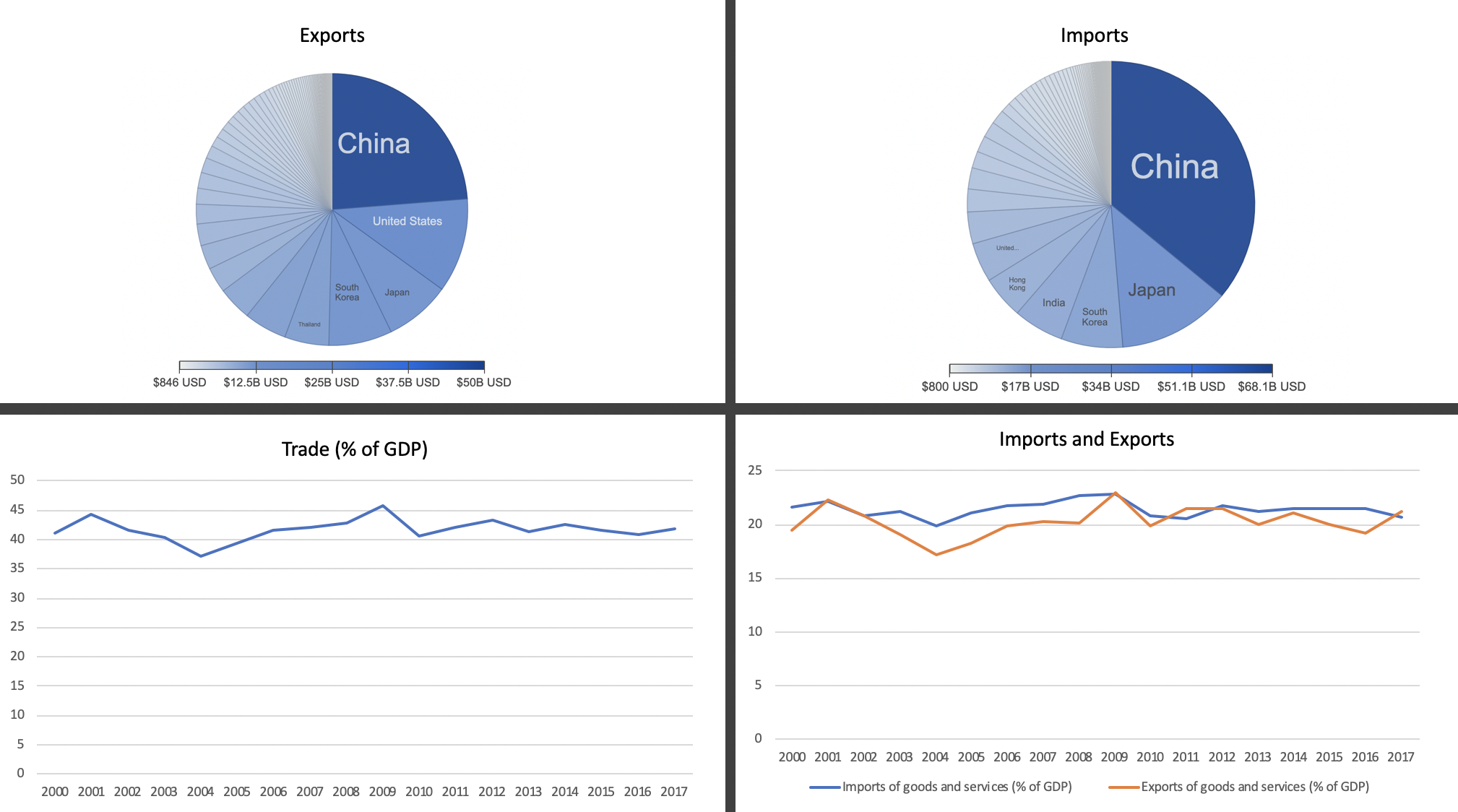
On the trade front, Australia is significantly dependent on China on both the imports and exports. Also, exports as a percentage of GDP are increasing over imports after a long time.

04 - Trade

Labour

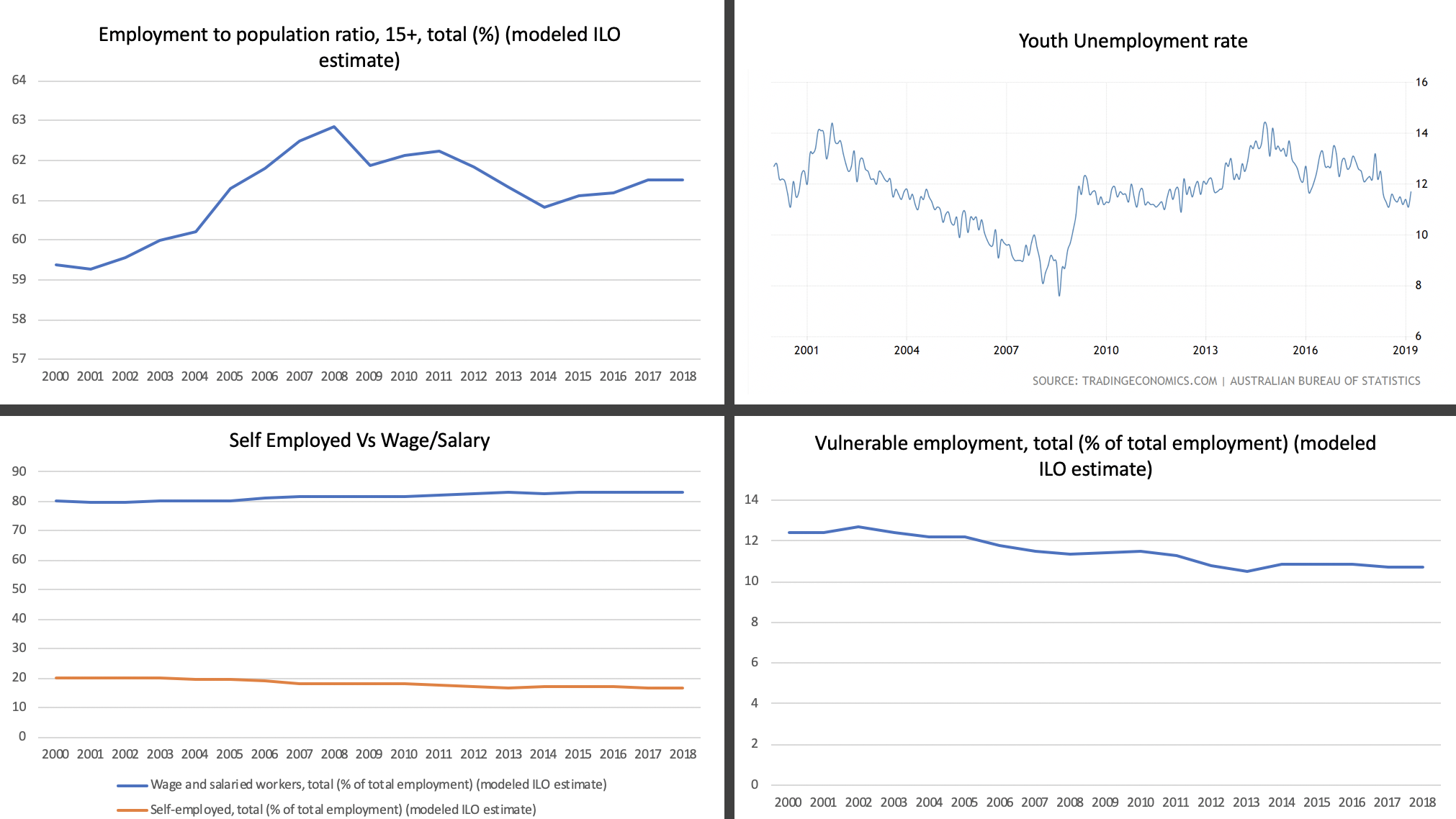
On the labour market parameters front, Australia is looking quite healthy. The employment to population ratio is fairly high. Thought the youth unemployment rate is high, it is still way below the global average. There is a good mix of people between self-employed and wages. The population who is into vulnerable employment is also low and steady.

05 - Labour

Domestic Finance

This is one of the biggest areas of concern for Australia. I want to interpret some of the numbers here.

  1. The household debt is at 120% of the GDP
  2. The homeownership rate is on the decline
  3. The dwellings are the biggest portion of a family’s wealth
    1. The housing prices are falling overall
    2. The household debt to disposable income is at its all-time high
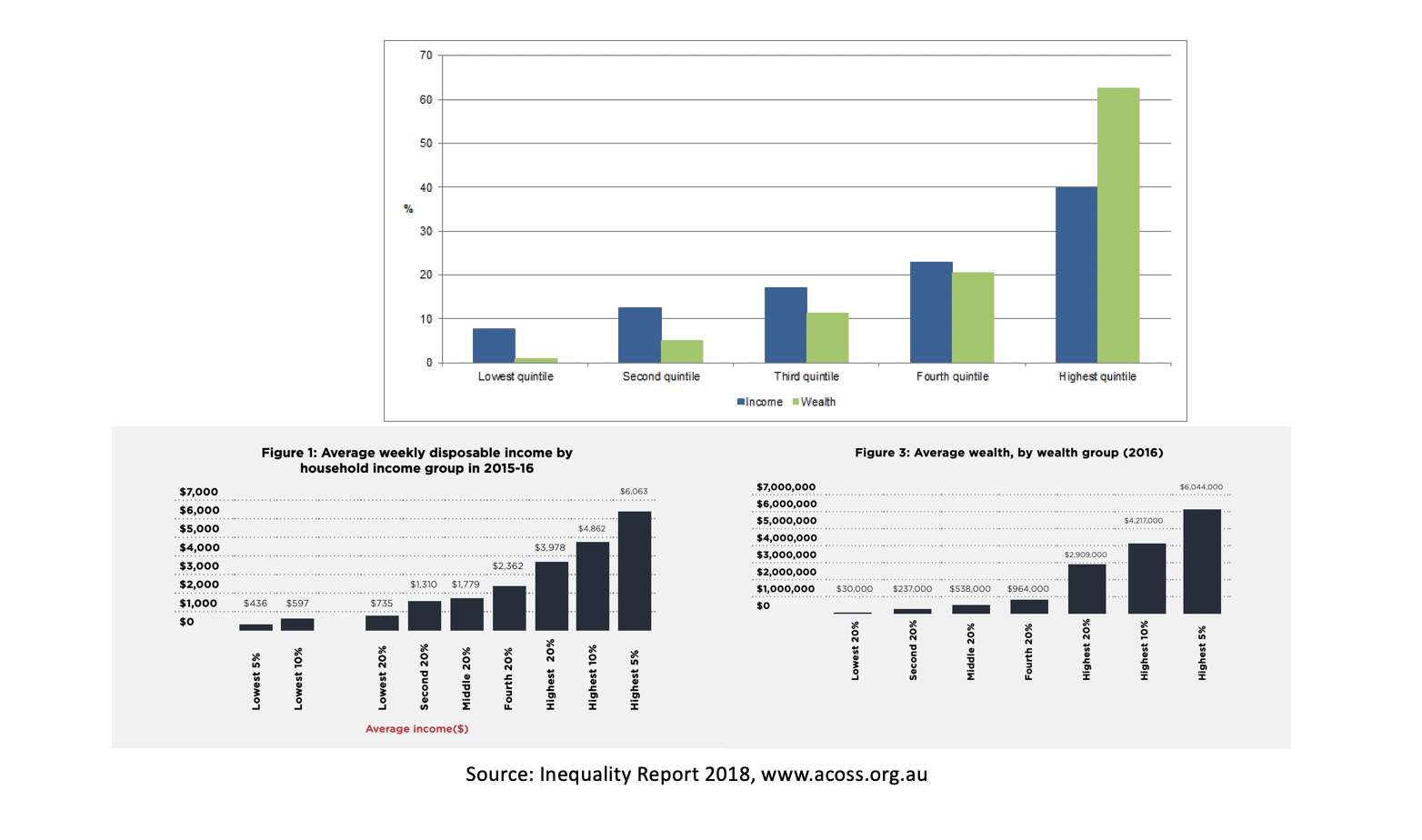
  4. The discrepancy in wealth is way higher than the discrepancy in income. The income distribution is good when compared to other OECD nations but the wealth gap is extremely concerning.

06 - Finance

Screen Shot 2019-05-15 at 1.12.25 pm

Energy

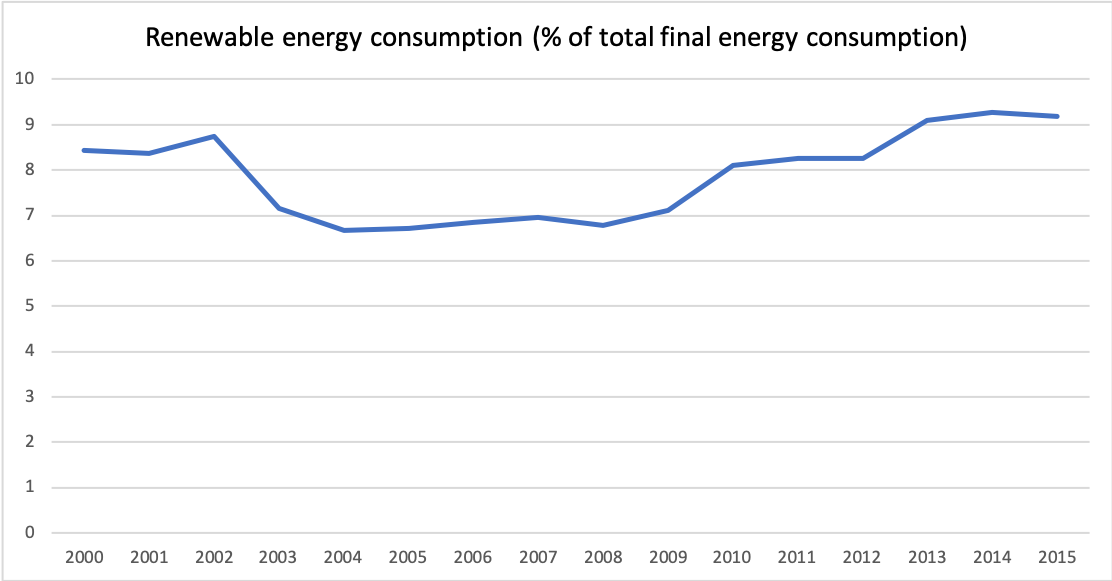
Last but not least, the percentage of energy consumed from renewable sources has stabilised since 2013. This shows a lack of movement towards alternate sources of energy.

07 - Energy

Key risks and issues

Automation and long term risks to jobs

One of the huge risks of the present generation is the potential loss of jobs to automation. These jobs are not just ones to do with manual labour but even skilled ones like legal advice, radiology, administration and teaching. Australia is not going to be an exception to this. Some countries like the US are seeing the effect of this already.

Household debt

The household debt has reached record levels. A median income Australian family has debt which is close to three times its annual disposable income. This debt value is going to look bigger if the economy slows down. Most of this debt is mortgage and the house is the biggest asset followed by super for most Australians.

The gap between income and wealth

While income inequalities are understandable, Australia is seeing record accumulation of wealth without income levels supporting the same. This wealth disparity is going to trigger a change in social behaviours over generations. It will result in slowing down of the government revenue, increased consumption without contributing income, stagnation in production and above all social unrest.

Trade

Australia is heavily dependent on China was its trade. 36% of Australian exports and 24% of imports are with China. This is a huge risk for two main reasons.

  1. The Chinese government is increasingly flexing its muscles and bullying nations which doesn’t agree with its terms. With Australians not keen on selling its natural resources and infrastructure to Chinese state-run companies, China will not take it lightly for long.
  2. Australia has now inadvertently linked its progress to that of China. This is a very high-risk strategy. It is only made worse by Chinese business and government practices not as transparent as ones in the developed world.

Foreign policy

Australia’s foreign policy has always been toeing the line of the big guns. This in the past was to follow NATO guidelines. This meant Australia doesn’t have either the passive non-aligned policy of the Nordic countries or Switzerland or the aggressive drive of the United States. This is not going to work for long as very soon the US and China are going to be in different camps. With the imminent trade war between the US and China, one has to review the follower mode. Australia will be left without a policy-making parent country. The answer is not to go find a new one but to start behaving like an adult.

Clean Affordable Energy

In spite of having over 33% of the world’s Uranium deposits, Australia doesn’t have a single Nuclear Power plant. Nuclear power is one of the cleanest sources of affordable power. Solar power is good for domestic purposes but it has worse disposal problems than nuclear waste. The risks caused by nuclear power generation can definitely be mitigated lot more effectively. All said and done, the black coal still dominates the power generation in Australia.

Education & Skilling

Over 70% of the students in Australia still go to Public Schools. However, Commonwealth funding is completely disproportionate. Further, skilling in Australia happens through apprenticeships and TAFE. University fees have increased tremendously over the years.

Screen Shot 2019-05-15 at 2.54.47 pm

Election Policies

Topic Labour Liberal
Healthcare HOSPITAL CARE
https://www.alp.org.au/policies/better-hospitals-fund/
https://www.alp.org.au/policies/national-rural-health-strategy/
CANCER
https://www.alp.org.au/policies/medicare-cancer-plan/
https://www.alp.org.au/policies/investing-in-services-and-support-for-cancer-patients/
https://www.alp.org.au/policies/investing-in-cancer-research/
https://www.alp.org.au/policies/olivia-newton-john-cancer-research/
MENTAL HEALTH
https://www.alp.org.au/policies/investing-in-headspace-plus/
DRUG AND ALCOHOL TREATMENT
https://www.alp.org.au/policies/drug-and-alcohol-treatments/
PRIVATE HEALTH INSURANCE
https://www.alp.org.au/policies/private-health-insurance/
MENTAL HEALTH
Youth Mental Health and Suicide Prevention
https://www.liberal.org.au/our-plan-youth-mental-health-and-suicide-preventionMEDICARE & PBS
https://www.liberal.org.au/our-plan-strengthening-australias-world-class-health-system
Education FUNDING
https://www.alp.org.au/policies/fair-funding-for-australian-schools/
CHILD CARE
https://www.alp.org.au/policies/labors-plan-for-cheaper-child-care/
https://www.alp.org.au/policies/national-pre-school-and-kindy-program/
SPECIAL SCHOOLS
https://www.alp.org.au/policies/students-with-disability/
https://www.alp.org.au/policies/community-language-schools/
https://www.alp.org.au/policies/asian-languages-and-literacy/
REVIEW
https://www.alp.org.au/policies/national-inquiry-into-post-secondary-education/
https://www.alp.org.au/policies/naplan-review/
https://www.alp.org.au/policies/evidence-institute-for-schools/
EDUCATION
https://www.liberal.org.au/our-plan-quality-education
Skilling SKILLING & RESKILLING
https://www.alp.org.au/policies/fee-free-tafe/
https://www.alp.org.au/policies/more-university-places/
https://www.alp.org.au/policies/building-tafe-for-the-future/
https://www.alp.org.au/policies/university-future-fund/
https://www.alp.org.au/policies/labors-plan-for-apprentices/
SKILLING
https://www.liberal.org.au/our-plan-delivering-high-quality-skills-and-vocational-education
Manufacturing https://www.alp.org.au/policies/battery-metal-manufacturing/
https://www.alp.org.au/policies/labors-plan-for-advanced-manufacturing-jobs/
https://www.alp.org.au/policies/labors-plan-for-rail-manufacturing-jobs/
https://www.liberal.org.au/our-plan-stronger-manufacturing-sector
Jobs & Wages https://www.alp.org.au/policies/labors-plan-for-local-jobs/
https://www.alp.org.au/policies/securing-a-just-transition-for-energy-workers/
https://www.alp.org.au/policies/labors-plan-for-secure-jobs/
https://www.alp.org.au/policies/labors-plan-to-drive-a-better-deal-for-auto-dealers/
https://www.alp.org.au/policies/labour-hire/
https://www.alp.org.au/policies/fairer-markets-for-a-fairer-australia/
https://www.alp.org.au/policies/labors-tradie-pay-guarantee-and-plan-to-fight-phoenixing/
https://www.alp.org.au/policies/better-protections-for-casual-workers/
https://www.liberal.org.au/our-plan-more-jobs-stronger-economy
Agriculture https://www.alp.org.au/policies/support-our-dairy-industry/
https://www.alp.org.au/policies/labors-plan-for-food-and-fibre-manufacturing/
https://www.liberal.org.au/our-plan-supporting-farmers-drought
https://www.liberal.org.au/our-plan-showcase-agriculture-our-heritage-our-future
Individual Taxes https://www.alp.org.au/policies/fairer-tax-cuts-for-working-australians/
Energy https://www.alp.org.au/policies/real-action-on-climate-change/
https://www.alp.org.au/policies/labors-plan-for-energy-efficiency/
https://www.liberal.org.au/our-plan-affordable-and-reliable-energy
Infrastructure https://www.alp.org.au/policies/labors-plan-for-an-infrastructure-investment-bank-for-the-pacific/
https://www.alp.org.au/policies/nation-building-infrastructure/
https://www.liberal.org.au/our-plan-keeping-australians-safe-our-roads
Small Business https://www.alp.org.au/policies/labor-will-make-unfair-contract-terms-illegal/
https://www.alp.org.au/policies/new-jobs-tax-cut/
https://www.liberal.org.au/our-plan-lower-taxes-small-business
https://www.liberal.org.au/our-plan-lower-energy-costs-small-businesses
Trade & Foreign Policy https://www.alp.org.au/policies/better-and-fairer-trade-agreements/
https://www.alp.org.au/policies/australian-shipping-industry/
https://www.alp.org.au/policies/labors-plan-for-strengthening-australias-diplomatic-engagement-in-the-indo-pacific/
https://www.liberal.org.au/our-plan-trade-and-investment
Science, Technology & Research https://www.alp.org.au/policies/australia-in-space/
https://www.alp.org.au/policies/labors-plan-for-science-at-the-centre-of-government/
None
Border Protection & Immigration https://www.alp.org.au/policies/labors-plan-for-strong-borders/
https://www.alp.org.au/policies/labors-plan-for-adf-troops-equipment/
https://www.alp.org.au/policies/protecting-local-workers-restoring-fairness-to-australias-skilled-visa-system/
https://www.liberal.org.au/our-plan-population-migration-and-better-cities
Social Safety https://www.alp.org.au/policies/better-medicare-centrelink-services/
https://www.alp.org.au/policies/online-safety-for-children/
https://www.liberal.org.au/our-plan-keep-communities-safe
Identity Politics & Multiculturalism https://www.alp.org.au/policies/labors-commitment-to-multicultural-australia/ https://www.liberal.org.au/our-plan-back-our-multicultural-communities
Housing Crisis https://www.liberal.org.au/our-plan-support-first-home-buyers
Military https://www.alp.org.au/policies/labors-plan-for-a-veterans-employment-package/
https://www.alp.org.au/policies/labors-plan-for-a-family-engagement-and-support-strategy-for-defence-personnel-and-veterans/
https://www.liberal.org.au/our-plan-stronger-defence-and-defence-industries

My Opinion

Both parties have similar sounding policies but written slightly differently. I want to first review each of their policies and then compare their performance against the key risks.

Labour Policy

The labour policy is a combination of the policies of the left-leaning parties in other countries like the UK and reverting to some of their old policies.  There is hardly a single policy which I can call out for novelty. Their policies address most of the talking points in the proverbial voter checklist.

Hits

  • Skilling – Investment in apprenticeship, TAFE
  • Space research
  • Manufacturing jobs
  • Infrastructure Investment
  • Naplan Review
  • Review of the free trade agreements

Misses

  • No standing on foreign policy apart from obeying Chinese government
  • No policy to address the housing crash/correction
  • The clean energy plan is extremely naive
  • The plans don’t add up economically. Asking multi-national to pay fair share is alone not going to contribute to the costs
  • Pandering to multi-culturalism – Chinese education, money transfer etc
  • No clamping on outsourcing

Liberal Policy

The liberal policy is a self-glorification attempt. It is a combination of moderate policies which the voter wants and not talking about their policies which the voter don’t want to understand.  There is again nothing new in their policies.

Hits

  • Scare tactic against Labour
  • Border protection
  • Plans for regional areas
  • First home buyer support
  • Crime protection

Misses

  • No substantial policy except incrementing the current one
  • Free trade advocacy
  • Lack of strong policies for leadership in the Pacific region
  • Free ride for corporations
  • No clamping on outsourcing

Performance

The next step is to review if the policy handles the risks outlined.

Risk/Issue Labour Liberal Choice
Automation and long term risks to jobs They have policies for reskilling, especially in the energy sector. There is no acknowledgement of the job losses due to automation or creation of newer sectors. They haven’t even thought of the issue. Labour
Household debt Hasn’t even bothered. If they want the bubble to burst, then they need to have policies which address the impact Their new homeowner policy might sound attractive but is going to increase the gravity of this issue. Neither
The gap between income and wealth None None Neither
Trade There is a slight focus on the renegotiation of trade agreements but no mention of how they are going to get it through. Continued focus on free trade is going to backfire on Australia. Slightly Labour
Foreign Policy There is a mention of diversification but the rest of the policies fall flat in this regard. There is a mention of derisking by improving the relationship with India but that is still not substantial. Slightly Liberal
Clean Affordable Energy Their renewable policy is definitely well written but I am still sceptical on this being affordable. The lack of discussion on nuclear is still appalling. None. Labour
Education & Skilling Their policy to fund schools better, review Naplan and support for the public schools is definitely good.

Their policy to improve TAFE, and create university fund is a good path forward.

There is no quality plan in this regard. The liberal policy is to continue the current policy. Labour

To conclude, the labour party is proposing a plan which doesn’t tie up economically and the liberal party is proposing a plan which doesn’t change anything. Both of them are engaging in a fearmongering tactic. Between a plan which is depressingly status-quo from the liberals and another one which is thoughtlessly naive from the labour the choice for the Australians is hard. The economy is growing globally so no government can take credit for this. Even after factoring in my biases, I will still advocate voting for labour to ensure there is an investment into key sectors which will result in intergenerational progress. I am definitely sceptical if they can turn their policies into action but there aren’t any more data points at the moment. A voter has to vote on policy.

References

  1. https://www.rba.gov.au/chart-pack/pdf/chart-pack.pdf?v=2019-05-15-11-52-15
  2. World Bank Data
  3. OECD Data
  4. http://www.Tradingeconomics.com
  5. Australian Bureau of Statistics http://www.abs.gov.au


Narendra Modi vs Rahul Gandhi – a battle of no significance

The elections for the representatives of the 17th Lok Sabha or the lower house of the Indian Parliament is underway. The Indian parliament election is one of unprecedented scale as over 900 million people are eligible to vote. It is a load test to any electoral process. As with most elections, emotions are running high, polarisation is immense and everyone is projecting a doomsday result if the other party gets elected. As a person who truly hates both the parties, I find it extremely laughable.  There will be no significant difference in outcome irrespective of which party comes to power. I will explain the reasons during the course of this blog.

The two coalitions

There are two major coalitions which are fighting the elections. One is the incumbent National Democratic Alliance (NDA) led by Bharathiya Janatha Party (BJP) and the other one is the United Progressive Alliance (UPA) led by Indian National Congress (INC).  I want to table a brief introduction about both these coalitions.

Name National Democratic Alliance (NDA) United Progressive Alliance (UPA)
Main Party Bharathiya Janatha Party (BJP) Indian National Congress (INC).
Leader Narendra Modi Rahul Gandhi
Last election performance (272 needed for a majority) 282 seats 44 seats
How followers see the leader
  • Protector of the Hindus
  • Only hope to develop India
  • Strong leader
  • Youth Icon
  • Secular leader
  • Will help create a progressive India
  • From a family of leaders
How opponents see the leader
  • Against non-Hindus
  • Against lower castes
  • Hasn’t made any progress
  • Against poor
  • Will destroy the Indian secular fabric
  • Has created an environment of distrust, division and hatred
  • Authoritarian
  • An idiot who has no new ideas
  • The only qualification is that he is from the Nehru-Gandhi family
  • Will bring India’s development to a standstill
  • Useless
My view of their leader
  • A good orator especially in Hindi
  • Extremely cunning statesman
  • Turns blind eye to Hindu fundamentalism
  • Has surrounded himself with smart people
  • Is incapable of having an intelligent conversation
  • Turns blind eye to non-Hindu fundamentalism

As far as the corruption and number of criminal cases go, both these parties are exactly the same. So, there isn’t much difference there.

Key performance

I want to look at some key performance indicators. I want to look at this in terms of the party in power and the resultant impact. I do not want to assess the validity of the parameters or the absolute performance of the country. I want to measure the performance relative to the party in power. The data for these have come from the World Bank, OECD and Indian government sites.

From To Coalition(Party)
19-Mar-98 22-May-04 NDA (BJP)
22-May-04 26-May-14 UPA (INC)
26-May-14 till date NDA (BJP)

Financial Indicators

The GDP of India has been constantly rising since 1998.  The growth rate though has been up and down. In a mixed economy dependent on both exports and huge internal consumption, a balance of inflation and geopolitical reasons will impact short term growth rate. What is also significant is that the debt/GDP ratio has been coming down since 2002. The Ten years of UPA and 6 years of BJP have had no impact on these financial indicators.

Economic 1

Economic indicators

I have got three main indicators of the economic health of a country. They are savings, distribution and investment. Here is the reason I have these indicators.

  • Savings: Does this country have enough assets to handle emergency situations?
  • Distribution: Has the economic model resulted in the growth of the whole population?
  • Investment: What is the focus on future generation?

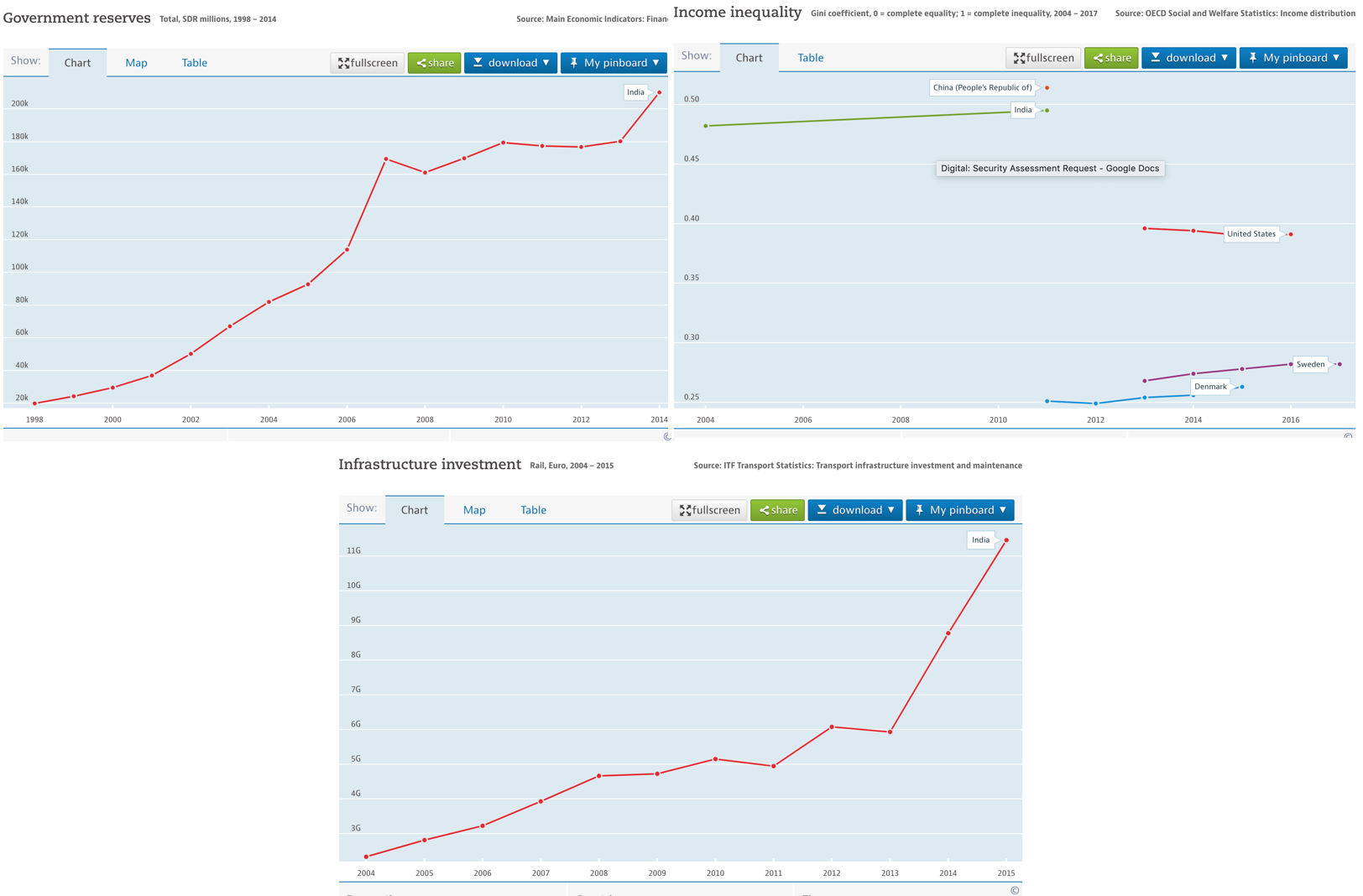
Based on these, there is again very little difference between the parties with a reserve and income inequality. There is however a big difference as far as investment in infrastructure is concerned. The NDA government led by Modi has made a lot of investment in their tenure.

Economic 2

Social & Environment indicators

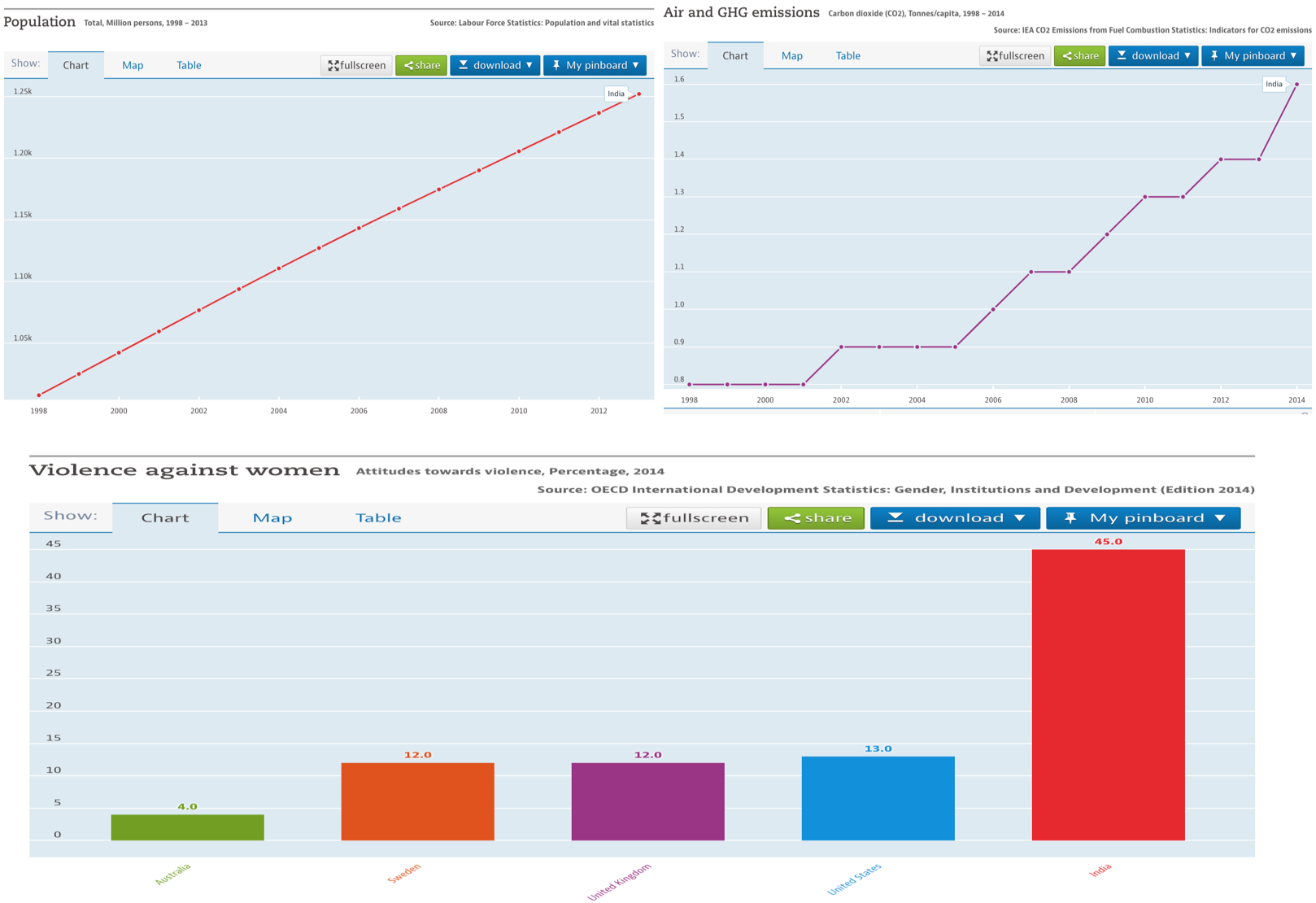
The next set of indicators are to do with social and environmental performance. The population is important as there is no point if the population grows faster than the GDP.

The population of India has been rising constantly for decades now. Through the number has been steadily increasing, the rate has been falling. The next one if the emissions caused. The CO2 emissions number in India has also increased over the period although the per capita emission has almost been constant.

The last one I want to highlight is violence against women. I do not have a trend chart for this but a comparison against most other nations show where India stands in this regard.

Social

Domestic Considerations

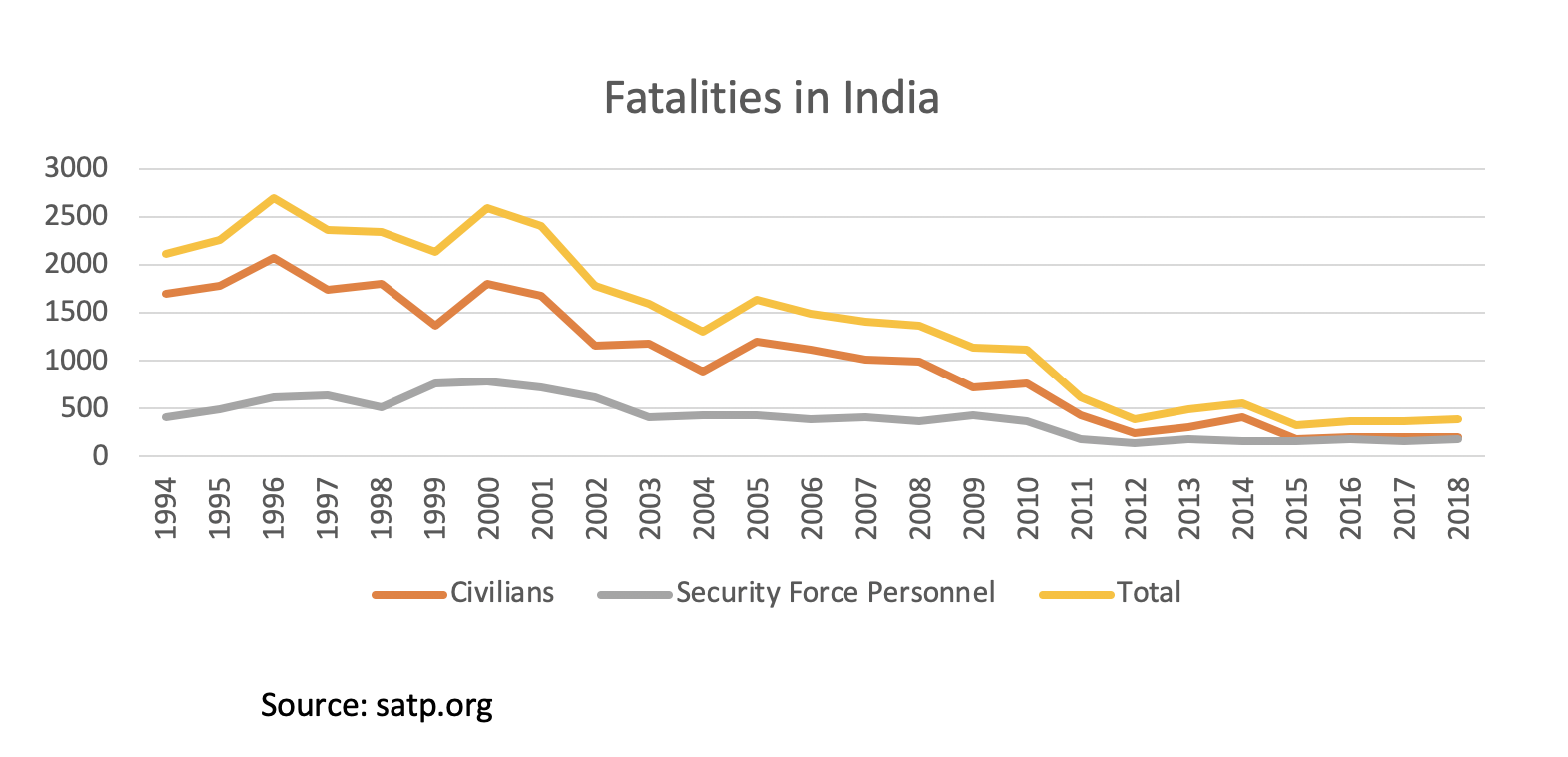
The NDA under BJP is claimed to be against minorities, stifling them of their freedom and instigating riots. The UPA under INC is accused of being soft on terror and crime. The statistics give a completely different picture. The number of incidents, deaths and injuries due to communal violence has almost been constant over the last 13 years. The fatalities to civilians have also seen a downward trend since 1998.

Screen Shot 2019-04-28 at 8.12.38 am

Screen Shot 2019-04-28 at 8.31.32 am

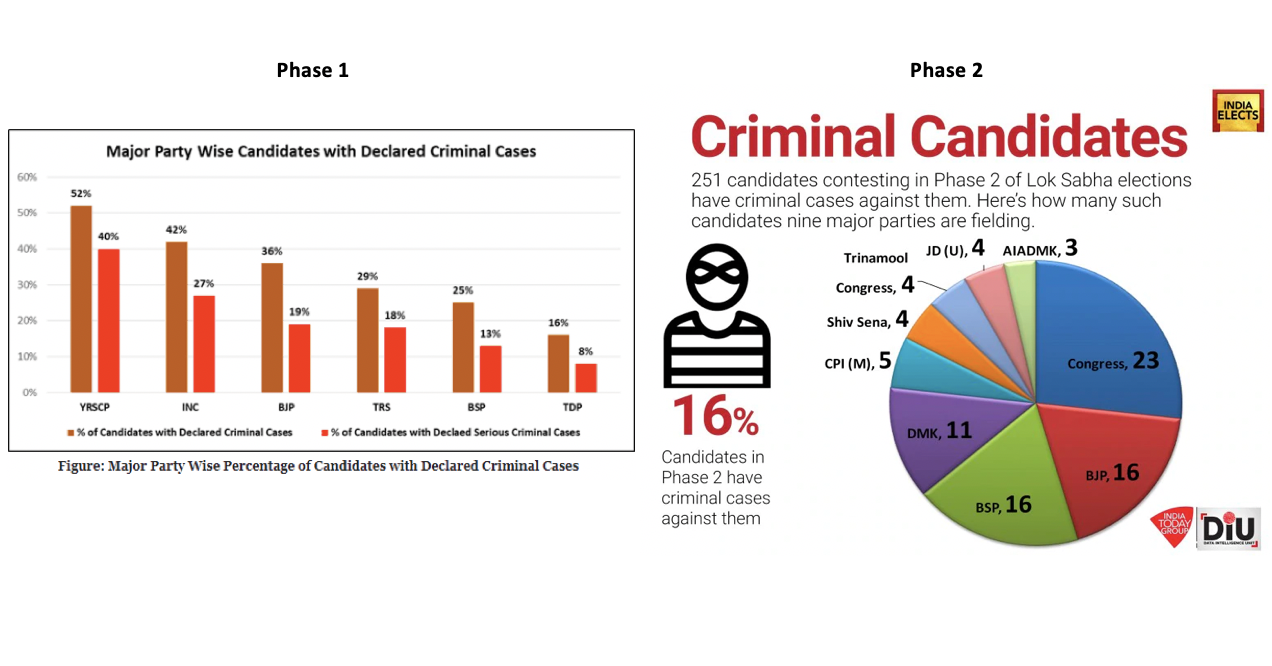
The number of people with criminal cases is almost the same in both parties. India Today magazine published the statistics on candidates who have criminal cases against them.

Screen Shot 2019-04-28 at 3.40.17 pm

Other developmental policies

There are definitely some policies enacted by each government which focuses on development. Those policies would have benefitted a community or a region. Again each party has its set of feathers in their cap. The net effect of these is still the same.

Foreign Policy Considerations

The next item to consider is the difference in foreign policy. I want to split the foreign policy into zones.

The United States of America: No significant change. India continues to toe the line which the United States wants them. From Manmohan Singh to Narendra Modi, no one wants to disturb the peaceful settlement of abject surrender.

China: No significant change. India continues the tensed relationship with China. Apart from the odd Doklam issue and rejection to join the OROB bandwagon, India has hardly been able to have any influence on China.

Rest of BRICS:  No change.

Pakistan: Both Narendra Modi and Manmohan Singh have tried to better relationship with Pakistan and both have ended not taking the relationship forward. The issue with the relationship continues to be volatile.

Middle East: One good aspect which has happened in the last 5 years is the improving relationship with Isreal. Other than the relationship has been one which ignores all the human rights violations for the sake of oil.

Iran: I can only find India’s relationship with Iran humorous. India has always had a good relationship with Iran. However, India hasn’t been able to capitalise it by setting up the oil and gas pipeline which they always wanted. Primarily, India doesn’t want to annoy the USA by publicly using its proximity to Iran.

South East Asia: No change

Europe: No change

Social Considerations

Secularism

India has no truly secular party. They have castist parties and religious parties. The only difference is which religion do they support. It is evident when you see the candidate from each party in a locality. It is always based on caste and religion.

Free Speech and Tolerance

There is no party in India which is tolerant and advocates free speech. From INC, BJP to the Communist parties, all of them have an extremist wing. They attack civilians and journalists who oppose them.

Journalistic freedom

While there have been claims of journalists being attacked during the BJP tenure, it is not unique to only one party. All parties have done that. The biggest attack on individual and journalistic freedom was the emergency period carried out by the INC government under Indira Gandhi. There were TV stations ransacked by the so-called secular, tolerant parties in different parts of the country. Journalists who have exposed corruption have always been attacked.

Conclusion

To conclude, in spite of the polarisation, there will be no significant difference between a  Rahul Gandhi led UPA government and a Narendra Modi led NDA government. Both parties will do what benefits them and pander to their base. They have already created a system when nothing can significantly change. So, Indians can relax. It is not doomsday yet.

References


The sexual abuse continues: My opinion

In the previous part, I shared the details of the grooming gangs in Pollachi. This racket has been running with the patronage and participation of people across political parties. However, in the aftermath of all these allegations, there are two unfortunately predictable social reactions.

  1. The girls are being blamed for not being modest enough. So, parents have taken control into their own hands by ordering curfew for their daughters.
  2. The marriage market has blacklisted girls from the Pollachi region.

When a society equates culture to more protection, reduction of liberties for just one gender then there is nothing that is going to significantly change. I look at this in a very simple fashion.

Any two individuals have the right to engage in a consensual sexual relationship.  When they do that it is a covenant between the two. There is no need for society to be involved unless they are impacted (eg. Extra marital relationships which the spouses don’t agree). Also, when one of the two breaks it by exposing the act without the permission of the other or threatens to do that then it should be a non-bailable offence.

The reality is people are going to have sexual relationships as it is innate to human desires. It is a function of hormones & opportunity. The issue of the force and lack of consent which makes the action reprehensible. This is where the law should come into the picture.

Two Key points to consider

The Rape Culture is pervasive

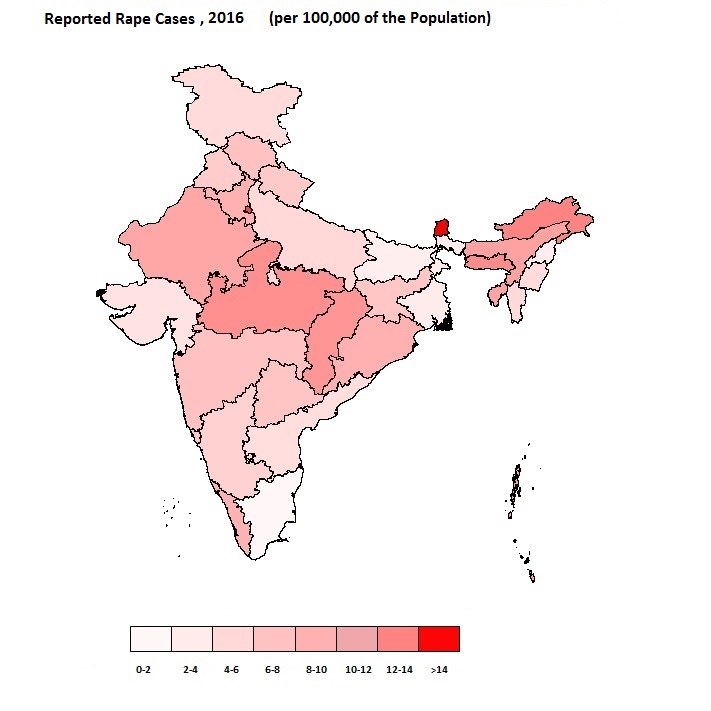
If one wants to look at the culture of rape, the NCRB data which only shows reported cases is a good indication.  Surprisingly when I started digging into the government records, there is no statistics after 2016. So, I have to analyse with 2016 data. The average for reporting cases seems to be around 10 for a population of 100,000. Though one rape is one too many, it can easily be dismissed as statistically insignificant. Let us break this down.

  • Population set size: 100,000
  • Approximate Number of Women @47% which is the India average): 47,000
  • Number of people within the age group of (15-55) 59% approx: 27,730
  • The probability of a person getting raped (assuming one person is not raped more than once) during that period: 1.5%

Now with a probability of 1.5% of a woman getting raped during her life and reporting the same, one has to acknowledge the culture of rape. Again, I have to stress this is only reported cases. Most of them go unreported as people are scared of social repercussions.

NCRB-Rape ReportedConviction

NCRB-Reported Cases Trend

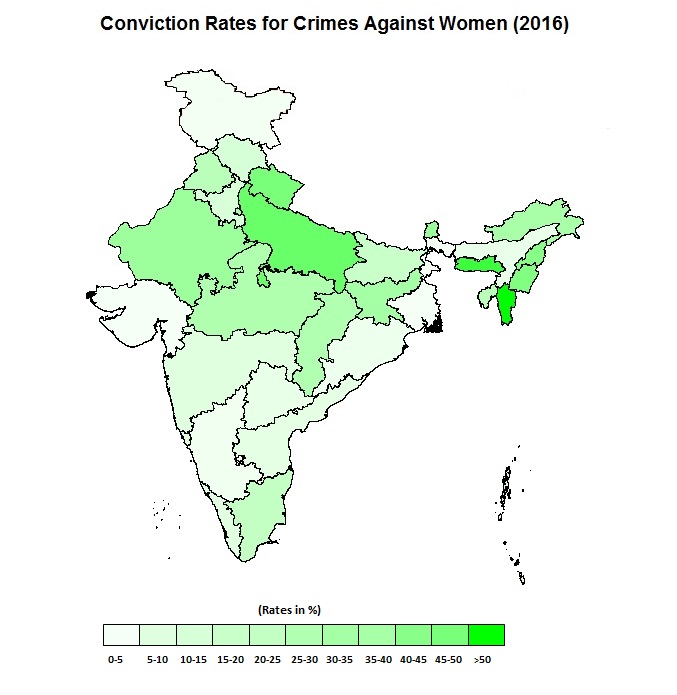
What is worse in this is the conviction rate for rapes are extremely low. This is not to say the rape didn’t happen but mostly that people who have been convicted were able to get away as there is no evidence.

Kailash Satyarthi, the child rights activist and Nobel peace prize winner has been working in this area for a few years now. According to his organisation, one in five girl child between the ages 5 and 9 have been sexually abused at least one. Most of them by people whom they know like family members, friends and school staff. If this doesn’t show the abuse of women is cultural then I am not sure what does. What is worse even when there is an abuse, the victims are almost always discriminated. She is the symbol of shame to the society. If the society is ashamed of what happened inside her birth canal, I suggest they chop off the organ which they think will go in. The extinction of such people is not such a bad option.

There are two cultures which claim to be pro-women from its origin, one is Islam and the other one his Hinduism. There is a reason they have to keep mentioning this everywhere. It is a coverup for their guilt. Muslim apologists always mention their prophet has given rights to women. Who is he to give rights? Hindu apologists point out the goddesses in their religion as a testimony to the rights of women. It is not mentioned that even the female gods are subservient to their husbands in their stories. This is probably like how Brahmin women were considered superior in the hierarchy to the men from other lower castes.

Power buys justice

It doesn’t matter whether there is a law criminalising dangerous actions, power will definitely buy justice. There are three forms of power in India or for that matter globally.

  1. Political
  2. Financial
  3. Religious

I want to give some examples of this.

  • Akash Ambani: The spoilt son of the wealthiest Indian Mukesh Ambani rammed his Aston Martin into an Audi which then went on to hit a Hyundai. The women driving the Audi reported that the Aston Martin was driven by Akash Ambani. The day after the accident a long term Reliance employee surrendered to the police taking responsibility.
  • Salman Khan: Another spoilt brat who continues to get away with serious crimes. He has been arrested for the below reasons.
    • Illegal possession of arms
    • Killing endangered species
    • Ramming his car into a platform and killing a person and injuring a few more
  • Manu Sharma: Again the spoilt son of a politician. His father was a member of the Parliament. Manu Sharma shot Jessica Lal a bartender for refusing to serve him liquor after the business hours. He was originally acquitted but was later sentenced after a huge public uproar.
  • SPS Rathore: SPS Rathore was an Inspector General of Police. He molested a teenage girl who was playing Tennis. He later harassed her continuously from going public with her allegations.
  • Jayendra Saraswathi: Jayendra Saraswathi was a pontiff and head of the Kanchi Matt. He has accusations of money laundering, murder and sexual assault. In spite of all this, he was acquitted without any charge.
  • Aseemanand: Aseemanand is an Indian monk. He was charged in the bombings of Ajmer dargah, Mecca Masjid, and the Samjhauta Express. He originally confessed to doing this and also called out RSS involvement in extremism. After all this, he retracted his statements and has since been acquitted.

A plausible solution

Regulation against recording & distribution of videos and photos

Any person who commits the below acts should be punished with a minimum of 7 years rigorous imprisonment with the option to extend it by another 7 years. In the case of the victim being minors, the punishment should be a minimum of 14 years with at least 5 years in solitary confinement.

  1. Revenge porn: Releasing recording of a sexual act without the permission of all the people involved
  2. Recording: Recording of a sexual or intimate act without the consent of the individuals
  3. Distribution: Circulation of videos or photos of a sexual or intimate act of private individuals without their consent unless it is done for legal or reporting purposes. The exception is a recording of any public event or artworks including photo shoots, theatre and movies.

Special squad to handle gang crimes against women

India doesn’t need anti-Romeo squads which go after couples or the people showing their affection in public. What India needs is squads which are vigilant about atrocities against women and children in both the real world and digital. The squads shouldn’t go after sex workers and consensual sex. They should go after human trafficking, forced prostitution and abuses. These squads should be tasked to come up with an operating model to percolate the benefits to every society or community.

Elimination of right to choose your lawyer for rape cases

Many accused get away because of the lawyers they are able to engage. There is a marked difference in quality between the public prosecutors and notorious high profile lawyers hired to defend the accused rapists. I advocate abolishing the right to choose a lawyer in case of cases of sexual abuse or homicide. Notorious lawyers like Ram Jethmalani have made a living defending criminals successfully. The accused have to be randomly picked a lawyer from the group of advocates to defend them.

I also advocate limiting the fees of lawyers in criminal cases. One can get any lawyer for civil cases but criminal cases should be controlled by the government. Justice should not be available for purchase.

A public register of Sex Offenders

The Government has to create a public list of sexual offenders. This should include accused, convicted and acquitted. The list of sexual offenders along with their photo and present location should be made public. Most sex offenders are repeat and it is important to highlight the same. The public has the right to protect themselves.

Victims need to feel love and empowerment

One of the key drivers for the fears around sexual assault is the fear of finding a partner. It is extremely common for Indian men to think of a girl abused as inferior. This despicable behaviour has to change. Men have to show love and care to the victims. They are not in any way responsible for the pain they have undergone. So, these women have to be empowered to make their life choices. They have to feel the love in their life again. That doesn’t mean that they need a partner in life but they should not be denied the option of having one if they so wish.

While I do feel that these are all plausible solutions, I don’t think anything is going to change. One might find rare cases of decency but the majority are happy with the status quo. The outpour of anger is strictly a manifestation of the need to project an image of decency. Every individual who wants to punish the victim also finds the need to escape punishment as small as it may be when they do commit it.

Sexual Abuse continues – I: The grooming gangs of Pollachi

#PollachiGroomingGangs

The incidents of sexual abuse, rape and misogyny are so rampant to even cause a distraction in India. I have previously written about the cultural aspects of this and the support of religion. The most recent one is the uncovering of the rape gangs in the small town of Pollachi in Tamil Nadu, India. The incident has a lot in common with the grooming gangs of the UK, especially in Rotherham and Huddersfield.

What is the scandal in Pollachi

The scandal came to light when it was reported that the Pollachi East police have arrested four young men for blackmailing a 19-year-old student of a private college by taking her in a car, sexually assaulting her and recording the act. What looked like yet another case of rape and blackmail turned out to be one of the most organised sexual crime gang in TamilNadu history. The mobile phones of the alleged perpetrators had over a thousand videos of young girls who were lured, trapped, abused and blackmailed for years. I listened to the audio of one particular clip. It was gutwrenching to hear the pleas of the girl being ignored as these monsters harrassed her. While it takes a psychopath to rape anyone, it is unimaginable the treachery involved in deceiving someone in the name of love and then capturing the moments to blackmail them. As things emerge, the four people involved are part of a larger network of men who have been doing this for close to a decade. The network includes people who are wealthy, well educated and have political connections. The number of victims seems to be as high as 200 according to some media reports.

https://www.thehindu.com/todays-paper/tp-national/tp-tamilnadu/four-booked-for-blackmailing-college-student-after-shooting-video/article26370305.ece

https://www.thenewsminute.com/article/what-pollachi-sexual-abuse-and-extortion-case-detailed-explainer-98266

Political aftermath

As it turns out the police have helped cover up these incidents for close to a decade. One of the main accused is an AIADMK party cadre, which is currently the ruling party in Tamil Nadu. This has resulted in the opposition parties calling for the ouster of the Chief Minister. The irony is none of the politicians is any better. The DMK Supremo M.K. Stalin has been accused of sexually assaulting many women. The hypocrisy in their speech is damaging the seriousness of the issue. The ruling party, on the other hand, is only interested in subduing the issue as there is an election coming up. They have transferred the case to Crime Branch – CID to wash their hands off. The government was so careless that they couldn’t maintain the privacy of the victims. They mentioned the names in the government order which went public.

https://www.thehindu.com/news/national/tamil-nadu/pollachi-jayaraman-slams-dmk-for-politicising-issue/article26515818.ece

Reactions

The reactions to this have been extremely predictable. The public in Tamil Nadu alone is outraged but is not able to do anything apart from standing silently in solidarity. They are asking for the guilty to be punished swiftly.

The national media was not interested in the case as it didn’t involve Pakistan, Bollywood or bluntly people from the north of India. The coverage was so bad that Madras High Court had to bluntly tell the media that they are not interested in the rural parts of Tamil Nadu.

https://www.thehindu.com/news/cities/Madurai/national-media-ignoring-rural-issues-hc-madurai/article26522088.ece

The average testosterone gushing men are forwarding the videos for personal pleasure at the expense of the emotional turmoil of the girls.  The police are requesting people not to forward the videos but that doesn’t change anything in the minds of the sick.

Though everyone is outraged, the story goes that prospective grooms don’t want to marry anyone from that town as they feel the girls could be one of those victims. So much for the outrage.

What has happened now?

The alleged perpetrators have been charged with the below sections of Indian Penal Code for the sexual assault and blackmail.

  • 354(A) Sexual harassment and punishment for sexual harassment
  • 354(B) Assault or use of criminal force to woman with intent to disrobe
  • 394 Voluntarily causing hurt in committing robbery
  • 66E IT Act violation of privacy

Few of them have also been charged the below sections for threatening the family of the victims and physical assault.

  • 341. Punishment for wrongful restraint.
  • 294(b) – sings, recites or utters any obscene song, ballad or words, in or near any public place.
  • 323. Punishment for voluntarily causing hurt.
  • 324 – Voluntarily causing hurt by dangerous weapons or means.
  • 506. Punishment for criminal intimidation.

[Source https://indiankanoon.org%5D

Some of these are non-bailable offences.

In the next part, I want to share my opinion on

  1. Rape Culture
  2. Buying justice
  3. Handling gang crimes