Let’s wind our memory back to 2016 and run it till 2020. A period that was marred by so much drama that we all felt like participants in the Real Housewives of White House. The new channels were going crazy, the were protests and counter protests each day and the White House staff were treated like a contestants of a badly run episode of Apprentice. The situation got out of control as families split over political support like never before in the history of the US. Clinical psychologists were kept busy as anxiety, depression and rage ripped through the heart of the country. Even as someone in Australia, I wasn’t immune to drama. So, here are my four key tips to myself to brace for potentially another four years of Trump presidency.
Democracy isn’t dying
Between Trump’s blatant support for dictators, attacks on democratic institutions, and media’s frenzy about him wanting absolute power, it is natural for people to feel anxious about the death of democracy. The truth however is that the institutions of the US are too powerful enough for Trump to achieve any of those. He successfully triggers people to react and gets amused in the process. One has to remember that between close to 500 million guns in the hands of people, powerful state governments and the congress, the POTUS has very low chance of declaring oneself as an all powerful dictator. If we look at countries that have a dictator or one where people have taken over as a dictator, they all the structural balance of the United States.
It isn’t bright as the right or gloomy as the left
The glory days of the past weren’t as glorious as the right wants us to believe. There were enough problems both in terms of abuse of power and unrest in every decade of the last 150 years. Let’s consider John Kennedy and Ronald Reagan, the two poster children of left and right respectively. Their tenure and policies would be far from acceptable by their bases today. Both EPA and Montreal Protocol were signed by republican presidents. On the other hand, it was Bill Clinton who got Gramm-Leach-Bliley Act replacing the famous Glass–Steagall legislation. Trump may bring down some acts and may replace them with others. The resultant changes will be no different from any other president of the past.
Get news from low percentile sources
It is critical to stay away from both mainstream news outlets and new age media (including social media). The frenzy created by both of them only adds to the mayhem. Whether it was Glenn Beck and Alex Jones on the right or Sam Adler and Cenk Uygur on the left, the key is to stay away from the extreme noise. I would like to get political news from the legislations being passed. I would get the national news from headlines that aren’t opinions. It is key not to get affected by the noise of the extremes.
Relationships go beyond politics
Family and friendships go way beyond political affiliation. To sever one’s relationship for mere support of another candidate in the democratic process is the worst possible reason to loose a relationship. As a person who has lost a lot of relationships in life mostly because of my intolerance, I have to admit the pain of severed friendships is one of the worst. I don’t think either Trump or Biden is worth that. We are fighting criminals but friends and family.
Most of these are easier said than done. We are surrounded by information more than we were in 2016. There are more twitter/X users now than ever before. More data flows through WhatsApp now than ever before. Whether it is correlation or causation, more people are having anti-depressants now than ever before.
Almost every poll that has come out in the last few months has given Donald Trump a comfortable lead over Joe Biden. However, elections are never won on opinion polls. They are won on sentiments in swing states. There is no question of who will win California or Texas. The candidate who doesn’t disturb their base and gets enough people from swing states to come to vote ends up on the winning side. To prove this, I want to share my analysis of the last 3 elections that happened.
The 2012 Presidential Elections
The 2012 presidential election was one for continuity. Barrack Obama was riding on his handling of the GFC, Affordable Health Care program and he got people united with the killing of Osama Bin Laden. With the killing of the most wanted terrorist of the time fresh in the memories of people, it wasn’t hard for Obama to get the voters to prefer him over a rather dull and boring Mitt Romney.
The 2016 Presidential Elections
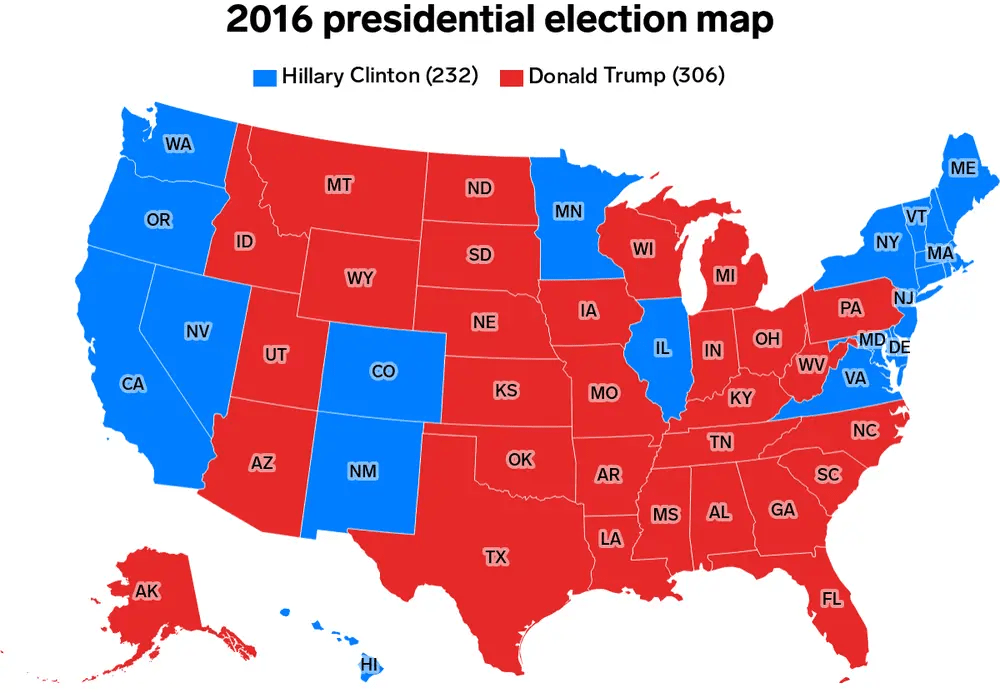
The 2016 presidential election was for polarisation. Hillary Clinton wanted to win it by pointing fingers at Donald Trump. Donald Trump on the other hand wanted to ride the way of populism. Hillary Clinton assumed victory and didn’t even bother motivating voters to vote. Between the choices of known vs unknown, people who preferred known came to vote more. The opinion polls consistently showed Hillary Clinton winning the elections. What we saw was a phenomenon where people lied about their preferences in public. It was a manifesation of Timur Kuran’s Private Truths and Public Lies in the political sphere. The result was the victory of Donald Trump.
The 2020 Presidential Elections
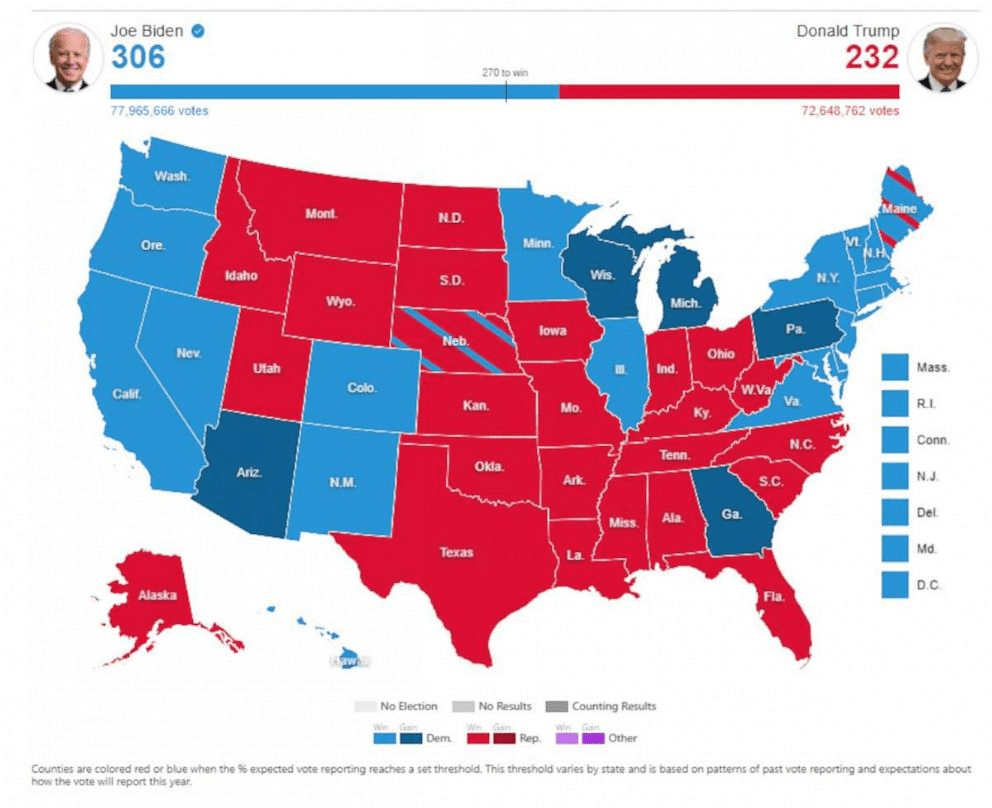
The 2020 presidential election was for normalisation. It wasn’t strange that the margin and the number of votes were the reverse of 2016 election. The preference of Donald Trump wasn’t taboo anymore. People who likes him came out in the open. On the other hand, Joe Biden was considered a safe choice, someone who is within the margin of normalcy. After adrenaline packed four years, where we were woken up by rants on Twitter, dismissal of secretaries, threats of violence against global leaders and calls to drink disinfectants to cure Covid-19, people wanted normalcy. A presidential term where we can have our heart rates in control, while we are all dealing with the rampant spread of a pandemic seemed to be the need of the hour. The deteriorating mental and physical abilities of Joe Biden didn’t deter people as much. He was able to get people to vote more in the swing states than Donald Trump.
The 2024 Presidential Elections
The 2024 presidential elections is one for compromise. Is having a president whose critical faculties are waning by the hour better than another four years of adrenaline rush? Can Donald Trump can scare enough people to not vote for Biden because of his falling ability over his erratic behaviour? Can Joe Biden remind people who the term from 2016-2020 and compare that to the relative sanity of the present? This is also the first election where people have a choice between two candidates who have been presidents(at least from my research). I don’t have a crystal ball but there is a case for and against both candidates. Here are my variables and predictions for the elections.
Key Criteria
The debates in this elections is lot more important than the previous ones. If Biden is able to standup to a bombastic Trump, then it will show that he is capable of handling himself for another four years. On the contrary if he crumbles under pressure then it will be advantage to Trump
A reversal of any kind to the economic downturn will definitely help Biden.
My predictions
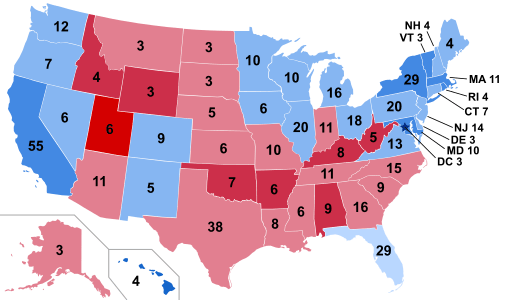
The results in this election will be lot closer than the previous two in terms of number of seats. It is unlikely to see a 306-232 split.
If the current situation and trend persists, then there is a higher chance of Donald Trump winning than Joe Biden. This is because voters have poor memories. We remember highs and lows in our personal life. The every day mayhem gets forgetten in four years. The anti-incumbency wave is more likely to go in favour of Trump.
The US Presidential Election season is back. The 2024 Election is the seventh presidential election since I started following it in 2000. I have to admit that the fever and anxiety have only increased with every passing election. The decency with which Al Gore wished George W Bush after 537 votes decided a well-fought election and a 5-4 decision in the Supreme Court is not in the culture anymore. 12% of the population who can vote (Approximately 31 million) weren’t born when this incident happened. As far as the Congress goes, friendships and respect across the aisle have been replaced with partisanship and divisiveness. The left wing of the US Congress believes that the country is still deeply rooted in racism, sexism, inequalities and constriction of opportunities. The right wing of the US Congress considers that the past was a glorious time, the future is looking bleak, and there is a war on culture and religion. People like me, who, for all practical purposes, were socially and economically left of the 1980s and 90s, are left baffled by this. At the risk of sounding like a lesser intellectual version of Steven Pinker, I want to analyse if the situation is indeed alarming and how to deal with this anxiety.
The two key outcomes I want to achieve out of this are
Are Donald Trump and Joe Biden as good or bad as their supporters and detractors respectively make them to be?
Is there a reason to be anxious about this election result? Will anything go wrong?
In the first stage of this process, I want to look at the data from the time of Barrack Obama to Donald Trump and finally to Joe Biden. I want to break the data into the following categories.
Economic
Action on Illegal Migration
Income and Wealth Distribution
Climate Impact
Military Spending and Wars
Economic Factors
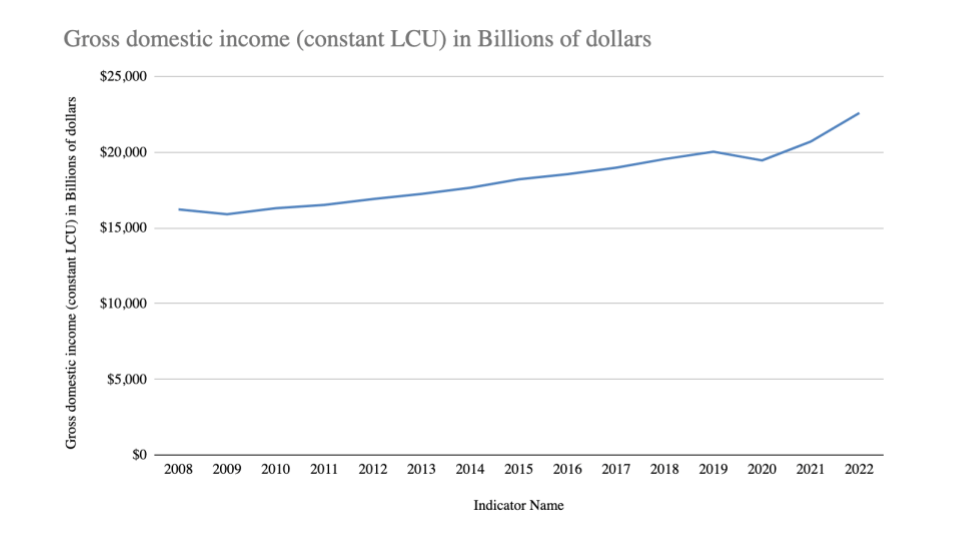
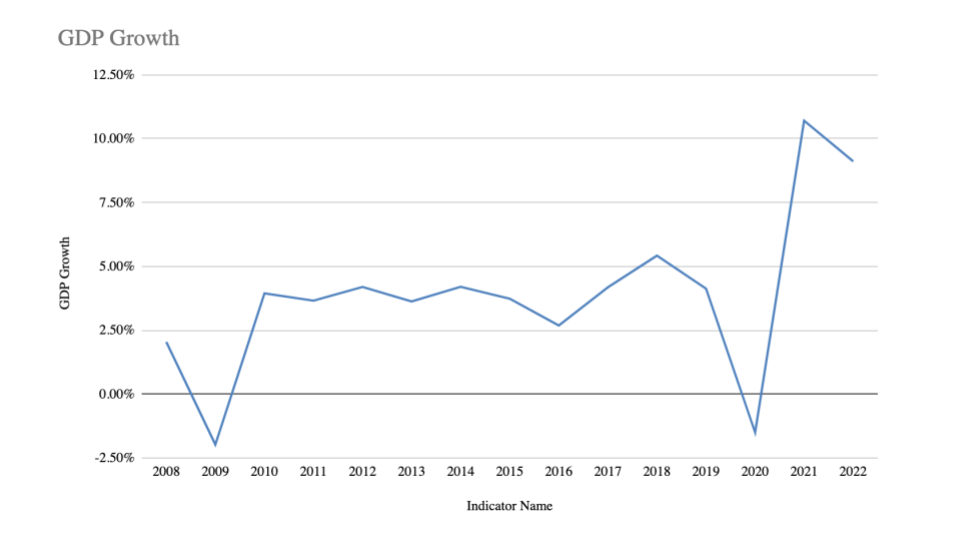
For the purpose of this exercise, I analysed the overall GDP, GDP per capita, GDP growth rate and finally, the Debt to GDP ratio. Starting at 16 Trillion dollars in 2008, the US economy has grown at an average of 3.88% yearly, cumulating to over 38% by 2022. Barring the COVID-19 impact in 2020, it has been a rather steady growth. The same pattern is reflected in GDP Per capita. The only alarming figure in the economy is the Debt/GDP ratio. While the GDP has grown at 3.33%, the debt has grown at a higher rate, thanks mainly to the boost provided during the Covid-19 crisis. While for any other country, a Debt/GDP of over 100% is a concern, the US $ being the global reserve currency, is better positioned to deal with this.
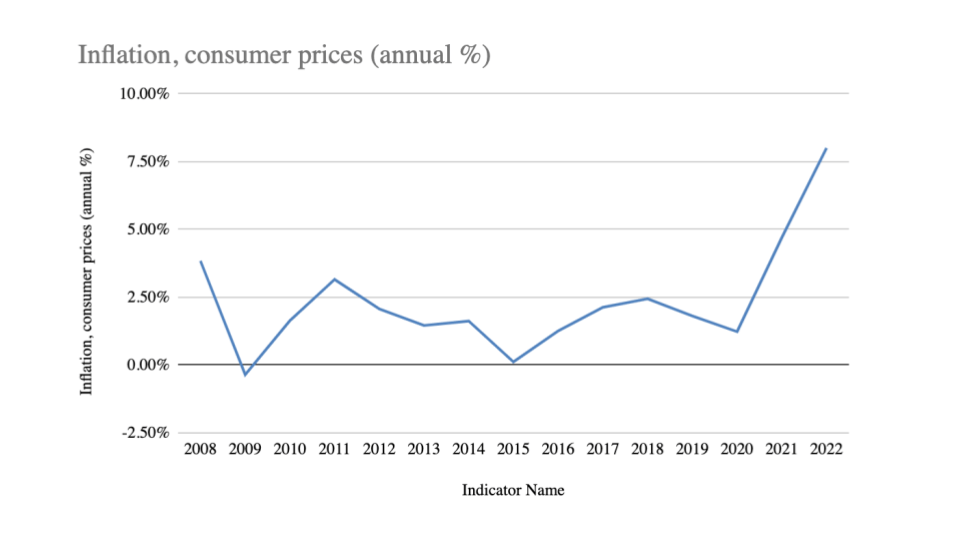
The most disturbing figure, though, is inflation. While it has been controlled for the better part of a decade after GFC, the war in Ukraine and the impact of the pandemic have put pressure on essential commodities, including fuel prices. If we combine this with the high debt, then we have another brewing crisis here.
Action on illegal immigrants
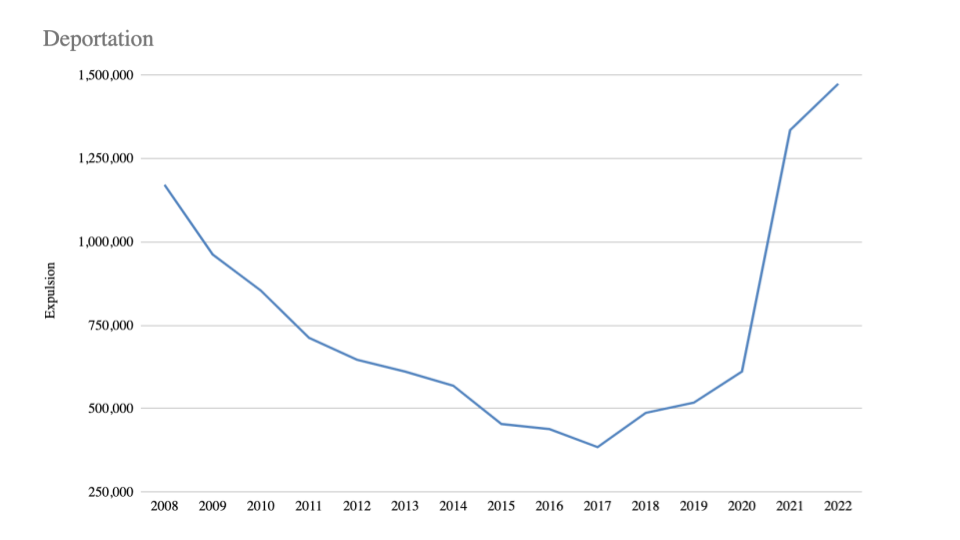
This was among the most sensitive issues between the Democratic and Republican parties. While Democrats were blamed for open borders, the Republicans were blamed for being insensitive and cruel. Well, as the saying goes, data never lies. The truth is Obama and Biden deported more people than Donald Trump ever managed. Trump, however, made more noise about this than Obama or Biden did.
Income and Wealth Distribution
One of the most popular opinions is that the Republicans are the party for the rich and Democrats are the party for the working class/unions akin to socialists. The reality is that the income distribution pattern in the US hasn’t changed in the last 16 years. Irrespective of which party is in power, they side with their donors to arrest wealth distribution of any kind. It is true that the top 1% have earned more in terms of percentage, but the pattern and percentages are no different from the past. I am not justifying the disparity here but merely pointing out that the situation hasn’t changed to warrant anxiety.
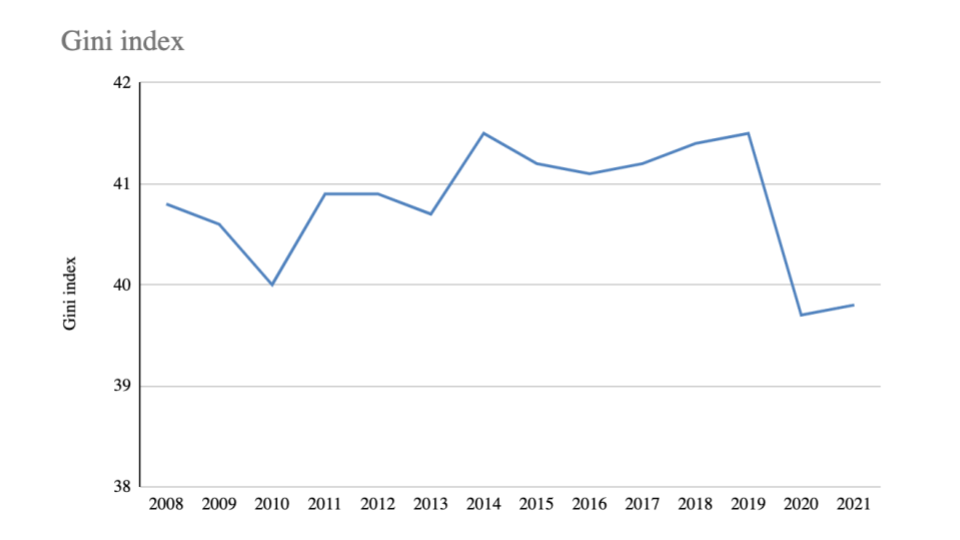
However, the GINI index, which measures the dispersion of income, wealth and consumption inequality, presents a more positive figure. For the first time in years, the figure is below 30 now. It isn’t a reason to celebrate, though, as the contributors to this are most likely inflation and economic slowdown.
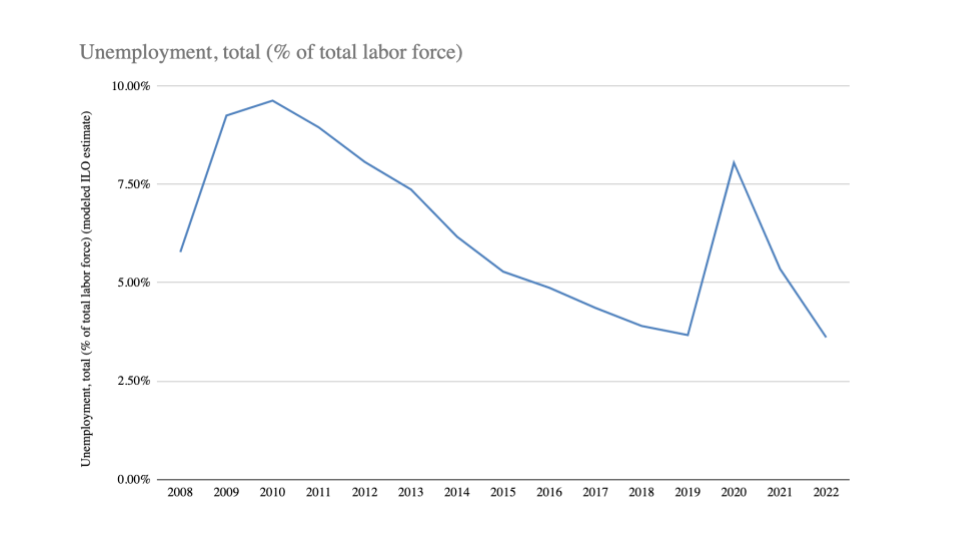
The last figure to look at now is the unemployment percentage. Again, barring the impact of Covid in 2020, we have seen this figure decline consistently from 2011. It doesn’t matter if the president is a Republican or a Democrat.
Climate Impact
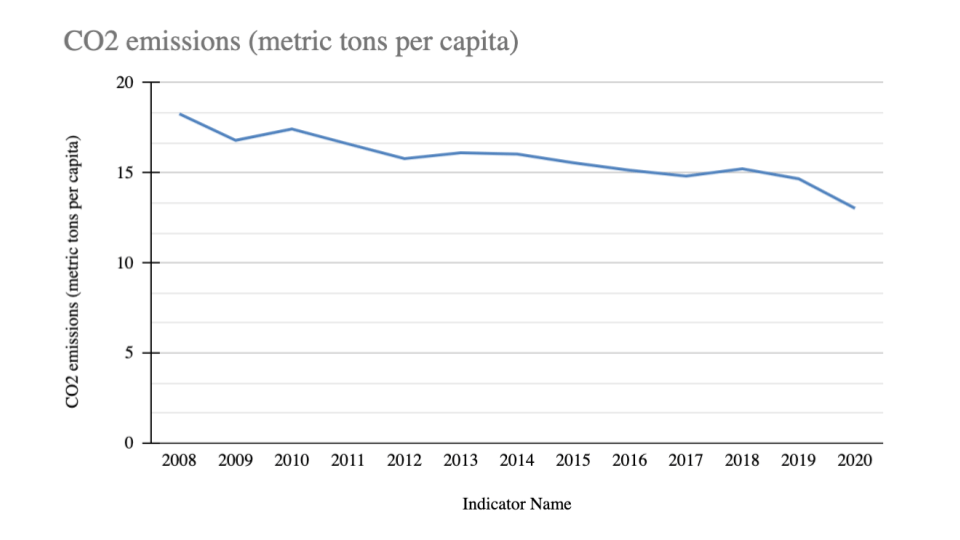
The last of the factors I want to look at is the impact on climate. As we look at per capita emissions from 2008, we see a steady decline even during the period of Donald Trump. Irrespective of whether the US is part of the Paris Agreement, the underlying change continues to happen, transportation is getting cleaner, and the emissions are going down.
Military Spending and Wars
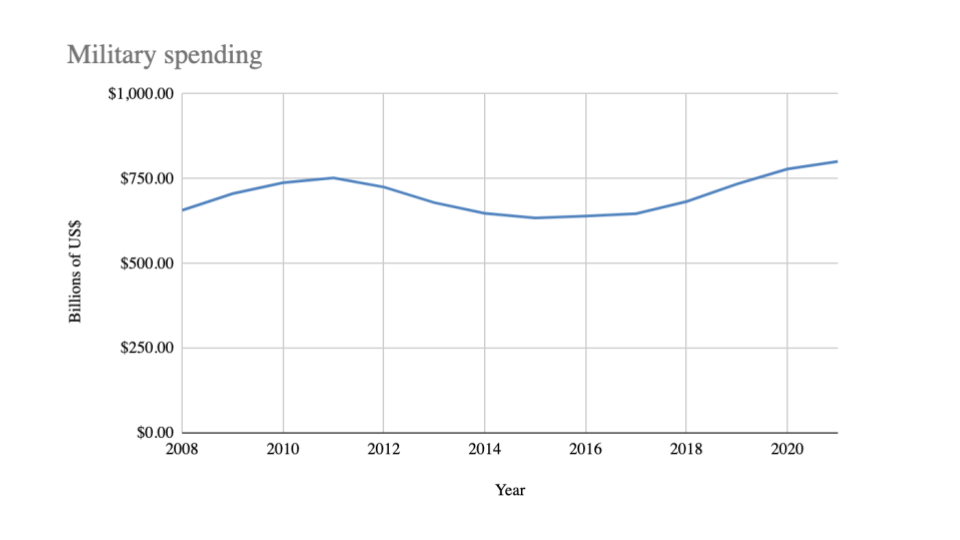
Inflammatory speeches and partisan opinions aside, the US hasn’t engaged in a new war since Hillary Clinton left the Secretary of State office. Neither Trump nor Biden have armed children in Africa or bombed a new sovereign nation. Bombastic speeches aside, Trump did diffuse a dangerous situation with Assad in Syria. Biden’s speech aside, he hasn’t added fuel to the fire in the latest conflict in Gaza. All said and done, the spending on the Military hasn’t come down. Having reached its lowest point in 2016, the spending is on the ascendency. I am sure most military officers will take spending over war.
As seen from the data (source: World Bank and OECD), the health of the United States is not dependent on the president at all. One could find more correlation between the war between Russia and Ukraine than the president or the party of the president. However, this definitely doesn’t mean that there aren’t problems or that the data is good. It is just normal. In the next part, I will focus on dealing with the probability of another Trump presidency. Whether we like him or loathe him, it is impossible to ignore the impact his term had on the mental health of all Americans.
The choice between sure death and a small probability of life is not something most of us will ever encounter. It is not even something we can fathom as it isn’t within the realms of possibility. If one is fleeing an oppressive Taliban regime with barbaric beliefs, then even clinging onto the outside of an aircraft is a chance worth taking. As we see the plight of millions of people stranded in Afghanistan and thousands trying to flee in the middle of a global pandemic, it is natural to question the timing of American troops withdrawing from the war-torn, landlocked country. I want to retrace the events which led to this decision and the reaction of the global leaders. Foreign policy can be messy, illogical, inconclusive and also devious. Foreign policies decisions also have a long term impact which are hard to predict.
The tale of 2 foreign policy blunders
The Cold war between the Capitalistic Social Democracies and the growing Communist single party rule was vastly responsible for what we consider present. From nuclear arms race which can obliterate our planet 10 times over to technology race to conquer space, the cold war had immense influence. What gets discussed less is the foreign policy impact of the cold war. Let’s pick two of the foreign policy blunders made by the US which are relevant to the context of Afghanistan.
The first foreign policy fiasco can be traced back to the era of Henry Kissinger and his indirect support for the capture of East Timor. The ego of the US war machine had been recently wounded by the Vietnamese. When Indonesian dictator Suharto invaded East Timor under the pretext of anti-communism, the Nobel peace prize winner Henry Kissinger found the opportunity to quench his thirst by supporting the movement. A weak Australia and other NATO nations joined. What followed in East Timor was ethnic cleansing and grave violation of human rights. The UN peacekeeping forces finally managed to get the imperialistic Indonesian forces in 1999. Why is this story relevant? This story is relevant as the freedom of East Timor is one of the biggest grudges Osama bin Laden had against the Americans.
The second foreign policy was the involvement of the US/UK coalition in the Soviet-Afghan war. The Soviet-Afghan war, ravaged Afghanistan from 1979-1989 between the USSR backed People’s Democratic Party of Afghanistan and the US and UK backed Mujahideen. Most of the later Taliban leaders were part of the Mujahideen. The principles of the Mujahideen haven’t changed from their original days. Towards the end of this war, al-Qaeda (formed in 1988) joined sides with Mujahideen to fight the Soviet-backed forces. The Mujahideen won the war with the fall of the USSR. This was followed by an Afghan Civil war which went till 1996. With the communist threat eliminated, the various factions of Mujahideen started fighting for control and ideologies. A newly formed group called the Taliban emerged victorious with the support of the al-Qaeda fighters and the Pakistani army. They took over Kabul in 1996, to establish the Islamic Emirate of Afghanistan. Once their mission of capturing Afghanistan was accomplished al-Qaeda started its attack against the US and its allies. This culminated in the 9-11 attack which shook the world.
By now, the world had forgotten the two big policy blunders which were nothing more than an extension of the cold war policy. The US support for both the Mujahideen in Afghanistan and the Indonesian invasion of East Timor was driven by their anti-communist ideals. Borrowing the language of Margaret Thatcher, the US government gave the necessary oxygen for the Taliban monster to grow. Would they have done this had they had the power of hindsight? It is anybody’s guess.
Evolution of the Afghan policy after 9-11 attacks
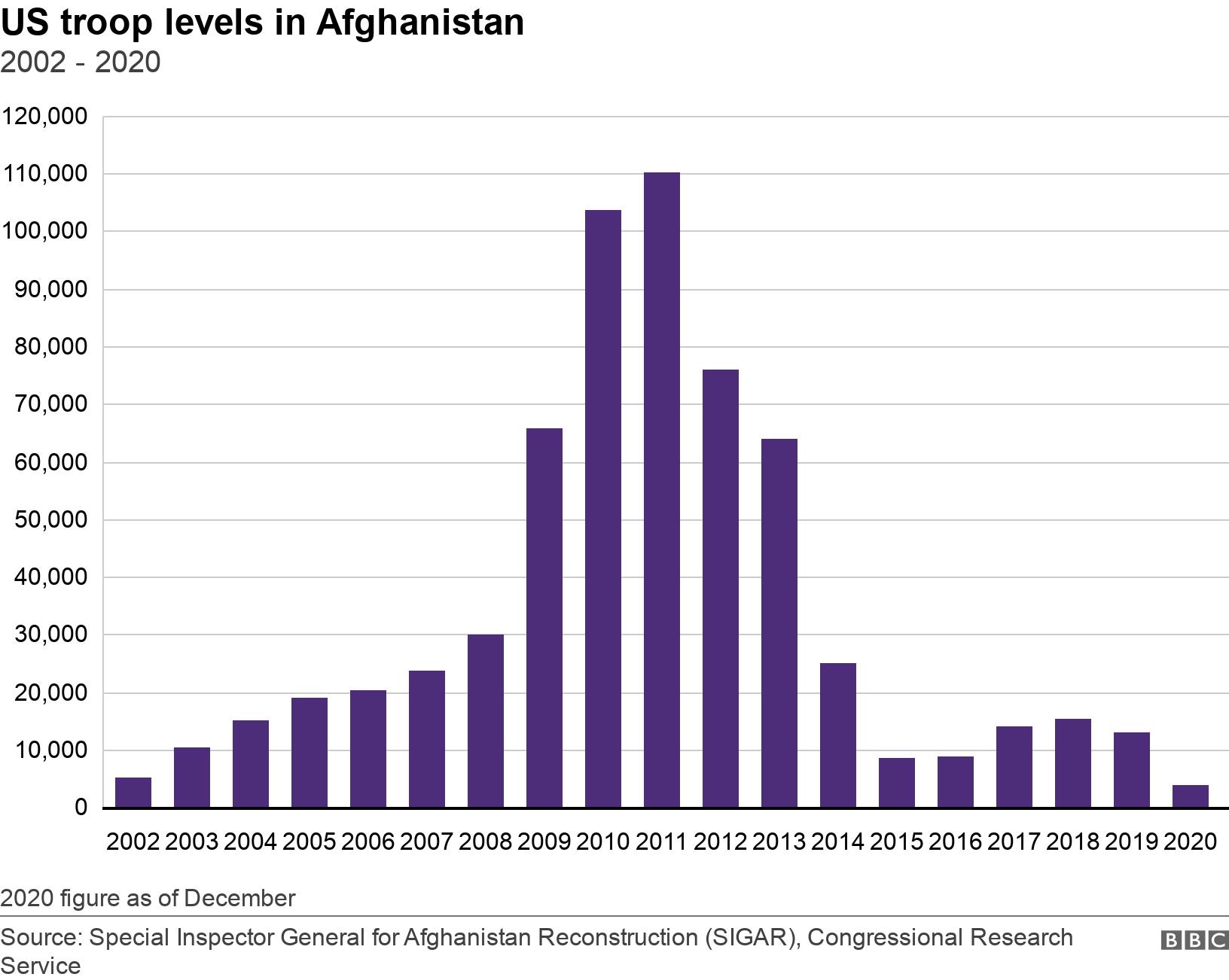
Three months after the 9-11 attacks, the Taliban government in Afghanistan and their al-Qaeda were ousted. They took refuge in the various remote parts of Afghanistan, Pakistan and some of its leaders went to Qatar. At this time the NATO army had less than 10,000 forces on the ground. They reached this level again only late last year. The total cost for the US treasury from this war is $830 billion which doesn’t include the military aid given to other countries to support the base or the support to veterans. A total of over 1 million people have been deployed to Afghanistan over the last 20 years.
The US foreign policy has also consistently changed over time. President George Bush said he wanted a ‘stable and free and peaceful’ Afghanistan. after the destruction of al-Qaeda and total elimination of the Taliban. When his administration finished its term, there were 30,000 American troops in Afghanistan.
The next President Barrack Obama wanted to end the war. His foreign policy included having a conversation with the weakened Taliban troops. Ironically, he increased the number of troops from 30,000 to around 100,000 by 2010. However, he did have a conversation with Taliban leaders. The then, Secretary of State Hillary Clinton had a condition, “Insurgents must renounce violence, abandon al-Qaeda, and abide by the constitution of Afghanistan, including its protections for women and minorities. If insurgents cannot meet those red lines, they will face continued and unrelenting assault.” The peace talks didn’t move further but the number of troops came down slowly. Obama left close to 10,000 members when his term ended. However, some territories had slowly been captured by the Taliban by then.
In comes the next President, Donald Trump. Trump has been calling for the end of the Afghan war and the return of the US troops during his entire campaign. The big difference between his secretary of state Mike Pompeo and the previous one was, Secretary Pompeo wasn’t keen on some of the protections which Secretary Clinton had demanded. So, on Feb 29, 2020, the US peace envoy Zalmay Khalilzad, and Mullah Abdul Ghani Baradar, the Taliban group’s top political leader signed a peace agreement. This deal meant close to 8600 US troops will leave in less than 4 months and the remaining by 14 months.
In April 2021, the current President Jo Biden announced that the remaining troops will return as per the agreement signed by his predecessor. In a press conference in Jul 2021, President Biden said he doesn’t believe the Taliban will take over Afghanistan. Was this wishful thinking or just bluff? Considering that the peace deal was signed with the Taliban permitting them to return, this was a very bold statement at its best.
The fall of Kabul
On the 6th of Jul 2021, the US forces leave Bagram airfield their main military base. By the 6th of Aug, the Taliban had started capturing provincial capitals. On 13th Aug, they take over Kandahar, the second-largest city in Afghanistan. At the dawn of 15-August-2021, when the Indians were celebrating their Independence day, their Afghani friends lost their national capital to the militia. It is not the collapse that has surprised people but the speed of it. President Mohammad Ashraf Ghani Ahmadzai fled the country leaving his people in the hands of a dangerous militia. Now, three big questions remain.
a. Who won this war? b. Was this a strategic mistake? c. What is going to unfold now?
The Afghan war has lasted twenty long years. The NATO forces spent over a Trillion USD in the war and building new infrastructure. 18 years of democracy crumbled in less than 9 days. The original leader Mullah Omar and Osama bin Laden are dead. Much to all our wishes, the Taliban have come back. Should we change the goal post now to say the aim was not to defeat the Taliban but to eliminate al-Qaeda?
For years now, members of both the left and right in the US have wanted the troops back. The only faction which was against it was the ones funded by the military-industrial complex. From Donald Trump to Bernie Sanders, from Rand Paul to Tulsi Gabbard, the politicians have called for the troops to return. This wasn’t a war for the US troops. The question was return was the one of if but when.
Now, could the handover been planned better? Was there an intelligence or strategic failure? To answer these questions, we need to look at the facts first. The US government has spent over $80 billion was spent training the 300,000 Afghan troops and provided them with modern war machinery. The Taliban on the other hand had 80,000 people with relatively older artillery. The Afghanistan government had army, police and local militia to support. Even with all these advantages, there was no clashes. The Afghan troops surrendered without a fight in most places. Would the situation have been any different if the US forces left a little later? Should the US forces have anticipated this and helped migrate the vulnerable people? In hindsight, I have to affirm the same. However, the writing for Afghan democracy was always on the wall. The only policy mistake I can see is that the allied forces should have got the people who supported them out of the country before exiting.
The future
Finally, to understand what could happen in the future, let’s look at the reaction of the global leaders in the aftermath. There are few distinct factions here. First is the pro-Taliban group which has the Pakistani Prime Minister Imran Khan. He has always been extremely supportive of the Taliban. Having been educated in Oxford and enjoyed the liberty of the western lifestyle for himself, Imran Khan has proclaimed this as “breaking the shackles of slavery”. The next group are opportunists, which include Russia and China. The leaders from these two countries have already spoken to the Taliban leaders. They see an opportunity with the fall of the retreat of the western forces. The next group are the sceptics, which includes countries like the US, EU, Australia and India. These countries won’t recognise the Taliban government but will be ready to have peace talks with them. The final group will include three countries that will not recognise or have discussions with the Taliban namely Isreal, Canada and Iran.
However, the big question in my mind is whether this move is the next foreign policy blunder after Vietnam, East Timor and the support of Mujahideen? While I don’t think it is a mistake of similar proportion, I fear the impact might be similar. We are going to see another refugee crisis, extreme oppression and international cry over human rights violations. The Taliban have an approach to gain power and unwavering allegiance to their interpretation of their religious texts. This approach will give them the power to rule but not the ability to govern. The local and global unrest is going to continue. The disadvantage for the Taliban over the Saudi Royal family is that they don’t have an oil supply to generate wealth.
The last week saw the result of three national election results in Indonesia, Australia and India. In all three places the incumbent leaders fondly called Jokowi, ScoMo and NaMo were reelected respectively. We all know the result, what we need to do is understand it. I want to quote Albert Einstein, one of my heroes.
Any fool can know. The point is to understand.
Now I want to understand the result and see what I can learn about politics in a representative democracy. Albert Einstein also said “We now have to divide up our time like that, between politics and our equations. But to me, our equations are far more important, for politics are only a matter of present concern. A mathematical equation stands forever.”. Since I am not smart to present the behaviour of the whole universe in a mathematical equation, I find it easier to concentrate on politics.
Politics vs Governance
Politics is the act of gaining power. Governance is the act of enacting policies and controls using the power to reach the outcome. There are plenty of ways to get power. In a representative democracy, an election is a way of getting the power directly from the voters. Once in power, part of the governance is also to enact policies which control the scope of the politics. This cycle is intended to keep societies in balance.
In general, politics has a very negative connotation and quite justifiably so. Politics is not a game where both parties play the same game the same way with the same resources. It is inherently divisive and is a game where people are allowed to play rough under a very broad legal umbrella. Acts which would normally be considered uncivil are almost essential in the space of gaining power. It is a fight for dominance in the hierarchy and fights are inherently unhealthy and disturbing. In order to win an election, the parties have to perform this act well.
Steps to win elections
Understand how people vote
In any election, people vote based on the below criteria.
Loyalty to an ideology/party/person
One issue closest to me
The charisma of the leader
Policies and Manifesto
Past performance
Least objectionable
Primary Research/Listen
There is no substitute for primary research. The research should give the following answers.
Percentage of people in each of the category given above
Key issues in people’s mind
What policies will shift people’s opinion towards you? What is the percentage swing?
What policies will shift your loyal vote base away? What is the percentage swing?
Communicate the policy
Draft a policy set: The manifesto is a policy set which will help you get the maximum swing.
Create a slogan: The best way to communicate a summary of the policy is to create a slogan which will resonate with the voter base. It should play with the confirmation bias of the users. As Einstein said, “If you can’t express is simply, you don’t understand it well enough”.
Create a communication strategy: Build an on the ground strategy to communicate the policies to people.
Outsmart and outwork the opponents
Hillary Clinton didn’t visit some of the states which she was confident of winning. She lost them by a very few votes. There is no substitute for hard work. Always the party which is smarter and ready to put in the hard yards wins.
Steps to lost elections
Alienating voters
The centre-left parties have been extremely guilty of insulting its voters. No voter likes to be patronised. It is worse to insult their loved ones. Few very common examples are the ‘Basket of deplorables’ comment by Hillary Clinton, ‘Anti-LGBT’ comment by Bill Shorten and ‘Divider-in-Chief Hindu nationalist’ comment by Indian Liberal media. These didn’t help their cause.
Resting on laurels
As I mentioned above, there is no substitute for hard work. The common theme sometimes is the leader not even visiting the constituencies. One can remember Hillary Clinton not even visiting some of the rust belt states. Rahul Gandhi didn’t campaign in his constituency Amethi. If a politician is so overconfident that they are not going to even address the people directly then it is a matter of time before they lost. The voters don’t like a condescending leader.
Weak leader
As strong as a system may be, it is important to have a respectable leader. The elected leader represents the people. So, the voters need to see the person as a strong respectable person. A weak leader is not going to be helpful.
Not understanding the needs
The most extreme mistake is to misunderstand, malign, dismiss, patronise or worst of all not attempt to understand the needs of the voters. The voters needs have no obligation to be in line with your ideology. The key mistake made here is go with a slogan which is completely different from the needs of the people. The Trump’s build the wall didn’t work in the states where people didn’t have problem with loss of jobs, crime or immigration. In the same vein, Hillary Clinton’s slogan ‘Stronger together’ didn’t address the issues of the rust belt. ALP under Shorten failed to address the needs of the working class in Queensland. This led to their collapse in the Australian federal election 2019.
To conclude, politics in a representative democracy is a game of tricks to gain power. It requires a lot of ground work, respect for the opinions of the voters and willingness to do the hard work. This will sometimes mean the party has to be decisive without alienating the voters. Insulting groups s a good strategy if you are a comedian wanting to win claps but not if you are a politician wanting to win votes.
Socrates considered Democracy as a system which is only better than anarchy. If I have to quote a more recent one, our fictional friend from Yes Minister, Sir Humphrey Appleby explains the purpose of the government as “Stability. Keeping things going. Preventing anarchy. It is only about order or chaos”. As Australia votes to elect its federal government, it is a good opportunity to reflect on the policies of the two key parties to see if Socrates and Sir Humphrey Appleby were indeed right. Is any party going to look at intergenerational investments and future proofing Australia instead of going through the motions? I want to do this analysis in four sections.
How is Australia doing?
The key risks & issues
Policies of the two key parties
My opinion
While I will try my best to state facts without cherry picking them to suit my narrative, I have to admit I am not an unbiased player in this space. I will never vote for authoritarians who erode civil liberties and I will never vote for conservatives.
There is also a popular misconception that the Labour Party is pro-workers and not tough on crime while the Liberal party is pro-business and socially conservative. While one can choose an example for these, it is definitely a stereotype. It is worth debunking this but I don’t think I will be able to do it in this blog. I find it more prudent to look at policies and implementation rather than opinions and feelings.
How is Australia doing?
In order to identify the key risks and issues facing Australia, I want to look at parameters which are under the influence of the government. I specifically didn’t focus on parameters which are not critical or have been consistently good (like Poverty rate, infant mortality). in the country.
Government
In order to form a judgement on voting, it is important to see which party has rules Australia in the last 2 decades. The Coalition led by Liberal has been the party in power for most of the time. The Labour party ruled from 2008 – 2013 during the Global Financial Crisis and its aftermath.
Demographics
The population of Australia has grown at a fast rate since 2006. Allowing skilled immigration has been the key contributor to this. As an immigrant myself, it can sound hypocritical but Australia has to control the inflow for a variety of reasons. The most important of this is the economy, especially the social safety. There is a strain on the economy now with the end of the mining boom and the falling of the housing sector. Adding more people at this time could have more dire consequences in the recovery. Further, raping growth will make integration extremely hard. Countries in Europe have already experienced this.
Economic
If we look at the economic parameters there are some interesting points to note.
The total GDP and GNI and per capita GDP and GNI have consistently trended up over the years. However, the rate hasn’t been the same. The per capita GDP and GNI have increased at a far lesser rate.
The budget is heading towards a surplus but the government debt/GDP is at an all-time high.
The gross savings against the GDP has come down significantly over the years.
Government Investment
One of the key roles of a government is to make inter-generational investments. I have looked at some key areas which the government has been investing. The trend to note is that the previous two coalition government haven’t been making much investment in capital formation.
Trade
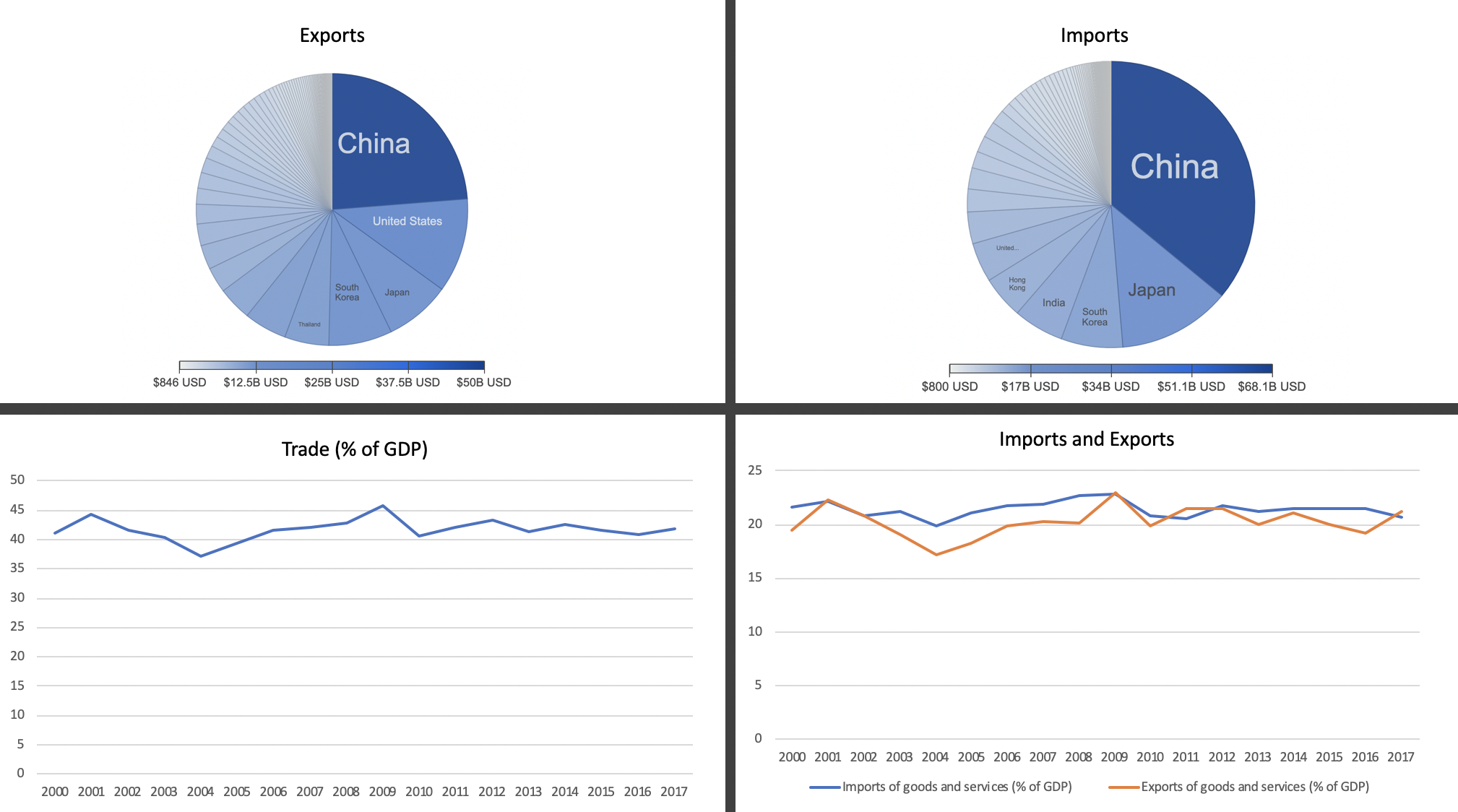
On the trade front, Australia is significantly dependent on China on both the imports and exports. Also, exports as a percentage of GDP are increasing over imports after a long time.
Labour
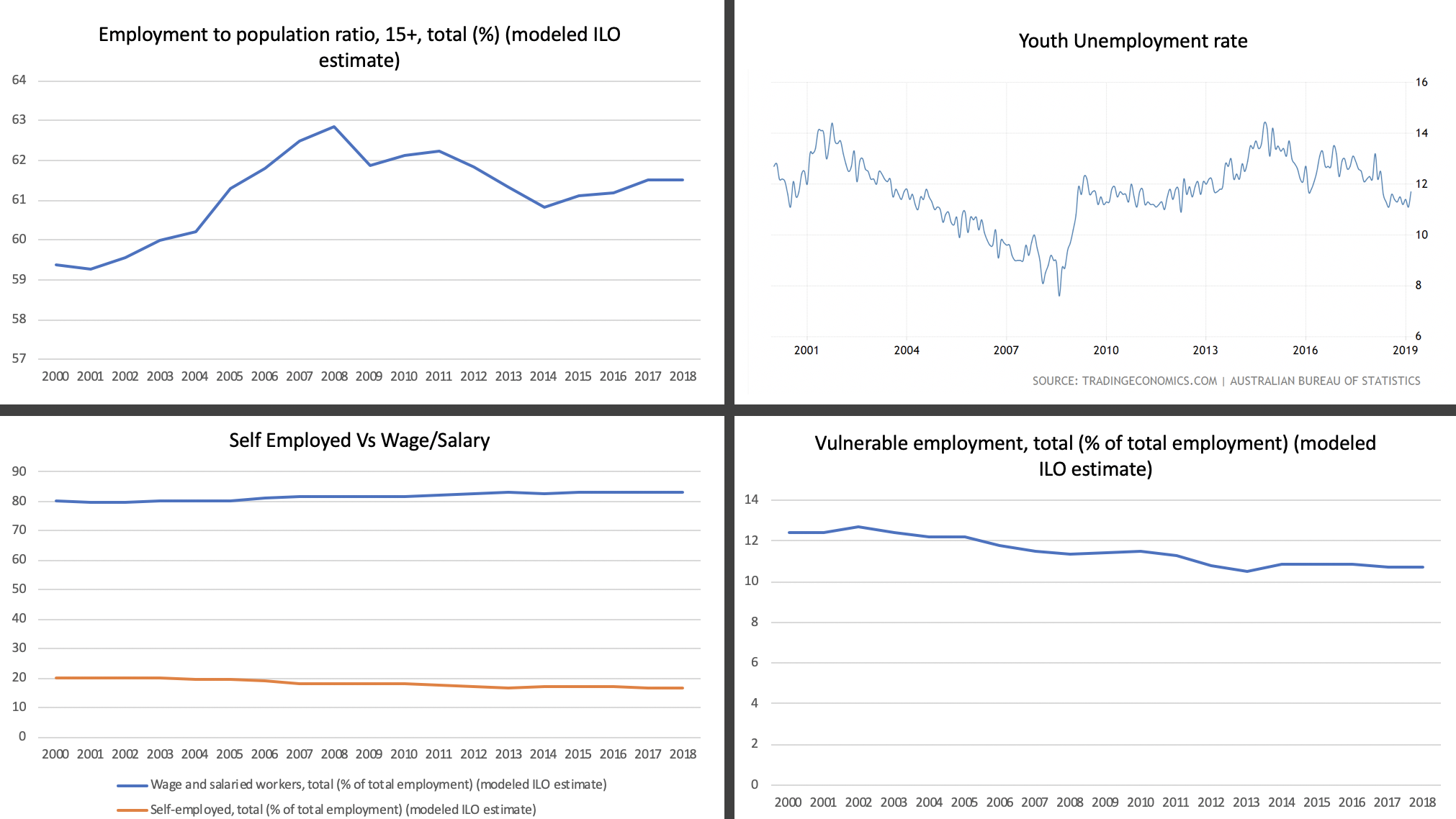
On the labour market parameters front, Australia is looking quite healthy. The employment to population ratio is fairly high. Thought the youth unemployment rate is high, it is still way below the global average. There is a good mix of people between self-employed and wages. The population who is into vulnerable employment is also low and steady.
Domestic Finance
This is one of the biggest areas of concern for Australia. I want to interpret some of the numbers here.
The household debt is at 120% of the GDP
The homeownership rate is on the decline
The dwellings are the biggest portion of a family’s wealth
The housing prices are falling overall
The household debt to disposable income is at its all-time high
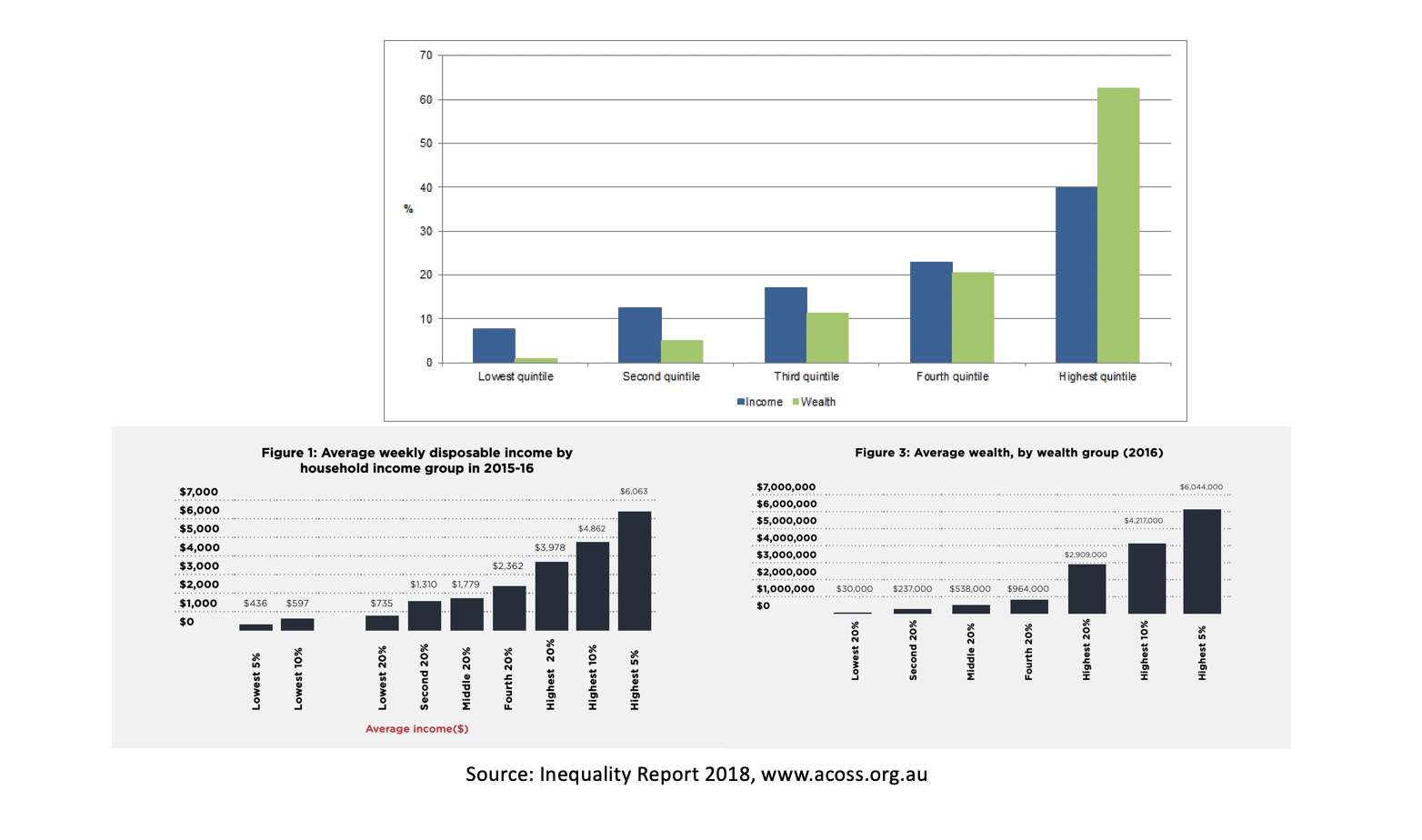
The discrepancy in wealth is way higher than the discrepancy in income. The income distribution is good when compared to other OECD nations but the wealth gap is extremely concerning.
Energy
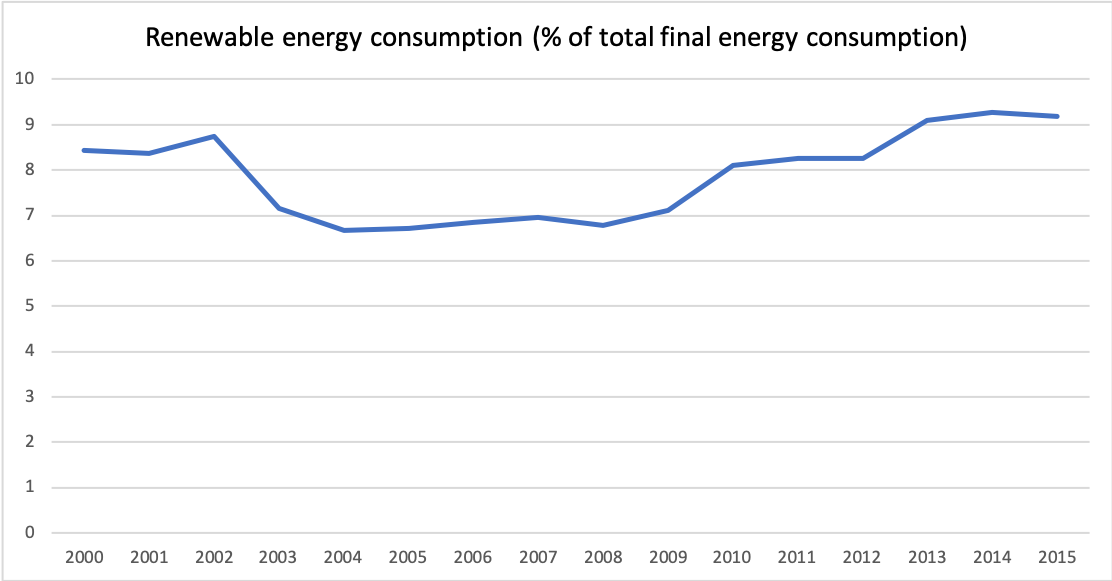
Last but not least, the percentage of energy consumed from renewable sources has stabilised since 2013. This shows a lack of movement towards alternate sources of energy.
Key risks and issues
Automation and long term risks to jobs
One of the huge risks of the present generation is the potential loss of jobs to automation. These jobs are not just ones to do with manual labour but even skilled ones like legal advice, radiology, administration and teaching. Australia is not going to be an exception to this. Some countries like the US are seeing the effect of this already.
Household debt
The household debt has reached record levels. A median income Australian family has debt which is close to three times its annual disposable income. This debt value is going to look bigger if the economy slows down. Most of this debt is mortgage and the house is the biggest asset followed by super for most Australians.
The gap between income and wealth
While income inequalities are understandable, Australia is seeing record accumulation of wealth without income levels supporting the same. This wealth disparity is going to trigger a change in social behaviours over generations. It will result in slowing down of the government revenue, increased consumption without contributing income, stagnation in production and above all social unrest.
Trade
Australia is heavily dependent on China was its trade. 36% of Australian exports and 24% of imports are with China. This is a huge risk for two main reasons.
The Chinese government is increasingly flexing its muscles and bullying nations which doesn’t agree with its terms. With Australians not keen on selling its natural resources and infrastructure to Chinese state-run companies, China will not take it lightly for long.
Australia has now inadvertently linked its progress to that of China. This is a very high-risk strategy. It is only made worse by Chinese business and government practices not as transparent as ones in the developed world.
Foreign policy
Australia’s foreign policy has always been toeing the line of the big guns. This in the past was to follow NATO guidelines. This meant Australia doesn’t have either the passive non-aligned policy of the Nordic countries or Switzerland or the aggressive drive of the United States. This is not going to work for long as very soon the US and China are going to be in different camps. With the imminent trade war between the US and China, one has to review the follower mode. Australia will be left without a policy-making parent country. The answer is not to go find a new one but to start behaving like an adult.
Clean Affordable Energy
In spite of having over 33% of the world’s Uranium deposits, Australia doesn’t have a single Nuclear Power plant. Nuclear power is one of the cleanest sources of affordable power. Solar power is good for domestic purposes but it has worse disposal problems than nuclear waste. The risks caused by nuclear power generation can definitely be mitigated lot more effectively. All said and done, the black coal still dominates the power generation in Australia.
Education & Skilling
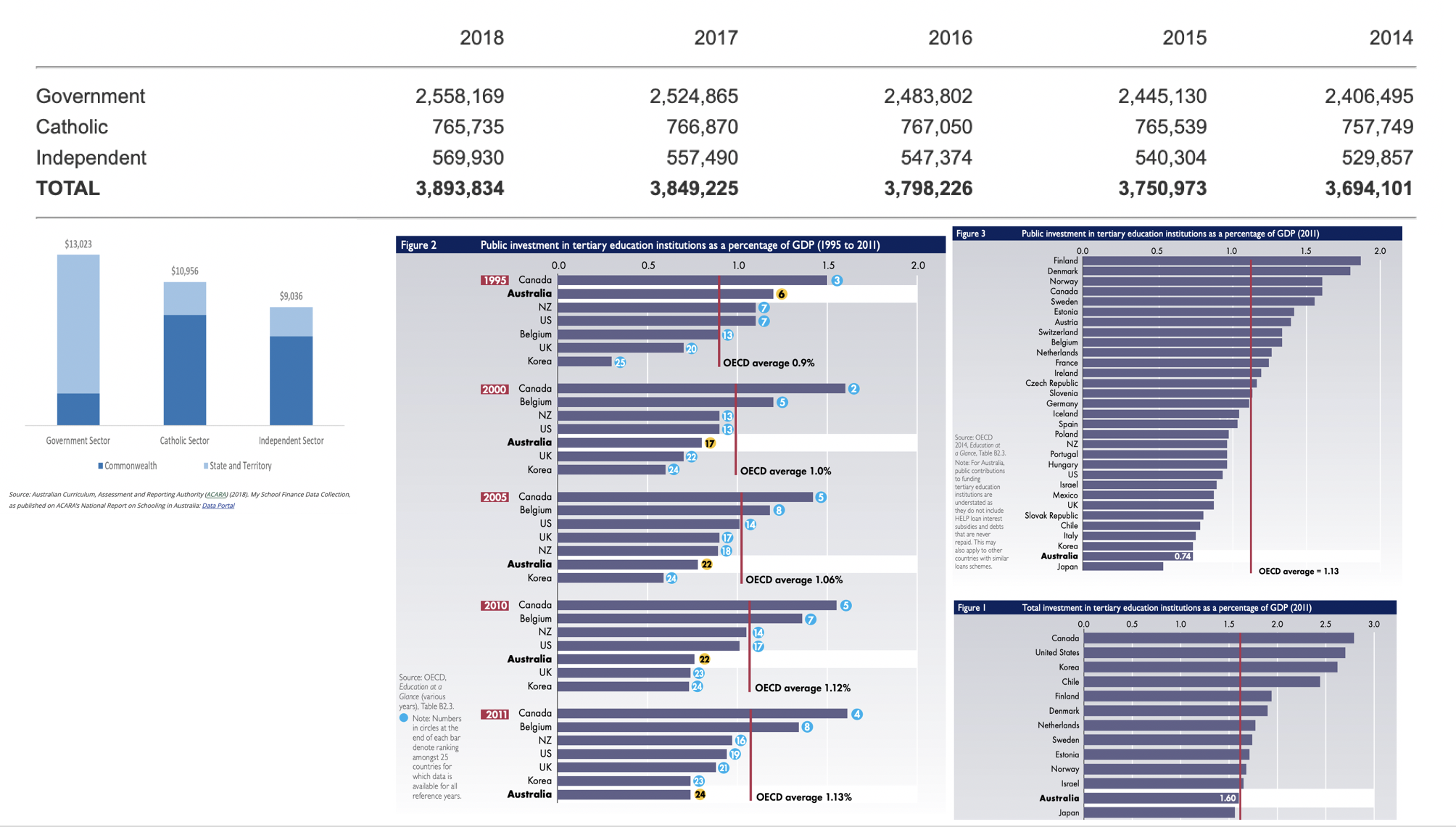
Over 70% of the students in Australia still go to Public Schools. However, Commonwealth funding is completely disproportionate. Further, skilling in Australia happens through apprenticeships and TAFE. University fees have increased tremendously over the years.
Both parties have similar sounding policies but written slightly differently. I want to first review each of their policies and then compare their performance against the key risks.
Labour Policy
The labour policy is a combination of the policies of the left-leaning parties in other countries like the UK and reverting to some of their old policies. There is hardly a single policy which I can call out for novelty. Their policies address most of the talking points in the proverbial voter checklist.
Hits
Skilling – Investment in apprenticeship, TAFE
Space research
Manufacturing jobs
Infrastructure Investment
Naplan Review
Review of the free trade agreements
Misses
No standing on foreign policy apart from obeying Chinese government
No policy to address the housing crash/correction
The clean energy plan is extremely naive
The plans don’t add up economically. Asking multi-national to pay fair share is alone not going to contribute to the costs
Pandering to multi-culturalism – Chinese education, money transfer etc
No clamping on outsourcing
Liberal Policy
The liberal policy is a self-glorification attempt. It is a combination of moderate policies which the voter wants and not talking about their policies which the voter don’t want to understand. There is again nothing new in their policies.
Hits
Scare tactic against Labour
Border protection
Plans for regional areas
First home buyer support
Crime protection
Misses
No substantial policy except incrementing the current one
Free trade advocacy
Lack of strong policies for leadership in the Pacific region
Free ride for corporations
No clamping on outsourcing
Performance
The next step is to review if the policy handles the risks outlined.
Risk/Issue
Labour
Liberal
Choice
Automation and long term risks to jobs
They have policies for reskilling, especially in the energy sector. There is no acknowledgement of the job losses due to automation or creation of newer sectors.
They haven’t even thought of the issue.
Labour
Household debt
Hasn’t even bothered. If they want the bubble to burst, then they need to have policies which address the impact
Their new homeowner policy might sound attractive but is going to increase the gravity of this issue.
Neither
The gap between income and wealth
None
None
Neither
Trade
There is a slight focus on the renegotiation of trade agreements but no mention of how they are going to get it through.
Continued focus on free trade is going to backfire on Australia.
Slightly Labour
Foreign Policy
There is a mention of diversification but the rest of the policies fall flat in this regard.
There is a mention of derisking by improving the relationship with India but that is still not substantial.
Slightly Liberal
Clean Affordable Energy
Their renewable policy is definitely well written but I am still sceptical on this being affordable. The lack of discussion on nuclear is still appalling.
None.
Labour
Education & Skilling
Their policy to fund schools better, review Naplan and support for the public schools is definitely good.
Their policy to improve TAFE, and create university fund is a good path forward.
There is no quality plan in this regard. The liberal policy is to continue the current policy.
Labour
To conclude, the labour party is proposing a plan which doesn’t tie up economically and the liberal party is proposing a plan which doesn’t change anything. Both of them are engaging in a fearmongering tactic. Between a plan which is depressingly status-quo from the liberals and another one which is thoughtlessly naive from the labour the choice for the Australians is hard. The economy is growing globally so no government can take credit for this. Even after factoring in my biases, I will still advocate voting for labour to ensure there is an investment into key sectors which will result in intergenerational progress. I am definitely sceptical if they can turn their policies into action but there aren’t any more data points at the moment. A voter has to vote on policy.
The elections for the representatives of the 17th Lok Sabha or the lower house of the Indian Parliament is underway. The Indian parliament election is one of unprecedented scale as over 900 million people are eligible to vote. It is a load test to any electoral process. As with most elections, emotions are running high, polarisation is immense and everyone is projecting a doomsday result if the other party gets elected. As a person who truly hates both the parties, I find it extremely laughable. There will be no significant difference in outcome irrespective of which party comes to power. I will explain the reasons during the course of this blog.
The two coalitions
There are two major coalitions which are fighting the elections. One is the incumbent National Democratic Alliance (NDA) led by Bharathiya Janatha Party (BJP) and the other one is the United Progressive Alliance (UPA) led by Indian National Congress (INC). I want to table a brief introduction about both these coalitions.
Name
National Democratic Alliance (NDA)
United Progressive Alliance (UPA)
Main Party
Bharathiya Janatha Party (BJP)
Indian National Congress (INC).
Leader
Narendra Modi
Rahul Gandhi
Last election performance (272 needed for a majority)
282 seats
44 seats
How followers see the leader
Protector of the Hindus
Only hope to develop India
Strong leader
Youth Icon
Secular leader
Will help create a progressive India
From a family of leaders
How opponents see the leader
Against non-Hindus
Against lower castes
Hasn’t made any progress
Against poor
Will destroy the Indian secular fabric
Has created an environment of distrust, division and hatred
Authoritarian
An idiot who has no new ideas
The only qualification is that he is from the Nehru-Gandhi family
Will bring India’s development to a standstill
Useless
My view of their leader
A good orator especially in Hindi
Extremely cunning statesman
Turns blind eye to Hindu fundamentalism
Has surrounded himself with smart people
Is incapable of having an intelligent conversation
Turns blind eye to non-Hindu fundamentalism
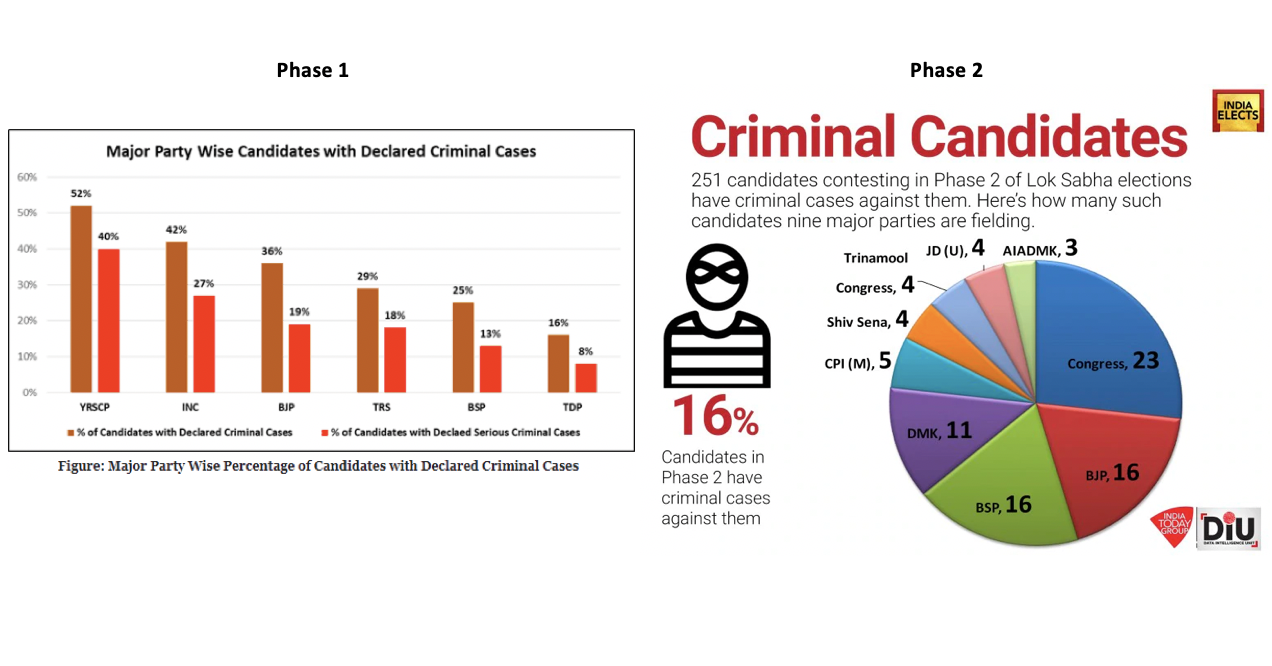
As far as the corruption and number of criminal cases go, both these parties are exactly the same. So, there isn’t much difference there.
Key performance
I want to look at some key performance indicators. I want to look at this in terms of the party in power and the resultant impact. I do not want to assess the validity of the parameters or the absolute performance of the country. I want to measure the performance relative to the party in power. The data for these have come from the World Bank, OECD and Indian government sites.
From
To
Coalition(Party)
19-Mar-98
22-May-04
NDA (BJP)
22-May-04
26-May-14
UPA (INC)
26-May-14
till date
NDA (BJP)
Financial Indicators
The GDP of India has been constantly rising since 1998. The growth rate though has been up and down. In a mixed economy dependent on both exports and huge internal consumption, a balance of inflation and geopolitical reasons will impact short term growth rate. What is also significant is that the debt/GDP ratio has been coming down since 2002. The Ten years of UPA and 6 years of BJP have had no impact on these financial indicators.
Economic indicators
I have got three main indicators of the economic health of a country. They are savings, distribution and investment. Here is the reason I have these indicators.
Savings: Does this country have enough assets to handle emergency situations?
Distribution: Has the economic model resulted in the growth of the whole population?
Investment: What is the focus on future generation?
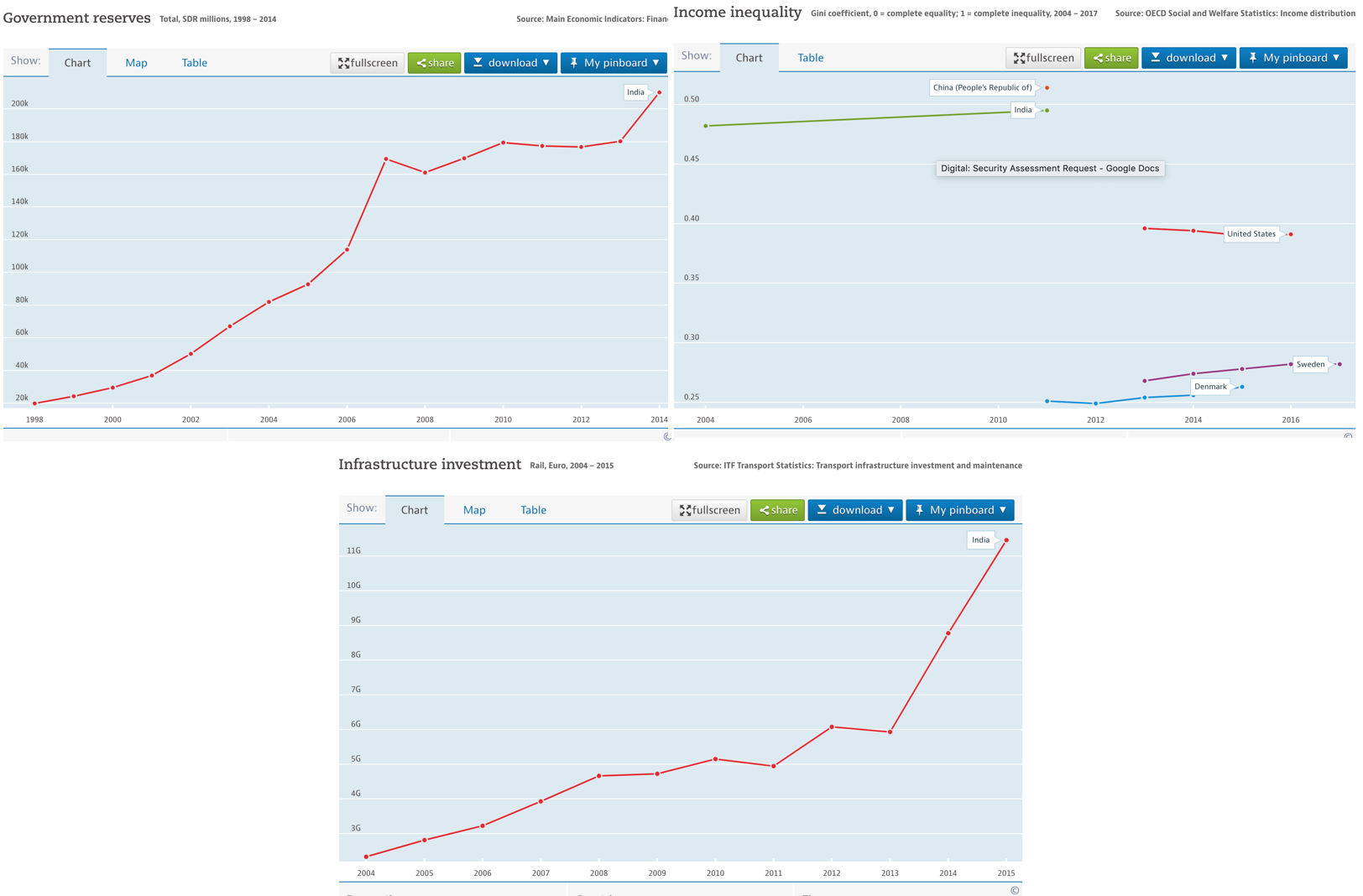
Based on these, there is again very little difference between the parties with a reserve and income inequality. There is however a big difference as far as investment in infrastructure is concerned. The NDA government led by Modi has made a lot of investment in their tenure.
Social & Environment indicators
The next set of indicators are to do with social and environmental performance. The population is important as there is no point if the population grows faster than the GDP.
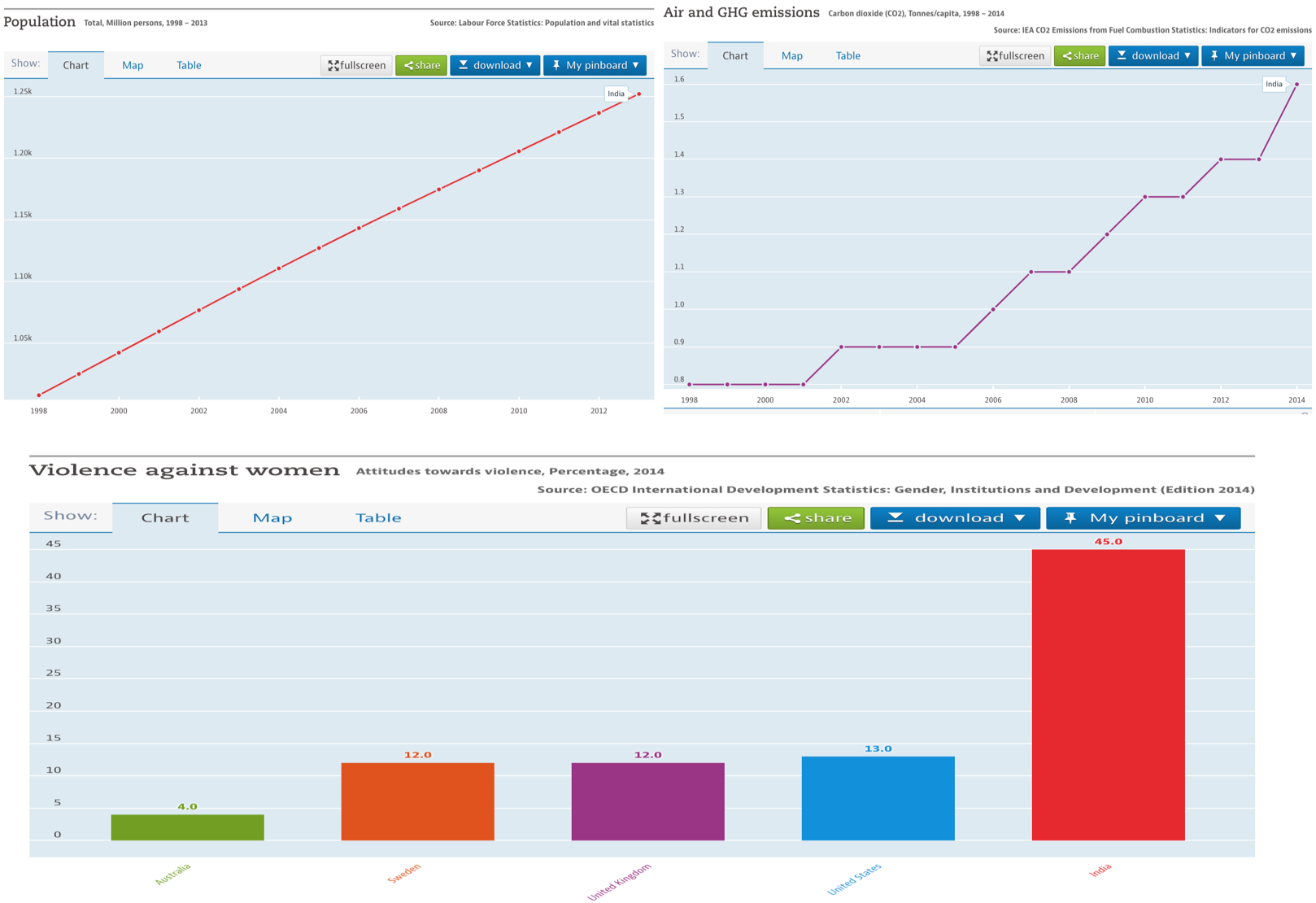
The population of India has been rising constantly for decades now. Through the number has been steadily increasing, the rate has been falling. The next one if the emissions caused. The CO2 emissions number in India has also increased over the period although the per capita emission has almost been constant.
The last one I want to highlight is violence against women. I do not have a trend chart for this but a comparison against most other nations show where India stands in this regard.
Domestic Considerations
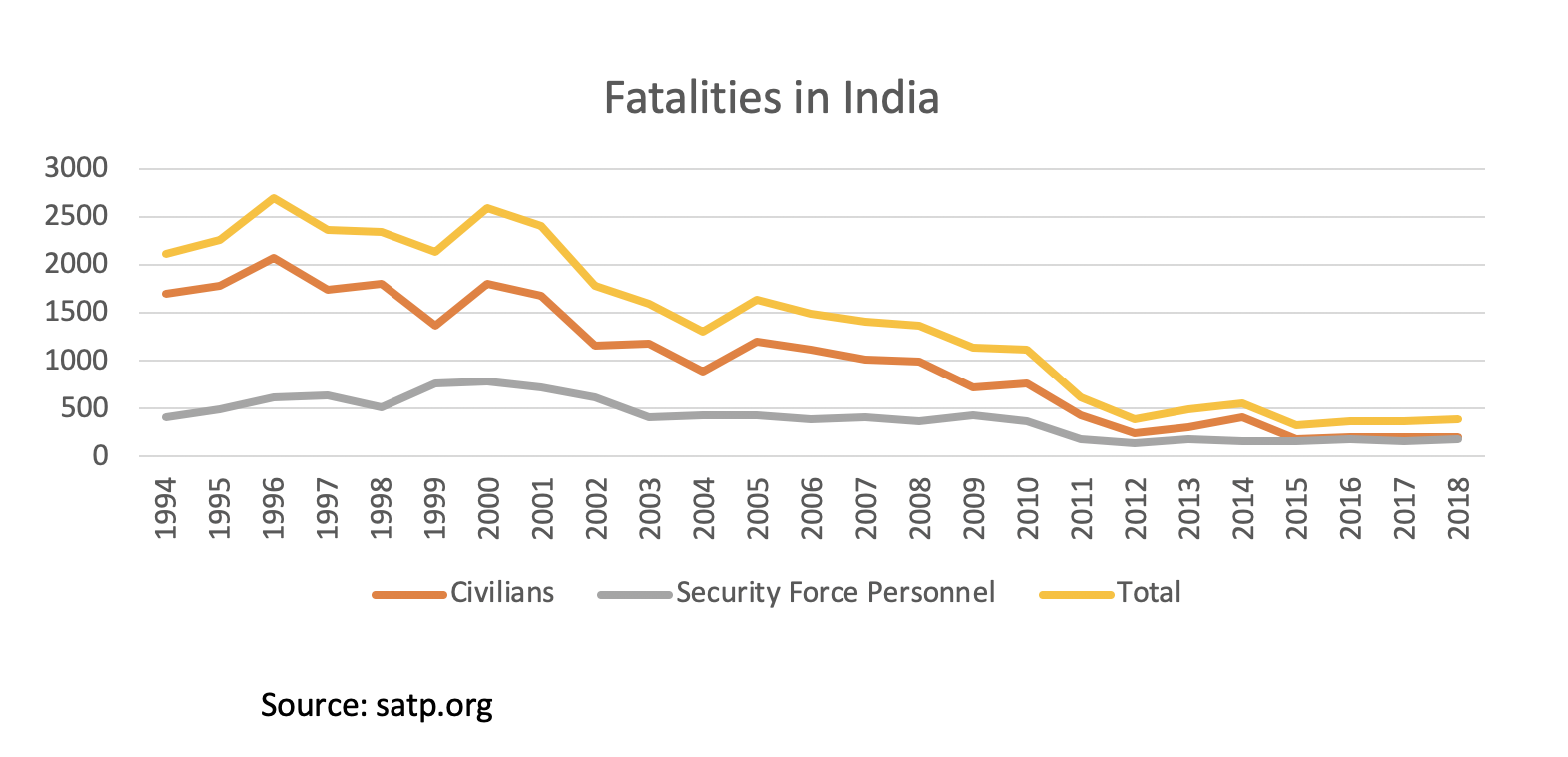
The NDA under BJP is claimed to be against minorities, stifling them of their freedom and instigating riots. The UPA under INC is accused of being soft on terror and crime. The statistics give a completely different picture. The number of incidents, deaths and injuries due to communal violence has almost been constant over the last 13 years. The fatalities to civilians have also seen a downward trend since 1998.
The number of people with criminal cases is almost the same in both parties. India Today magazine published the statistics on candidates who have criminal cases against them.
Other developmental policies
There are definitely some policies enacted by each government which focuses on development. Those policies would have benefitted a community or a region. Again each party has its set of feathers in their cap. The net effect of these is still the same.
Foreign Policy Considerations
The next item to consider is the difference in foreign policy. I want to split the foreign policy into zones.
The United States of America: No significant change. India continues to toe the line which the United States wants them. From Manmohan Singh to Narendra Modi, no one wants to disturb the peaceful settlement of abject surrender.
China: No significant change. India continues the tensed relationship with China. Apart from the odd Doklam issue and rejection to join the OROB bandwagon, India has hardly been able to have any influence on China.
Rest of BRICS: No change.
Pakistan: Both Narendra Modi and Manmohan Singh have tried to better relationship with Pakistan and both have ended not taking the relationship forward. The issue with the relationship continues to be volatile.
Middle East: One good aspect which has happened in the last 5 years is the improving relationship with Isreal. Other than the relationship has been one which ignores all the human rights violations for the sake of oil.
Iran: I can only find India’s relationship with Iran humorous. India has always had a good relationship with Iran. However, India hasn’t been able to capitalise it by setting up the oil and gas pipeline which they always wanted. Primarily, India doesn’t want to annoy the USA by publicly using its proximity to Iran.
South East Asia: No change
Europe: No change
Social Considerations
Secularism
India has no truly secular party. They have castist parties and religious parties. The only difference is which religion do they support. It is evident when you see the candidate from each party in a locality. It is always based on caste and religion.
Free Speech and Tolerance
There is no party in India which is tolerant and advocates free speech. From INC, BJP to the Communist parties, all of them have an extremist wing. They attack civilians and journalists who oppose them.
Journalistic freedom
While there have been claims of journalists being attacked during the BJP tenure, it is not unique to only one party. All parties have done that. The biggest attack on individual and journalistic freedom was the emergency period carried out by the INC government under Indira Gandhi. There were TV stations ransacked by the so-called secular, tolerant parties in different parts of the country. Journalists who have exposed corruption have always been attacked.
Conclusion
To conclude, in spite of the polarisation, there will be no significant difference between a Rahul Gandhi led UPA government and a Narendra Modi led NDA government. Both parties will do what benefits them and pander to their base. They have already created a system when nothing can significantly change. So, Indians can relax. It is not doomsday yet.
14-Feb-2019, as the world was celebrating St. Valentine’s day over 40 CRPF( Central Reserve Police Force) soldiers were killed in a terrorist attack in the Pulwama district of Kashmir. Justifiably, it has been followed by anger, scorn and calls for revenge. Sadly, the intellectually lazy members of the society have also pinned this on the terrorists being victims.
The Kashmir issue is also the most contentious and divisive after the Isreali-Palestine struggle. In spite of my interest in the subject, I have found it is hard to write on the topic because of the number of variables involved. I do not want to reduce the complexity of the issue in an attempt to dissect it. It requires acknowledgement of history, the mistakes made and above all the experience of people who identify themselves as Kashmiris. I finally feel like I have a position which can be articulated. It is what Eric Weinstein put eloquently calls as the long-short position. It is a strategy predominantly seen in Hedge Fund management. I want to run through my thought experiment of how this approach can be used in the Kashmir issue. For the purpose of this blog, I do not want to cover the issue details. There are plenty of sources which anyone can search to read on the actual issue.
Expected Outcomes
I want to start by calling out an end outcome to this struggle and my acknowledgement of the situation. Towards the end, I will also mention my sources. My strawman of the outcomes of any solution for this issue will contain the below mentioned three points.
Peace for all Kashmiris irrespective of their faith or lack of it
National Security for India and Pakistan
Agreement on borders and sharing of waters
Acknowledgements
While I try to unravel this convoluted issue, I want to also acknowledge a few points on the overall situation.
With regards to liberty, even a corrupt Indian Government is any day better than the theocratic mob rule in Pakistan
The people who are promoting mass attacks in Kashmir are not freedom fighters
The Indian Military forces have committed crimes in Kashmir
Pakistan is harbouring the terrorist jihadist organisations
Kashmiri youth have been radicalised
It is not easy to differentiate between the peace-loving Kashmiris and the supporters of terrorism in any counter-terrorism operation.
The key points which prevent the struggle are given below.
Political implications of a negotiated solution in both countries
Unwillingness on the part of Pakistan’s Government to dismantle the terror outfits operating in their country
Massive radicalisation
There will never be a world with or without humans that don’t have bloodshed. We do live in a glorified jungle. Animals hurt each other for survival. However, what animals also do is to create territories and form norms for survival. So, if principles of the game don’t align it is important to create boundaries and stay within the rules of those boundaries. This is true with international relations too. The struggle in Kashmir is more ideological and political than sovereignty. It cannot be resolved without addressing the core. India or for that matter even Pakistan will not be able to adopt the ideology of their neighbour. So, we have to look at the solution. Considering that Pakistan’s democratically elected government has limited power over its military and intelligence, I do not have a solution in mind for them. I want to focus on what I believe India can do to address it.
Using the Long-Short strategy
Now let me transition to the long-short position I favour as on this problem. The two positions are focusing on the development of Kashmir and internal security. These are within the paradigm of the duty and right of the government.
Focussing on development
The government of India has for long called Jammu and Kashmir an integral part of the country. However, this has to be translated into action. There are critical aspects of development which has to be driven as a result.
Academic development – Building schools, drive more population to fields of study which will expand their perspective beyond religion
Infrastructure development: Building roads, bridges, hospitals, factories, power plants which will promote a better lifestyle.
Social development: Having a social system which will support people in need. This includes health care, housing and rehabilitation of people.
Economic development: Build opportunities for people to get into full-time employment. The job market in Kashmir is ripe but it is also blocked.
Focus on internal security
The only way to get peace for people who want it and desperately need it is by focusing on inland security. This requires investing a lot in investigative infrastructure, surveillance and enforcement agencies. This also requires a lot of transparency. There are two risks and three mandates for this.
Risk #1: Privacy invasion: Surveillance naturally causes privacy issues. However, intelligence and investigative services are inherently privacy breaches. Liberty works only when the environment is for liberty. The Kashmir struggle cannot be put in that bucket.
Risk #2: Policy hindrances: This solution requires a set of policies which need to have an interest which goes beyond partisan political perspectives. For this to pass the parliament and state assembly requires a degree of goodwill that I haven’t seen. Further one of the key aspects of these policies should be to stay outside of any religious affiliation or promotion. For example, there is no need to have waivers for either Mecca or Amarnath.
Mandate #1: Consider the LoC as the border: The Line of Control between India and Pakistan should practically be considered as a border. This also means tight security and heavy surveillance.
Mandate #2: Avoid diplomatic contact with Pakistan: The government of Pakistan seems to a puppet of its army and intelligence agencies. There are plenty of non-state and state actors which support the terrorist organisations. There is no use in having a diplomatic relationship with a state that doesn’t believe in diplomatic relations. The Prime Minister of Pakistan, Imran Khan responded to attack asking for evidence. It is strange he is asking for evidence considering Jaish-e-Mohammad the agency operating out of Pakistan has already admitted to carrying out this attack.
Mandate #3: Drive the UN to recognise the border
India should focus on solving the issue of Kashmir by making the United Nations recognise the line of control as the international border. This will mean India has to forego land it doesn’t control and hasn’t controlled for decades. India should take that stand as everyone on the Pakistan side of Kashmir is a willful Pakistani citizen. If they are not, I believe they are to raise their voices.
In conclusion, I want India to take a more pragmatic approach on Kashmir which is true to the people of Kashmir and also protects the lives of people who are willing to continue living in Kashmir or fighting for its security. This duty comes with the right to be hard of terror or organisations which promote violence from either within the country or from actors in Pakistan. The realist in me doesn’t see that happening though.
The President of the United States of America declared a National Emergency in the southern border to fund his border wall. The Democrats and some of the Republicans oppose the move. I find this a missed opportunity at huge levels. The Democrats continue to be against their own people under the pretext of being moral. The end up being neither. Here is my simple take on this.
The different viewpoints in this include
The wall will not help
The net migration from the southern border is negative
It is immoral to push back fleeing refugees
It is not possible to build the wall because of the terrain
It is not an emergency
It will increase the national debt
If Trump declares an emergency then Democrats will use this precedence in the future
While there is some degree of truth in all the claims above, it is not a helpful suggestion. The most common Republican hypocrisy is that they are against birth control but also pro-war, Anti-social security and for the death sentence. Their counterpart Democrats seem to be all for immigration till those people become citizens at which point they are ignored.
There are two big crises in the US at the moment. The first one is well paying secure jobs and the second one is health care.
The best way for the Democrats to have handled this issue is by negotiating directly with Trump. In return for fully funding the border wall, the Democrats should have negotiated the below deal
Increase the national minimum wage to $15
Increase taxes on corporations which outsource jobs or operate offshore services for US business
Increase Medicare to Medicare for all
Negotiate with pharmaceutical companies for a better deal
The Wall will be built by an American company using only American workers.
This would have put Trump’s policy to test. He will now have to compromise on all his claims if he denies the items Democrats bring to the table. That way, Democrats could have shown they are for people in their country. However, the Senate Minority Leader Chuck Schumer and House Speaker Nancy Pelosi will not do that. They are both bought out by big pharmaceutical companies. They are just as status quo as the rest. The members of the new age progressive cult including Alexandria Ocasio Cortez or Ilhan Omar are too occupied in their headspace. Combined their only common goal is to oust Trump. They have their goals but have no non-authoritarian way to reach there.
In conclusion, as a person who can never vote for someone like Donald Trump, I am increasingly surprised by the combination of clueless and callous opposition. Trump is throwing opportunities for the Democrats to capitalise. They are keen on talking about the wordings of this tweet and the morality of the throw instead of using the opportunity to solve a real issue.
As an immigrant, I want to be very clear that I am in favour of controlled legal immigration. At the same time, it is hard to look at detention centres and separation of families and not feel the ugly side of the debate. I have so far not seen a single person across the board in any country who has said, we need open borders but somehow that accusation remains. I want to write about immigration in two parts, one on the exploitation of misery of the family separation saga in the US and second on immigration itself. I will write about the former on this blog.
Sometime last week my daughter watched a supposed comedy movie clip which ended with a teenage daughter and her father being arrested and jailed. In the middle of the night, she came to my bed crying. She said that the father and daughter being jailed is bad and she is unable to sleep thinking of them. If my daughter is unable to sleep in the comfort of her bed, having watched the plight of someone being jailed in a movie, I can only imagine the impact of young kids being separated from their parents or guardians.
There is no point blaming Donald Trump alone for this. He did promise a lot of atrocious policies and he is implementing the same. This is also a result of years of propaganda. As bad as the move was, the resulting exploitation was awkward to see. There were four types of reactions, I want to highlight.
Frenzy Media
Partisan supporters
Opportunists
Partisan opponents
Frenzy Media
As depressing as the news is, it is important for the media to report on facts rather than make it into a reality show. To show crying babies is one but for the media personnel to behave like babies doesn’t inspire confidence in the news. Some of the adequately documented reports are ones where the reports understood the emotions but reported on facts. Opinions are good but that cannot reflect adrenalin rush. Further, when the reporters are trying to make a point, they need to check what they are doing. This below video tweeted by NYT is a perfect example. You don’t show late teen boys if you are trying to make a point on the unaccompanied migrant issue.
A group of seven boys, who appeared to be unaccompanied migrant children, arrived at New York’s La Guardia Airport from Texas on Wednesday night. Read more: https://t.co/6M83JFEP26. pic.twitter.com/tBASq8j0c3
I did not expect anything factual or reasonable or remotely nice from a person like Ann Coulter, especially on the subject of immigration. However, what was really appalling to see was the comparison of the immigrants to child rapists and gangsters. This is exactly the kind of rhetoric that intends to instil fear in the minds of people. Also to say we have to treat people seeking refuge humanely has nothing to do with not treating your own people badly. Treating everyone humanely cannot be considered as a ill-treatment of a few. Also, when one generalises immigrants from certain countries as criminals and rapists and criminals from other countries as individuals, it lacks any credibility. Further, no one I saw in the media actually wants open borders and uncontrolled immigration. To keep harping on that point and giving it credibility in the media is the very embodiment of fakery. It is also quite hypocritical when Tucker Carlson does this and complaints about the lack of decency in the left.
You think any of these people care about family separation? If they did, they’d be upset about the collapse of the American family, which is measurable and real. They’re not. They welcome that collapse, because strong families are an impediment to their political power.
As bad as they are, the above two responses are in the expected lines. To me personally, the lines of decency are crossed when one starts to utilise such a situation for their personal agenda. For example, Dave Rubin tweeted the below. It not only delegitimised the opposition for this order, it also the wrong problem to highlight your libertarian agenda.
Firstly, he calls out Senator Chuck Schumer for not wanting to discuss this in the Senate and handle it through the executive branch. He highlights this as some kind of laziness on part of the senator. He also is hinting at this driving some kind of authoritarian streak. This argument doesn’t stand for two reasons.
This situation was caused by an executive decision. So, it makes sense for the executive decision to reverse it. A bill through house and senate takes more time. It is not easy at the time of an emergency. 2000+ kids are already affected and one can’t wait for bills to be passed.
The existing immigration bills in the House are bait instruments more than bills. It combines DACA renewal with building Trump’s border wall. It is not a bill that will ever get passed.
Secondly, he sarcastically points out at Trump repealing the separation order by making fun of people who compare Donald Trump with Adolf Hitler. I do not agree with the comparison of President Donald Trump with Adolf Hitler. We are pattern seeking mammals and want to compare one thing we don’t like to the other thing we don’t. That said, Donald Trump should not get credit for reversing an order that will stop the damage which he triggered in the first place. This is called fishing for credit where credit is not due.
Trying to make sense of the child separation issue without adding to the hysteria. So lemme get this straight, Republicans offered a plan, but Dems want Trump to do it with executive action? Why is @SenSchumer afraid of doing his job instead of giving more power to Trump? pic.twitter.com/7xylNQOHqk
This piece will not be complete without talking about Maxine Waters. Maxine is a democratic congresswoman from the state of California. Dignity and civility should not be optional traits in a civilised world. It is not an excuse to be uncivilised if you believe your opponent is wrong or even undignified. Maxine called for supporters to confront people in the Trump administration. This is a blatant call for harassment and will incite violence. You cannot become the monster you hate. If you oppose Trump’s lack of civility, you cannot retaliate with uncivil behaviour. Maxine’s behaviour definitely was uncalled for and diluted the entire opposition to this policy. The unruly opposition, in general, will only result in de-legitimising valid, civil opposition. No amount of blame transfer from Maxine can defend her call to confront and harass Trump administration officials who show up in public places.











 Demystifying a skeptic's world