I should admit guilty of the unsolicited cheap shot at Jordon Peterson in the title of the blog. I am with Sam Harris on Dr Peterson. While I agree and respect 90% of his views, the balance 20% is shatteringly dismal. This blog is not intended at Dr Peterson though. I wanted to write about my experience with stories while acknowledging his thought-provoking methods of extracting I universal archetypes from ancient stories. I also want to share a viewpoint where an average individual who is not as smart as Dr Peterson can drift from having a metaphorical look at stories to a more dogmatic one.
Let me start in a simple fashion by defining an archetype. Archetype has its origin in Greek where ‘arkhe’ means primitive and ‘tupos’ means model. This morphed in archetype in Latin. In psychoanalysis, according to Oxford Dictionary, an archetype means a primitive mental image inherited from the earliest human ancestors and supposed to be present in the collective unconscious. Archetypes (Carl Jung, 1947) are images and thoughts which have universal meanings across cultures which may show up I dreams, literature, art or religion. Dr Jordon Peterson eloquently communicates how the religious texts of the past and other forms of fiction have communicated these archetypes by harnessing the power to stories. He quotes the works of philosopher Friedrich Nietzsche a lot in this regard. The part where he loses everyone including me is when he doesn’t separate value from the truth. There are two parts to his approach.
Use of stories as a potent tool to communicate a message
Considering the story as true, because the message is valuable to humanity.
I want to address both these points, first in isolation and then as a combination.
Stories as a potent tool to communicate a message
I agree with this statement completely. I will start with a personal example first. I have found out the best way for me to communicate morality, understand concepts even mathematics is through stories. A simple story makes her pick the concept so effectively which I struggle to get through when I explain in the first person. She thinks about it a lot better. The same can be said about communicating complex subjects to adults. Some of the best examples of fiction writers are Friedrich Nietzsche, William Shakespeare, Mark Twain and George Orwell actually communicated their ideas through stories. This is also the reason why the field of performing arts is uniformly adored across the globe. It is a great way to communicate a message. A story is to message is what music is to lyrics. You can have one without the other but the combination creates magic. It is also a way the human brain processes a message easily.
A story is true because the message is valuable to humanity
The pursuit to a definition of truth is an old philosophical concept. The most commonly used definition of truth is based on the correspondence theory of truth, where truth is grounded on a set of facts proven by the basic axioms accepted by everyone. There are various theories of truth in philosophy. I have listed a few here.
Correspondence theory of truth
Coherence theory of truth
Constructivist theory of truth
Consensus theory of truth
Pragmatic theory of truth
Semantic theory of truth
Dr Peterson has a morphed view of the pragmatic theory of truth, which was later named metaphorical truth. He feels reality which isn’t morally good is not true. For example, any reality which will result in annihilation and destruction of humanity is not true. He feels the moral truth superimposes all other truth. The other truths are only true in their realms. I don’t subscribe to it for the below reasons.
There was truth before humans evolved
There will be truth after humans become extinct
The Andromeda galaxy and the Milky Way galaxy will collide even if we don’t want to think it is true. There are plenty of other examples where I can say Dr Peterson’s morality based truth can even be dangerous. Also, there is a Circular reasoning fallacy in his argument. Dr Peterson’s claims that Darwin’s theory of evolution is the basis of his truth. Truth is what which helps in keeping humans alive and moral. Darwin fundamentally negated the foundation of the Judeo Christian ethics in which God created the universe and humans, around 5000 years ago. Peterson then says scientific reality is only true when it supports morality, especially the Judeo Christian one. Based on that Darwin’s theory of evolution which negates this premise should be false.
I have to discuss the nature of truth as that is the only connector in the premise. I accept something is a story. I accept there are morals valuable to humanity. Now we all have to decide which theory of truth we are using to decide if the premise is true or false. If we use the most prescribed theory of truth, the correspondence theory then Peterson’s assertion is not true. If you use his definition, then the proposition will be true. However, we have already rendered the logic of that definition as flawed.
There is definitely a possibility where one might say, I have used logic to negate the definition and Logic is fundamentally a construct of the correspondence theory. So, I have used the proposition to prove itself. It is a begging the question fallacy but again I have used logic. So anyone might see I can infinitely regress but one has to move out of the dimension of logic and reality to get into Dr Peterson’s world of truth.
A story is a potent tool, so I live my life like the story is true if it leads me to live a moral life
This statement sounds obnoxious and even a decent one at the outset. However, if you dig one level deep there are few fundamental parts of this which make it extremely diabolical. The core of the statement is moral life. Who defines what is a moral life. Let us say you define morality as something which will help humans prosper. Then the issue is what is prosperity and how to achieve that prosperity.
Now, let us take examples. A suicide bomber genuinely believes he is doing a moral act by living his life as the work of fiction he believes says. What do you say about slavery? Slavery is condoned in most religious texts across the world. These works of fiction are considered moral and are supposed to help us lead a moral life. I don’t think any sane individual wants to go back to that era.
In summary, I strongly agree with Dr Peterson that stories are a powerful tool to communicate a message. The message registers better and transcends generations. However, the validity and usefulness of the message don’t make the story true. If you start living your life like those stories are true, then you risk pledging your critical faculties to a work of fiction and live a life of servility and credulity.
As a proponent of the lean approach to product development, I have lost count of the number of times I have been asked, “…. but, how do you scale this approach?”. Since completely unrelated people have asked me this question, I have to assume sincerity of the question. I am also beginning to wonder that the existing frameworks to scale (like SAFe or LeSS) haven ‘t worked. However, nothing suggests that scaling lean approach shouldn’t work. Toyota, one of the most quoted companies for lean production has over 300k employees and manufactures of 18 million units a year.
Where are we in the field of software product development getting it wrong? I want to address this without sounding like I had a moment of epiphany. I am going to avoid the issue instead of solving it. Like Kent Beck usually says, “if an idea is good and it turns out to be true someone smart would have done it. If the idea is stupid then you have a chance no one else is dumb enough to try it.” Many people much smarter than me have attempted to solve the scaling issue, so I am just going to eliminate the roots of the issue instead of solving it.
In a nutshell, I want to flush out decompose to avoid scaling instead of scaling for growth. The issue with scaling is it not only assumes the problem of organic growth but assumes the solution to reach there is by scaling team(s).
Let me start by putting forward a couple of questions.
What does scaling mean?
How is scaling solved in the traditional software development models? Is it solved at all?
These questions are important as they helped me identify that when people mean scaling, they mean one or more of the below items.
I need to develop this product faster.
I need to ensure the teams are aligned with the broad vision.
I need to ensure that there is coordination within the team and across teams
So, scaling is not an issue. The real issue is why, when and how.
My learning
I want to summarise my learning on this topic through the below points.
When in doubt about how to structure a team go back to the first principles on a product.
Do not fall in love with the tool
Identify if what you are doing should be part of your product or another one which is dependent on yours.
Assume you will not be in the product team for long. Make it easy for the other person who might pick it up from where you left.
First Principles
Definition of a product
Kotler, P., Armstrong, G., Brown, L., and Adam, S define a product as “A product is anything that can be offered to a market that might satisfy a want or need.”. Mike Cohn defines a couple of key constructs of a product.¹
Products provide benefits to a market
A product can exist within another product. A pen, for example, may have replaceable ink cartridges. The pen is a product. But so are the ink cartridges within the pen.
Products can be defined recursively
When we identify subproducts within a larger product, we need to be careful that each subproduct provides benefits to a market.
Attributes of a product
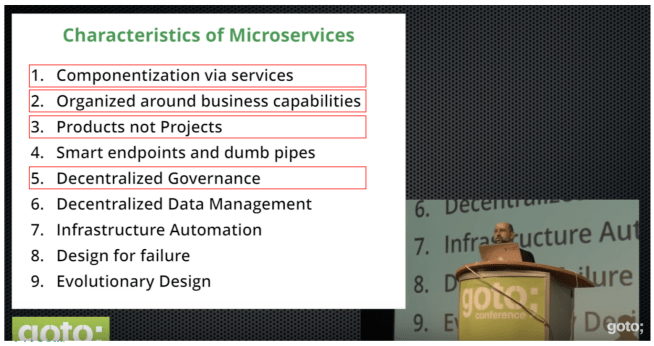
Martin Fowler came to my rescue to give the fundamental principles in his ‘goto conference’ speech on Microservices.
The key attributes of a product are the same as the one Martin Fowler used to describe his microservice.
Componentization: A component is a unit of software that is independently replaceable and upgradeable.
Organised around business capability: The microservice approach to division is different, splitting up into services organized around business capability
Products not projects: a team should own a product over its full lifetime. The product mentality ties in with the linkage to business capabilities. Rather than looking at the software as a set of functionality to be completed, there is an on-going relationship where the question is how can software assist its users to enhance the business capability.
Decentralised governance: One of the consequences of centralised governance is the tendency to standardise on single technology platforms. Experience shows that this approach is constricting – not every problem is a nail and not every solution a hammer.
So, after looking at the definition of a product and the characteristics of a microservice and with the approach of Lean Startup, I came up with the below understanding of a product.
The answer to ‘Why?’
The answer to why scaling became an issue is because the products were not decomposed properly. The above principles can be decomposed to the below snippet.
A solution can be classified as a product if
It provides benefit to the market (Problem – Solution Fit)
It is independently replaceable and upgradable
Even if
It exists within another product
If it is part of the same engagement/project
And should
Be organised around business capability
Provide decentralized governance
If the product is not decomposed, it will result in
Loss of context
Team feeling directionless
Erosion of practices
Releases feel bloated
Tools become roadblocks
Practices don’t feel like they can scale
The answer to when?
The next question to address is when to begin decomposing so that we avoid the issue of scaling. I want to use the nomenclature of Lean Startup to drive this point. The first point is when you reach the problem – solution fit.
Decision Point#1: Problem – Solution Fit
Criteria
How many problem – solution sets are there?
Does solution can constitute a separate product?
Next Steps
Prioritise one problem – solution fit
If both the problems have to be started and can be started, then start them as two different teams
If both the problems have to be started and cannot be started because of dependencies, then identify the right pre-conditions for starting the second product stream
Decision Point#2: After each round of research
Criteria
Have we validated a new problem altogether?
Do we need to solve this problem now?
Next Steps
Kickstart another stream of work
Highlight the reasons to start this as a separate stream
Decision Point#3: Product – Market Fit
Criteria
Have we validated the product – market fit through our MVP?
Do we need to scale to more problems?
Next Steps
Kickstart another stream of work
Run them as separate teams if possible
The answer to ‘How?’
The high-level approach to decomposing a product to form multiple sub-products involves three key components
Timeframe or Duration of the activity
Structure of the backlog
Structure of the team
Here is a simple flow which can be used to determine how to decompose a product.
The idea is to determine the answer to the key questions.
Do I create a product?
Do I spin off a separate team?
What should that team look like?
How much coordination is required?
When the product is decomposed this way, it results in multiple small teams. The teams should balance team autonomy and intrateam collaboration. The governance for this will be the minimum needed to keep the balance going.
Unlike most of my blogs, I want to construct this one around creating a conscious model for positive change. It will not be far from the truth to say this title come from my anathema towards the modern feminist movement. However, I will try my best to go back to the first principles instead of the fundamentalist and reactionary form of feminism that is seen today. For the sake of this discussion I reducing the variability of discrimination to just one parameter. I am also assuming a dichotomy of genders here for the ease of argument. Using principles of Induction, I can then extend it an increasing number of parameters.
Principles
Women have the same rights as the men (Liberty, Equality and Fraternity)
Women have the same duty to the society as their male counterparts
Physiological and psychological differences are not parameters which can make one group superior over another across all vocations.
Facts
Irrespective of what individual communities and religions say, women have been discriminated against in the past.
Today, some communities are better and treating their women than others.
There are levels of mistreatment and their impact has to be differentiated. A perceived sexist remark is completely different from a rape.
Rules
Religion has formed the rules of the dominance hierarchy. I will not use either the religious rules or my prediction to define the current
I will avoid ad hominem attacks on any individuals
Someone taking offence is nobody’s problem
Constructing Women’s Rights from the principles
I now want to construct a set of rights from these principles, facts and rules. According to me, there are three critical women’s rights. While these three might look like something applicable to everyone, there are specific tenets in it which make it specific to this issue.
Right to control reproduction
Right to work
Right to defend
Right to control reproduction
Women have the right to control their reproductive cycle. This includes contraception and termination under due considerations. Any movement to prevent contraception or short term pills is just plain unscientific, immoral, stupid and authoritarian.
However, the two movements in this space have created a false dichotomy. They have hijacked the discussion. This is not a pro-life or a pro-choice debate. While the pro-life team is completely evil, they do have a point do you consider the being to have a life. Based on the view of the biologists, I see that as the early stage of the foetal development, which is 9 weeks after fertilisation. Prior to that, it is an embryo. The other reason I think this is right is that after this stage, the termination of pregnancy also poses a risk to the mother. This is not to say I do not think pregnancy should be terminated after. I believe we should show extreme caution after that. Some of the reasons for the termination of pregnancy should be.
Improper development of the foetus.
A risk to the mother’s life
Other untoward reasons like rape etc
There is also a reason for being careful post foetal development begins. It risks people checking gender before termination. Again, I want to reiterate, I say we have show restraint and caution after 9 weeks. I didn’t say we should never do it.
Right to work
For me, the right to work includes the following tenets.
Equitable pay and allowances
Right to respectful treatment (which should cover everyone, not just women)
Fair policies compensation for women’s contribution to the society. I consider women bearing a child as something that is critical for the survival of our species. In that instance, the society (Government or otherwise) should compensate the women adequately for the process.
I do not mean the below items.
Special privileges which cannot be shared with anyone else. For example, flexible work arrangements if possible should be available to all employees.
Unilateral policies which convict people before an investigation, even if they are in favour of women.
Right to defend
Everyone has the right to defend themselves, especially from physical attacks. However, women need additional privileges to be able to do this effectively. Here are the main reasons.
Women are attacked more often when any relationship breaks.
Women, especially single moms are more vulnerable to physical abuses
Women on the average are physically less strong than their male counterparts, so they need to have enough armour to defend themselves.
This right will encompass the below points.
Pre-emptive strike to defend their honour against an intruder or a prospective molester.
Train to use self-defence arms like handguns.
Ability to get licenced arms without hassles.
Why is a reset of this topic important
I plan to write another blog on the arguments around privilege which we need to avoid. However, there are the reasons why resetting has become very critical.
The term misogyny is used indiscriminately. It has become a smear attack now.
Feminism has gotten stereotyped and has become the monster it hated. A mother who wants to stay home for a few years to take care of her child is not an old-fashioned submissive woman. That is her wish. To force our wish on a woman is what brought about this issue in the first place.
Defending anti-woman practices cannot be feminism. I am seeing women defending practices like female genital mutilation, dowry, submitting to the wishes of the male partner under the name of feminism.
Neither has every male lived a privileged life nor has every woman lived a subjugated life. Historically different cultures had different forms of subjugation and discrimination. There is no effective mechanism to come up with a weighted average of the impact of intergenerational subjugation and discrimination on individuals. So, an open statement on privilege by the looks of a person is not going to help. The war against class-based discrimination in medieval Europe had only people of one race. Most of it was not gender specific as well.
I deliberately called the new version of feminism ‘angelic’. It should respect feminity, individual preference, responsibility while continuing to oppose the anti-woman practices in the society.
As I concluded in my previous part, privatisation of the temples is definitely a plausible option. There is a movement in India to free the Hindu Temples from the influence of the Government. I am completely in favour of this option albeit for a different reason. In this blog, I want to write about the movement, the reasons and my opinion.
The movement to free Hindu Temples from Government Control
This movement is to challenge the Hindu religious and charitable endowments (also called HR & CE). These government departments control the management of the Hindu Temples under their control. It all started with the Tamil Nadu HR & CE Act in 1959. Here are the arguments against these controls.
Hindu Temples are the only religious institutions which are under Government Control
The income from the temples goes to the government, thereby depriving the temple to get richer.
Hindu Temples pay more income tax than other religious institutions
Hindus are not allowed to manage their own religious affairs
Hindu Temples and their assets are allowed to be destroyed by HR & CE of different states
These regulations take away the constitutional rights of the Hindu groups to manage their own affairs.
There are plenty more but these are the main reasons. There are some factual errors in this but I want to highlight one of them. The constitution of India does give the state government rights to pass regulations like these as deemed appropriate. So, the acts themselves are not unconstitutional.
Why is this relevant?
This movement has been gaining momentum from the beginning of this decade. This has gained prominence with the Sabarimala case as the same people like J Sai Deepak are fighting for both. Their logic is simple. If they gain enough momentum towards this case, they can make it an election issue. If these acts are removed, then the Hindu temples will cease to be public assets. Therefore, the rules of the temple are similar to the rules of a private body.
They will not have the money power to run education institutions to push their agenda.
None of their rules can be termed discriminatory. They can prevent people from entering, from women to people of the Dalit communities.
This will drive towards their broader agenda to make India into a Hindu nation.
Why do I feel the government should not control temples?
I am a strong proponent of the separation of church(or temples) and state. If the state starts to involve itself in the management of religion, it soon has to take sides in religious wars. It also is obliged to protect the demise of these religions. Here are my reasons why I want the state out of the business of religion.
The state has a responsibility to government people according to the rule of the law and not on religion.
The civil code should be uniform and secular. For example, child marriages, dowry and polygamy should be prohibited irrespective of a religion.
All institutions (religious or otherwise) should pay their taxes. Religious institutions should not get charitable status.
The government should not give grants or aid for people to perform religious activities, from Amarnath Yatra to Hajj trips.
The government in a secular country has the responsibility to be neutral. It can’t take responsibility to build or destroy places of worship.
The government has a responsibility to keep education secular. Religious concepts can be taught in scripture classes but not science. Evolution cannot be an optional part of biology.
The constitution still has laws against discrimination which has to be deep.
In conclusion, I see this as a dangerous sign. The articles in magazines like Swarajya show how nuanced the arguments have gotten. Considering the history and breadth of beliefs and practices in Hinduism, one is bound to find contradictions in the scriptures. This has paved the way to the new fundamentalists who have come up with an approach which only be called death by a million nuanced cuts. This confusion results in people falling for their trap. The only way to expose their devious behaviour is by letting them take control and expose their vicious, cruel agenda. If you are a parent of a child, you need to be worried about these people. Here are the reasons.
Your child might be a homosexual. Imagine the plight of a homosexual in a society run by such people.
Your child might be growing in an increasingly polarised society where the caste system is controlling collaboration.
If you have a girl child, imagine her plight as she finds a partner in her life. She might be forced to live a life of mediocracy just for being a person of the female gender.
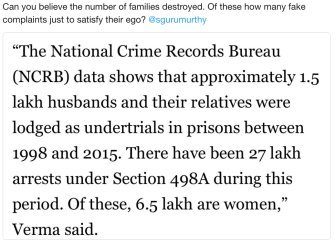
If anyone thinks, I am exaggerating I want to attach some proofs.
This message is extremely specific. It doesn’t say that any false complaint should be punished. If one has to be fair, they should also consider any perpetrator who has denied crime to actually get punished more. Further, the girl just complained. She didn’t provide the judgement.
This was another tweet by a Hindu Right winger on the impact caused by Section 498A which is the Dowry Act that criminalises dowry.
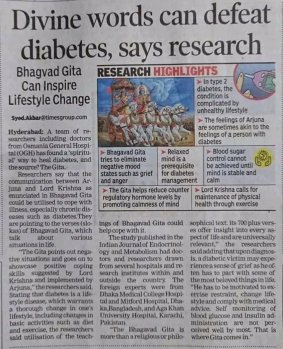
They want to spread fake medical research too.
These people are capable of defending anything under the name of religion. If you think they are good just because what they are saying now is in line with your beliefs, then think more they might be coming for you or your family next.
As mentioned in my previous blog, S Gurumurthy recently triggered a discussion on Twitter around the Sabarimala case. He was weighing in his opinion on how the legal system cannot be above faith. This is a director at Reserve Bank of India. It is intellectually boring to break down any analysis by S Gurumurthy. His opinion and bigotry can only be matched by someone like Steve Bannon from the US. However, the most acclaimed narrative has been produced by a Hindu apologist, J Sai Deepak. He is the best spokesman for the Hindu right wing and I want to take down his argument in this blog. I want to do this through the below parts.
The Sabarimala Case
Analysis of J Sai Deepak’s argument
Analysis of other arguments
Ready to wait
Blaming judgements for natural calamities
My Opinion
The Sabarimala Case
The core of this case is extremely simple. A bunch of people filed a case against women being barred from entering the Sabarimala Temple. The case was filed in 2006 and taken up by the Supreme Court of India in 2017. Towards that time a bunch of girls from Kerala started a movement called ‘Ready to wait’. This movement wanted to keep the status quo. The movement got traction and attracted some prominent religious and legal experts into the case. J Sai Deepak was one of the lawyers representing the ‘Ready to Wait’ movement. I can go on an on about de-mystifying the Sabarimala deity, Ayyappa but that is not of any significant benefit to this argument. Wikipedia provides a decent introduction on Sabarimala and Ayyappa. However, there are a few points I want to share, which adds some value to the case.
Difference between Ayyappa and Manikandan
As the legend goes, Manikanda(n) was a prince of the Pandalam dynasty. He is believed to have lived in the 12th Century BC. He is supposed to be an incarnation of the Hindu god Ayyappa. It is one short of a trinity, probably can be referred to as duality.
The belief is Ayyappa maintains celibacy
According to the belief of the people who run these temples, the deity Ayyappa wishes to be a celibate. The temple website mentions the below.
“As Sabarimala Ayyappa is ‘Nithya Brahmachari’ (celibate)women between the 10-50 age group are not allowed to enter Sabarimala. Such women who try to enter Sabarimala will be prevented by authorities. Only pilgrims who have observed Vrutham alone are allowed entry through the holly Pathinettampadi. They have to carry Irumudikettu (Pallikettu)also.”
Sabarimala is autonomous but under the Government of Kerala
The Sabarimala Temple is run by the Travancore Devaswom Board. Though the functioning of the board is autonomous, the members of the board are nominated by the state government of Kerala. The Travancore Devaswom Board website has the details. It is not a completely private institution. Further, they cannot have a constitution which contradicts the constitution of the country.
The judgement hasn’t come through on the case
There is so much noise around this subject but the judgement hasn’t been given yet. The court has reserved the judgement to a later date.
This wasn’t the first case on the subject
This case cannot be understood in full context unless we look into in the context of the judgement given by the Kerala High Court in 1991 in a case related to letting women entering the temple. After listening to the argument, the judgement was pronounced as below.
“The restriction imposed on women aged above 10 and below 50 from trekking the holy hills of Sabarimala and offering worship at Sabarimala Shrine is in accordance with the usage prevalent from time immemorial.”
“In the light of the aforesaid conclusions we direct the first respondent, the Travancore Devaswom Board, not to permit women above the age of 10 and below the age of 50 to trek the holy hills of Sabarimala in connection with the pilgrimage to the Sabarimala temple and from offering worship at Sabarimala Shrine during any period of the year. We also direct the 3rd respondent, Government of Kerala, to render all necessary assistance inclusive of police and to see that the direction which we have issued to the Devaswom Board is implemented and complied with.”
There was a similar protest to allow women to enter the Haji Ali Dargah. The women who fought for their rights won their case. The judgement was pronounced on 26 August 2016 when the Bombay High Court ruled that women could enter the Dargah. Though the Sabarimala case was filed a long time before, the Haji Ali Dargah case definitely has opened the floodgates.
J Sai Deepak’s argument can be divided into the below parts. There is so much mentioned about the veracity of this argument but I feel it only convinces people who are already convinced. I don’t think defending anything reprehensible should be praised as an act of bravery and skill. Anyway, I will deconstruct his arguments to see what makes sense.
Lord Ayyappa is a juristic person and has the liberty to do what he wants
This is a question of religious freedom
It is not a women’s issue
The court should not be imposing their views on religious practices
There are similar examples across other religions or other temples
I have given references to the argument presented by J Sai Deepak in the section below.
Lord Ayyappa is a juristic person and has the liberty to do what he wants
“Lord Ayyappa of the Sabarimala is a “juristic person” for the purposes of property ownership and taxes and hence, he equally has rights under Article 21 (protection of life and personal liberty), 25 (freedom to practice religion) and 26 (freedom to manage religious affair) of the Constitution.
The deity has the right to remain a ‘Naishtika Brahmachari’ (eternal celibate) and this was also part of the right to privacy of the deity, the will of the deity needed to be respected.”
It is true that Lord Ayyappa is considered a juristic person under the Indian Penal Code. According to law, the juristic person includes not only natural person (living) but also corporations, idols and even the dead people. However, Article 21 has an exception. When carrying out a procedure established by law, one’s personal liberty shall be deprived. So, Ayyappa has the right to remain an eternal celibate, as long as he stays lawful. The same is the case with Article 25, Ayyappa has the complete freedom to practice his religion.
However, the argument is completely mute. Sabarimala is not owned by Lord Ayyappa. The place is owned and operated by Travancore Devaswom Board for the person named Lord Ayyappa. Lord Ayyappa can walk out and sit inside his private property. At that point, he will have all the personal liberty he wants. As long as he is sitting inside a building owned and maintained by Travancore Devaswom Board it has to operate under Article 5 of the constitution. Travancore Devaswom Board is partially maintained by the State Government of Kerala and has constitution provisions.
Article 15 – 2 (b) the use of wells, tanks, bathing ghats, roads and places of public resort maintained wholly or partly out of State funds or dedicated to the use of the general public.
The proof that the board is funded by the state is in Article 290A of the Indian Constitution.
290A. A sum of forty-six lakhs and fifty thousand rupees shall be charged on, and paid out of, the Consolidated Fund of the State of Kerala every year to the Travancore Devaswom Fund; and a sum of thirteen lakhs and fifty thousand rupees shall be charged on, and paid out of, the Consolidated Fund of the State of 1 [Tamil Nadu] every year to the Devaswom Fund established in that State for the maintenance of Hindu temples and shrines in the territories transferred to that State on the 1st day of November, 1956, from the State of Travancore Cochin.
So, this argument is a non-sequitur.
This is a question of religious freedom
Now, let’s look at Article 26 of the Indian Constitution which outlines religious freedom.
26. Subject to public order, morality and health, every religious denomination or any section thereof shall have the right— (a) to establish and maintain institutions for religious and charitable purposes; (b) to manage its own affairs in matters of religion; (c) to own and acquire movable and immovable property; and (d) to administer such property in accordance with law.
This is a plain conflation of concepts. Every religious denomination has the right to manage their own affairs in matters of religion. However, matters of religion come under the law. Supreme Court is not ruling against rules of Hinduism. However, the rules of Hinduism have to come under the legal code. For example, if my religion asks me to perform a cruel operation on a newborn resulting in the death of the baby, it will still be classified as murder. Right to manage your religious matters doesn’t mean a right to discriminate. Either way, the usage of this clause is meaningless in the context of an individual called Lord Ayyappa.
Now, coming to the definition of Naishtika Brahmachari. Naishtika Brahmachari means celibacy till death. How do women entering the temple take away the celibacy of the Lord Ayyappa? According to Hindu scriptures (Smritis), a naishtika brahmachari is supposed to live under the supervision of his guru. This means he owns nothing and lives by begging. Can you think of someone begging and a male offering them food in the olden days? Also, this rules of Lord Ayyappa owning the place. Now there is another famous naishtika brahmachari in Hindu mythology, Lord Hanuman. I don’t think he avoids seeing women. The Supreme Court of India is not changing the definition of the word by any means.
It is not an issue of discrimination against women.
This is laughable. I am not sure how you can say that women who are capable of having a child cannot enter the temple and still say it is not an issue of discrimination against women.
Further, the point mentioned was “The women have been respecting the tradition for a long time now and this is not a case of temple versus women or men versus women”. Now women have also been respecting Sati for centuries. That doesn’t make the sati an acceptable practice.
The other point made is, “The issue of exclusion of women was not based on the notion of purity and rather dependent on facts like celibate nature of the deity which has been preserved for years”. This is completely false. How do I know? Prayar Gopalakrishnan, the president of the Travancore Devaswom Board has done the job. His quote says everything that needs to be said in this regard.
“These days there are machines that can scan bodies and check for weapons. There will be a day when a machine is invented to scan if it is the ‘right time’ (not menstruating) for a woman to enter the temple. When that machine is invented, we will talk about letting women inside.”
The court should not be imposing their views on religious practices
The next point by J Sai Deepak is that the court and others should not be “superimposing” their social views on the temple which has stated its position “loud and clear”. He followed that with the below point.
“Tomorrow somebody can say that he would like to offer chicken as ‘prasadam’, can such an offer be entertained and the rules of religion and the God cannot be changed.”
This is an argument from emotion than logic. Let us look at the first point here. The court should not be superimposing their social views on the temple. This is completely incorrect. The temples come under the jurisdiction of the Indian Constitution and any views that they have which are against the constitution will be challenged. A temple, for example, cannot preach discrimination or violence. It is against the law. Temple is within a jurisdiction of a legal entity. It is cyclic fallacy if you use the same law to argue that the temple is above law.
On the second point of offering chicken as ‘prasadam’, there are laws protecting such actions. For example, one cannot say that by allowing women to enter mosques, pigs can also enter the mosques next. This is a hasty generalisation fallacy. It also commits an argument from analogy.
There are similar examples across other religions or other temples
The last of his argument was that there are other such practices which continue. The example used is throwing of babies outside the Baba Umer Dargah, Solapur Maharashtra. It is worth noting that the National Commission for Protection of Child Rights has already banned the practice. It still continues to happen illegally because such people are idiots. Further, the fact that A is wrong and still happens. Therefore, B is wrong should also be allowed to happen is not a logical argument. If he is trying to trigger a divide between Hindus and Muslims in this case, then it is worth noting that there are Shiva temples in the same area which do the same ‘Throwing Baby’ act.
Overall, his complete narrative is an argument from incredulity. There is no logic to it apart from trying to strike an emotional chord with his co-fundamentalists.
Analysis of other arguments
I also want to list other arguments presented in this case.
Argument by K. Radhakrisnan
A Senior advocate K Radhhakrishnan, appearing for the Pandalam royal family, referred to the concept of morality and said that the constitutional morality cannot override the private morality in cases of religious practices. This is completely wrong. Morality is the principles concerning the distinction between right and wrong or good and bad behaviour. As seen in Wikipedia, morality is the differentiation of intentions, decisions and actions between those that are distinguished as proper and those that are improper. Constitution fundamentally does that. Most religious moralities allow you to own and trade people as slaves. The constitution gives you the right to think and speak freely. It is your right to not want to exercise it. Morality, however, is how you behave with the society in that context. Private morality is a meaningless construct in that case. It is a deliberate conflation of the definition of the word morality. I am assuming he meant liberty. Even with that, I have already shown that the argument is flawed.
Argument by Abhishek Manu Singhvi
Abhishek Manu Singhvi is a lawyer and a Member of the Parliament in India. It is outrageous to see him defend unconstitutional practices.
Defending the Sabarimala tradition in the Supreme Court, advocate Abhishek Manu Singhvi on Tuesday told the bench that there are temples in the country where even men are not allowed. He added that a court cannot be invited to give a finding that a tradition or belief is not of antiquity without the evidence being examined in a trial. Arguing for the Travancore Devasom Board which administer the sabarimala temple, Singhvi also argued that there are hundreds of traditions practised buy dozens of faiths in India and it is not possible to bring them all under definition of Constitutional morality. “Even in Mosques across the country, women are not allowed,” said Sighvi. He added that the test under articles 25 and 26 was not whether a particular practice was right or wrong but whether it was a bonafide belief practiced for centuries by a community.
His first point of men not being allowed is fundamentally allowed under the constitution of India. This is the same reason why you have women-only compartments in trains but don’t have it for me. Article 15-3 of Indian Constitution says, “Nothing in this article shall prevent the State from making any special provision for women and children.” So, women can have such special privileges. There are 8 such temples in India. His second point should comfortably be the worst of the lot. Since there are too many traditions, we should not bring them under the constitution. I wonder what is the purpose of a constitution or legal system in such a situation. I wonder if he is calling for anarchy in a court of law. And finally, I have already discussed the articles 25 and 26 above. So, I am not going back to it.
Ready to Wait argument
There is something about this campaign which invites mockery. The premise of the ‘ready to wait’ campaign is utterly stupid. While it is a cool hashtag, it is meaningless. No one is forcing these women to not wait. Even if the judgement allows women to enter the temple, it doesn’t force these women to enter. It is not a mandate. They can wait. I am surprised, people can’t see the stupidity in these arguments. It is also pretty ironic that the parent organisation is called ‘People for Dharma’. I wonder the context in which they are using the word ‘Dharma’. It could mean righteousness, rule, law or cosmic order. Do they mean, the rest of them are for ‘Adharma’? This is the callousness seen in some movements like ‘Pro-life’, like anyone who opposes it is ‘Anti-life’. You don’t need a right to wait in a democracy, just like you don’t need a right to stay hungry or right to shave your head.
I was subsequently proven right by the nature of the arguments posed by the people propping up this campaign. Here are a few.
“If you don’t wish to believe in Hindu deities and their stories/legends, then don’t. But this sudden interest in destroying millenia old traditions in the name of “rights” is becoming absurd. Would you, for instance, support my right to eat pork inside a mosque? Religious places are not public places.”
“Sati, triple talaq, child marriage are social customs. #Sabarimala temple’s tradition is based on Shastras. Not a ‘SOCIAL’ issue. Devotees coming out with #ReadyToWait declaration. Women don’t intend to allow atheism win over Bhakti.”
“I respect my traditions, therefore will never visit Sabarimala before the right time for me. Feminists should leave us alone.”
I sometimes wonder how far and deep the termite of misogyny has spread. Now women want to become their torchbearers. I want to just highlight a few points.
Destroying traditions under the name of rights is not absurd. Traditions have to be questioned in any civilised society. The Hindu Sastra (Manusmriti) highlights the role of a woman to be subservient to her male guardian.
You do not have a right to eat anywhere. It doesn’t say that in the constitution. You don’t have the right to kill a lion as well.
Shastras are social issues. Hindu Sastras call for discrimination of people based on various factors. I wish she reads a bit more before making a fool of herself in public.
Feminists are not forcing anyone, especially these people to go to the temple. No one is forcing anyone to enter. People are fighting for the right to enter a temple here.
It is not surprising to see this line of argument. In 1934 there was a report submitted to the Maharaja of Travancore on allowing lower caste Hindus to enter the Sabarimala Temple. I have given an excerpt from the report (as I read it from another source) below. This was called the ‘Temple Entry Committee Report’. I have provided more links in the references section.
“Exclusion from temples, not always the result of the excluded class being considered inferior to others. It is based on a belief that the approach of certain people is likely to derogate from the spiritual atmosphere surrounding the pratishtha, the deity installed in the temple. A large body of (high-caste folk) believe, on the basis of the (scriptures), that the entry of the (low) into (their) temples would cause defilement of the temples…and there will be no efficacy in the worship or rites performed in them.”
As it can be seen, this line of argument is not uncommon with the people running the temples and the people practising these beliefs.
Blaming judgements for natural calamities
Religious fundamentalists have always been guilt tripping judiciary when it has promoted equal rights against the will of their religions. The evangelicals in the past have blamed Hurricanes in the US, the attack on WTC, the earthquake in Haiti and even the 2011 tsunami in Japan to gay rights. Now the Hindu right in India has taken over the same approach. They are pressurising the judiciary into think there is somehow a connection between the judgement and the floods in Kerala. However, they are using a multi-pronged approach for this. There are volunteers on the ground who are helping the flood victim. This builds the goodwill. Then, there are people who drive local movements drawing the connection. They evoke the causation versus correlation conundrum in people. Finally, there are people who attack the judiciary. It is a good strategy only if everyone else is an idiot.
My Opinion
I am not a fan of religious reforms. When people talk about reforming a religion, all they do is add another flavour of the religion essentially twisting some elements of the religion to make it more palatable to the society. If the religions adapt to the social changes, then they do not perish. So, we leave the next generation to fight this evil construct. Morality has always come at the expense of religion and not because of religion. Religion has successfully collected the social morals of a time and encompassed them in their system. However, morals evolve as people learn more. If religions are allowed to move their goalpost we can never get rid of this evil.
At the same time, I am not sure about the need for any self-respecting woman to enter the temple premises after knowing how they are being discriminated against by the system. Unless they do it to annoy the establishment, I can’t think of a valid reason to enter. For that reason, I can’t think why any woman would want to be religious. No religion ever gives a woman equal right.
I want the Supreme Court of India to give the Travancore Devasom Board two options. The fundamentalists fighting for the right of the Lord Ayyappa like J Sai Deepak want the first option while the people who are contesting them want the second. I feel the court should provide both the options to the board and ask them to take a call.
Option #1: Become a completely private entity by leasing the area from the Government. This means
Lost their charity status
Pay taxes like a private institution
Lose government protection
Still under Indian Constitution and Legal system
They would run like a theme park. They set their rules. However, this requires a constitutional amendment.
Option #2: If they want to operate in its current fashion then
Allow women of all ages to enter the institution
No discrimination against any community, gender or sex
On a different note, I wish tax rebates for all religious institutions should be removed. When a cab driver or a car mechanic has to pay one’s full due of taxes why should religious institutions get a free pass?
Nothing obliterates a civil society more than its despicable treatment of women. The traditional conservative societies have moved from enslaving women to whining about their freedom to now claiming to have been an embodiment of women’s liberties. Not only have they not done anything to liberate women but also are intentionally obtuse to distract everyone from their devious intentions. The theocratic societies across the middle east and south Asia exemplify this behaviour.
The case in the Supreme Court of India to allow women to enter the Sabarimala Temple and the reactions aftermath stands a testimony to the new wave of religiosity. S Gurumurthy, the journalist and one of the directors of RBI tweeted about the possibility of the connection between the Kerala Floods and allowing women to enter the Sabarimala Temple. The sad story of the Indian culture is that this is a mainstream opinion. I want to address this in three parts.
I want to wrap this up with my opinion on how to take on the theocratic bullying we are witnessing.
The stigma and trepidation around menstruation
The deep-rooted misogyny in the Indian Culture was always covered up by traditions. I have already written about the culture of rape in the country. The discrimination against menstruating women is the ugly domestic secret of the Indian society. For a seemingly developing society with a high percentage of college graduates, it is rather ironic to see their belief in superstitions. The culture is obsessed with the women’s vagina and what comes out it. Anyone who thinks the previous statement is gross or a massive exaggeration is either an ignoramus or a charlatan. I am sure that everyone from an Indian Hindu family has seen treatment of women during their mensuration. I will call out some of the most common practices.
Menstruating girls and women are
not allowed in most religious functions and temples.
not allowed inside the kitchen
not allowed to touch anyone in the house
not allowed to go near the place of worship inside the home
not allowed to use the same dishes as the rest of the members
As a young girl child, one is made to feel scared, ashamed and even disgusted with what is happening to their body. I have personally witnessed this in well educated upper middle class families growing up in a city. The situation is worse in villages and other remote areas. While every culture across the globe had these superstitions, not all cultures have equally come out it. Education has especially done a lot to get most societies out of it. But the Indian society seems to have a unique status where a very educated family finds it acceptable to follow these prejudices. What is worse, they have upgraded to new reasons for why these practices are valid. I have heard a few Hindu religious scholars say some of the below reasons.
The radiation from the body is so intense that people should not come near menstruating women.
This sounds scientific, doesn’t it?
God cannot withstand the energy from women during those times.
I am assuming they have some weak god.
To prevent men from getting attracted to women during those times.
This assumes men have no control. If they mean religious men like themselves, then I suggest we cage men when their wives go through this. I will be more than happy if men actually took care of their wives during those times.
Women get extremely angry during those times.
I want to see the reaction in a man bleeding for three days.
The most ridiculous reason I heard was that people married their daughters at a very young age those days only to avoid these questions. As you might see, none of these actually have any moral value. There is no way a humanist or a secularist will every present such an argument. This irrational bullying is the superpower of the theocratic community. Most women who have grown up being subjugated with these practices have a trepidation at the possibility of questioning these practices.
There is also a line of argument that Hinduism or what the fundamentalists like to call Sanatana Dharma worships menstruation. The examples quoted are the Kamakhya Temple in Assam and the Bhagavathy Temple in Chengannur in Kerala. It is counterproductive for people to bring this up as neither of these temples actually allow menstruating women to enter.
As I have mentioned before in my earlier blog, the systemic misogyny in India is too deep and too well spread. The problem is that defendants of the misogynic practices now are becoming more mainstream and taking a more nuanced stand. The main case which is highlighting this is the case of allowing women to enter the Sabarimala Temple.
As a product manager have you faced the question, “Why are you deprioritising design?” from your designers? If yes, then it is a symptom of a broken process. You are probably facing at least one of the below issues.
Your product delivery value stream is not lean. There is a disconnect between the design and the execution.
Your MVP is not delightful. This means your product is looking to be functional without being usable and delightful.
For the purpose of this blog, I want to look at the first issue as the second one is easier to deal once we handle the first.
The concepts of lean, customer-centric design and team collaboration have existed for decades now. However, I still see companies struggle to put them to practice. So, most of what I say is going to be well known from a theoretical standpoint. The theory suffers to give people tools to identify when practices are corroding the intent. I will take an example to drive my point here.
The ‘every product’ story
Eric and Evan are the founders of a startup which develops products to educate people in the field of psychology. Their latest in that list is an online quiz product. Jim is the product manager of the product and Joan is the product designer. Both Jim and Joan are avid practitioners of lean product management and customer-centric design. Who is going to argue against both those concepts? At least, Eric and Evan are not going to do that.
Through their research, Jim and Joan have validated the need for the product and tested the solution through their product. Eric and Evan were very happy with the designs they saw. The mockups had 4 screens.
Signup
Select a test
Take the test
View results and post them
The designs had fancy breadcrumbs which will help the customers navigate. Now, Joan’s role in the team was reduced to support the engineers with the designs needed. Jim, on the other hand, decides that the MVP is just a set of questions and answers on the same page. This will give him learning on framing of the questions and structuring. It eliminates all the features on the screens which don’t address this problem. It also merges the steps 3 and 4 given above. The team follows the best practices of agile software development to deliver a good working software.
Joan looks at the output at is not impressed. She feels her work has not been respected. It opens up a lot of disgruntlement. She goes to Jim and asks the million dollar question “why have you deprioritised design?”.
What happens next is called damage control in corporate terms. Eric and Evan are involved in discussions with Jim and Joan. After discussions, they will invariably reach one of the below conclusions.
Joan will be asked to stay quiet and respect the role of PM. Jim takes the call.
Eric and Evan (as sponsors) will take a call balancing Jim and Joan wishes. They reach a settlement between Jim and Joan.
Jim will be told that Joan has the full control of the design. From now onwards, Joan will be the gateway for design. The design will go through her review before it goes to the customer.
I have been Jim, interacted with Jims and Joans and have also seen the legacy of Jim and Joan in a company. Waterfall design using the customer-centric design techniques and agile delivery seems to be the latest amongst the smart-stupid mistakes in the product development space.
Does any of the above three points actually solve the issue? No, almost never.
Is it the fault of either Jim or Joan? No, it is a collective failure. From the individual vantage point, they might look right.
So, why did this happen and how to address this?
Mistakes made
Mistake #1: Why did we design those screens?
The first mistake made is to design those four screens. They solved multiple outcomes.
The customer can take a quiz to see the result
The customer can choose a quiz to take
The customer can signup so that they can get the result over email
The customer can post the result
Which is the most important point outcome to solve? If Jim’s answer to this is the first, then Joan and Jim should have collaborated to solve for just the first one. Once Joan has solved for all four and shared it, it is hard to take something out.
Mistake #2: Why did we move the designer to a support role?
The designer is an integral part of the team. By moving them to of the core product team, their role is reduced to support. This leaves them in the capacity of either a powerless contributor or a powerful gatekeeper. Either of these two is not collaborative.
Mistake #3: Why is the team not aligned on MVP?
The team is not aligned on the MVP. Assuming the first two mistakes have already happened, it is paramount to have got an alignment on the MVP and the resultant impact on the design. This means the designs reflect what needs to be done for MVP, the MVP is shared with the sponsor and validated with the customer.
Mistake #4: Why were the symptoms addressed instead of the cause?
None of the three proposed solutions has actually addressed the core issue in the process. Eric and Evan should have reflected on how they reached this stage and fix the cause instead of addressing the symptom.
Learnings
Here are my learnings from this approach.
Learning #1: Solve for one problem at a time
Identify the outcomes which have been validated, then prioritise the outcome which has to be solved. The prioritisation, though a product management function is best done as a team. The designer can solve for the prioritised outcome.
Learning #2: Easy to add features than remove
Even while solving for one problem, it is important to think if the features are important for achieving the customer outcome in question. It is always easy to add features later than removing something which has been done.
Learning #3: Design to a team is just as vital as development
The design is how the product helps achieve the customer outcome. So, the designer becomes a vital part of the team. It is always strange that even the team claiming to be extremely agile, always end up having designer outside or even outsourced.
Learning #4: There is no alternative to team alignment
Teams have to be aligned with the goal and the outcomes they are trying to achieve. If the three critical functions (product management, design and development) are not aligned, then the decisions are going to drive discontent and inefficiency.
My friends asked me whom do I call stupid. Considering my loathe to stupidity, they wanted to understand my model. Here are my 10 criteria for identifying a person as stupid. Two questions for you. How many do you disagree? What percentage of the world do you think fall under this group?
Anyone who thinks the earth is flat or universe was created 5000 years ago.
Anyone who looks at the evidence and turns the other side to say my belief is the truth
Anyone who thinks that they have a divine commandment to impose their will on others or discriminate against them
Anyone who preaches against contraception or the empowerment of women
Anyone believes they are superior by the accident of birth
Anyone who is expecting logic to prove the non-existence
Anyone who wants to procreates indiscriminately
Anyone who acts like the reason for all their problems is someone else
Anyone who wants to take the world to the values from the Bronze Age civilisations
Anyone who looks at a new scientific evidence and claims that their faith encompasses those evidence.
So far the answer to these questions has been
Agree: 100% Population percentage: 80% approx
I feel there are two main reasons why it is hard for people who agree with the above facts and still not able to distil it.
The erosion of the premise that the majority of the people are not decent and not stupid is beyond their realm of acceptance. It shakes the foundations of camaraderie and kinship.
People have friends and family who fall into this category. It creates a cognitive dissonance when they have to deal with the two. It is hard to call someone you love, adore, respect as stupid.
The one point I keep telling myself is reality and as an extension truth has no obligation to be to my liking. It is for me to stare, admire and feel challenged.
I am definitely looking to convert this into a model and introduce a dangerousness coefficient based on it. I will definitely update the blog after that.
Muthuvel Karunanidhi (fondly called Kalaignar) died on 7th August 2018 at the age of 94. His death brings to end the generation of people who saw the transformation of politics in Tamil Nadu through the Dravidian movement. The Dravidian movement in Tamil Nadu which spread to most parts of India was the Tamil version of ‘New Deal‘. In my mind, it was also a movement that anticipated and prevented a massive civil war between the North of India and the South. Muthuvel Karunanidhi was one of the key architects of this deal. I do not want to write this as a Tribute as I do not revere or worship him as an individual. I want to intertwine my adulation of the Dravidian movement with his contribution.
For many like myself, Karunanidhi or Kalignar was a writer, an activist, a politician and an orator par excellence. The millennials and the brainwashed caste addicts of Tamil Nadu might have a different viewpoint from mine. For his detractors, Karunanidhi was also a typical politician, a hypocrite, a pseudo-atheist, a corrupt leader who was charged with both bribery and nepotism. I want to acknowledge these facts. Karunanidhi is definitely guilty of nepotism, corruption, self-indulgence and in some instances abetting political crimes including murder. However, I also see a partisanship in some of his detractors. His detractors mostly support others who do the exact same mistakes. Irrespective of what one thinks of him, his impact on the political arena in Tamil Nadu cannot be overstated.
The Dravidian movement started with the formation of the Justice Party which was predominantly non-brahmin elites. However, it wasn’t until EV Ramasamy and Annadurai joined hands did the movement get any direction and traction. Actor turned politician Kamalhasan rightly pointed out that the people who led the Dravidian resurgence movement during the mid-twentieth century were actually the men of the hour. The situation was ripe to fight the status-quo. However, someone has to still fight the battle. I want to highlight a few critical aspects of the movement.
Revolution through literary arts
The early Dravidian movement also created a resurgence of Tamil literary arts. The beauty in the words of Annadurai, Kannadasan and Karunanidhi captivated and mesmerised the readers. They used the performing arts sectors like stage plays and movies to gravitate people towards this renaissance of Tamil Literature. Their ability to combine revolutionary ideas with humour and realism was mindblowing. Annadurai’s Velaikari, Oru Iravu and Karunanidhi’s Kagithapoo, Thookkumedai were stage plays which transformed the field of their times. They harnessed the power of literature to send a message that resonated with oppressed classes. Their philosophy resonated with women, people belonging to discriminated castes and working communities. It was a movement to emancipate the communities. There is also a part of me which feels for their speeches not becoming as famous as the ones of Dr Martin Luther King Jr, even among the Tamil speaking people of today. I fear more know about ‘I have a dream’ than the words of Annadurai.
Fight without destroying the democratic fabric
Most of the revolutions of their times destroyed the democratic fabric of the society. When the Dravidian movement started gaining momentum, India and with that Tamil nation had recently obtained the rights of self-determination from the British. While the movement in its early stages was definitely separationist, it was never non-democratic. Annadurai was always in favour of contesting elections and winning the hearts and minds of people. This brought him at loggerheads with his partner E.V. Ramasamy.
Just for history, E.V. Ramasamy affectionately called Periyar and Annadurai, parted ways firstly on India gaining Independence from British Rule. Periyar felt that being ruled by the British will be better for the oppressed castes and Annadurai was fundamentally opposed to that. Annadurai was for the rights of the people federate and self-determine. Annadurai broke from the parent organisation Dravidar Kazhagam to form Dravida Munnetra Kazhagam, a political movement which later became a political party.
While Freedom from aliens was ringing in the air, the Dravidian community wanted freedom of identity. Post Independence, the Madras Presidency or the State of Madras was ruled by the Congress Party under Chakravarti Rajagopalachari. Much like what Periyar feared, South of India also referred to as Madras State was ruled by Brahmins and people in support of the North Indian rule. The imposed learning Hindi and caste-based vocational training. The Dravidian movement opposed the status-quo. However, they didn’t do it by going out of the systems. It was never a call to move out of the social democratic structure being set up. It was a call for national identity and federated powers without destroying what worked.
Project the federated nature of the Indian union
As I mentioned in my previous point, the movement was a call to federate the country. Surprisingly, the rejection of the federal structure was the primary reason behind the creation of both Pakistan and Bangladesh(East Pakistan). Jawaharlal Nehru wasn’t the one to relinquish the powers. He had a vision with him in the lead. It was much like Lee Kuan Yew of Singapore. Once people get a sense of freedom, it can be addictive and dignifying. The underrepresented communities of India started to call for federation. The Dravidian movement called for a separate Dravidian state. The central government under Jawaharlal Nehru had to give up its powers to keep the Indian Union intact. The process continued to reorganise states on a quasi-linguistic basis.
Once the Indian Union federated its structure, the Dravidian struggled continued to fight for identity and representation. The ruling members didn’t represent the culture, views and aspirations of the people. The Dravidian movement was a correction phenomenon. It was a correction which intended to
Fight for the Right to self-determine for the ethnic Dravidians
Fight against the mandatory learning of Hindi as a second language and move focus to learn the native languages
Fight against the rule of the minority Brahmin community
Fight against the educational system promoting caste-based vocational training
Non-violent rationalism
I am neither a pacifist nor a Gandhi follower. However, I appreciate a non-violent struggle where appropriate, especially in a democratic setting. The Dravidian movement started as a movement for rationalism in a non-violent fashion. It is true that there were elements of violence by some members, but the movement overall didn’t have strands of extremism. Their brand of rationalism encompassed secular pluralism and individual liberty. It utilised freedom of speech, expression and protest to drive the philosophy. I have to appreciate their approach.
In conclusion, I want to pay my respects to the literary works of a great writer in a language I love and hold dear. I will wrap up by sharing his words.
“வீழ்வது நாமாக இருப்பினும், வாழ்வது தமிழாக இருக்கட்டும்.”
Even if he has disappeared into eternal solitude, the words of Kalaignar Muthuvel Karunanidhi and Annadurai will remain with the Tamil lovers for generations.
“தனிமை போன்ற ஒரு கொடுமையும் இல்லை; அதைப்போல் ஒரு உண்மையான நண்பனும் இல்லை.”
The one word which has been removed from the social vocabulary over the last few decades, especially in West is the ‘N word’. There weren’t any regulations against it but people just stopped using it. No one even respects an individual who uses that anymore. I do know that it is still used in some countries like India and Singapore but overall no one uses it anymore as it has become devoid of any utility.
Keeping the tradition of George Carlin’s ‘ Seven Dirty Words’, I want to share seven words of no social utility in 2018.
Racist
Fascist
Nazi
Free speech crusader
Skin colour(Black activist, brown man, white supremacist)
(Native, African, Asian, European, Indian) American
Islamaphobe
Let me address one point before I take this forward. I do not think there aren’t fascists or racists or Nazis but these words have baggage which is not applicable for a conversation in 2018. Now, I want to go through each word and share why I feel that way. I feel the main reason behind the continuous use of these phrases is that these were some of the important phenomena of the twentieth century that affected people’s lives.
Racist
This term has lost its utility because of two key reasons.
It is only used against white people and that too quite indiscriminately. I have never seen it used against people of Chinese, Indian or African origin. I have seen just as much racism in these cultures as the rest.
The term has become so abused that we are failing to distinguish between people who are really racists or in some instance genocidal against normal people with whom we disagree.
Fascist
Just like racism, I am seeing this term being used against everyone. Many democratically elected leaders from Barack Obama to Donald Trump have been called fascists. Fascism as defined as “the radical authoritarian ultranationalism, characterized by dictatorial power, forcible suppression of opposition and control of industry and commerce“. Any pro-democratic leader cannot be called fascist.
Nazi
Similar to Fascism, National Socialism is a movement defined by the ideology of the Nazi party. The term was coined towards the end of the 18th century. Again not every socialist is a Nazi and not every racial supremacist is a Nazi. It is a significant attack on an individual when you call them a Nazi. It is one thing to call someone a Nazi sympathiser but a leap of irrational faith to call them Nazi. The movement doesn’t exist but for certain pockets. Above all most of them are banned. Even organisations like KKK are not Nazi organisations.
Free speech crusader
This is my pet peeve for this list. I am tired of unintelligent people gaining attention because they referred to themselves as a free speech crusader. I haven’t seen many free speech crusaders in my life. I most definitely don’t see any now. Most of them (even some people I like) like Sam Harris, Jordon Peterson, Douglas Murray, Maajid Nawaz, Bill Maher, Milo Yiannopoulos and Dave Rubin to name a few become free speech activists when
Something doesn’t offend them but there is a general furore around it
Something they say offends people and there are protests against it
Something someone says that they like and there are protests against it
Quoting George Carlin, narrow and selfish interests don’t impress me. I find such crusades to be repugnant just as the people whom they fight.
Skin colour adjectives(Black activist, brown man, white supremacist)
I find this particularly annoying when people refer to others with their skin colour. However, there is a particularly annoying stereotype in this as well. It is never a Black or a Brown Supremacist and a White activist. It is always the other way around when you use the skin colour adjectives. Furthermore, it is always used by people who are against racism. It is meaningless and above all counterproductive. I also want to differentiate this from people who are comfortable in a neighbourhood of a certain ethnicity. There is nothing wrong with a bunch of people of a certain ethnicity to want to live in the same neighbourhood. It is not racism or bigotry. Also, people like to speak certain languages or live in a certain way. If a bunch of vegan people decide to form a colony and live there, it is not an issue for me. Even if they think that vegans are the best and there should be a country for vegans, I am still fine. Where it becomes a problem is when they infringe on other’s right to exist or live their life a different way. If I replace vegan with white or black or brown, the core of the argument still remains the same. This makes any description of a bunch of people using their skin colour counterproductive to the broad argument that we want to make.
Native, African, Asian, European, Indian American
This one is definitely an American trait. I particularly love the response of Gérard Araud, France’s ambassador to the United States to comedian Trevor Noah’s comment on calling the World Cup winning French Football Team as ‘The African Team’. He said, “Unlike in the United States of America, France does not refer to its citizens based on their race, religion or origin. To us, there is no hyphenated identity. Roots are an individual reality.”. This was followed by people calling French as not a culture for comedy or failure to call people. It does shed light on this rather unintelligent practice of calling people from where they come from and mostly based on their skin colour. Barack Obama was called African American but he was born to a Kenyan father and an American Mother. While he does have a part of his ancestry from Kenya the other part is from England. Calling him African American is both inaccurate and unnecessary.
Islamaphobe
The final one in my list is a recent kid in the block, a 20th creation which can be thrown anywhere in a conversation without it actually adding any value. There are two main reasons why I find this descriptor particularly useless. This word is used in two circumstances.
One religious group who hate the other
Fear of terrorism
In the first point, there is no need for a special word for hatred towards a certain religion. There is no word for hatred towards Buddhism, Jainism, Hinduism, Christianity etc. Anti-Semitism, on the other hand, it not just hatred towards Jews based on their existence, it is hatred towards Jews coming from certain religious constructs within Christianity and Islam against Judaism.
On the second point, it is a genuine problem. Most of my Muslim friends are afraid of terrorism. If calling out against radicalisation and terrorism is bad, I am not sure what is good. So, this usage is also meaningless. Actually, I feel we should rename this to “Terrorphobia” and acknowledge that it is practical.



 Demystifying a skeptic's world